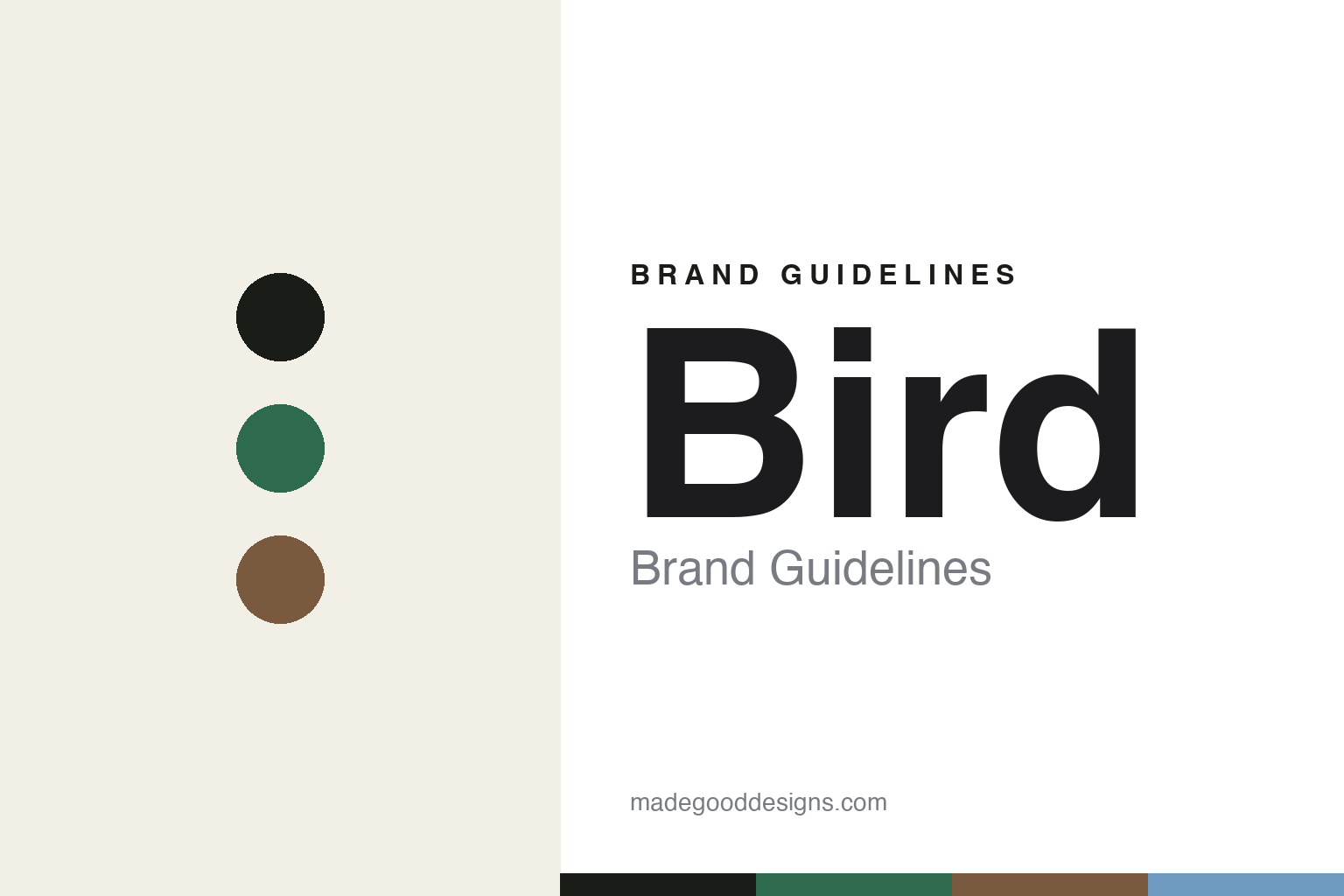
Bird Brand Guidelines
From nature, for nature.
Aa
Two constants: a forest-and-bark palette and a humanist sans register. Abstract homage — not the Bird identity.
From nature, for nature
Bird made its material the whole identity.
Bird is a lesson in material as identity. Founded in 2017 in Exeter, Devon by three brothers — Ed, Paul and Lawrence Bird — it is an independent, founder-run eyewear brand, and the first UK eyewear company to become a B-Corp (certified 2020, described as the highest-scoring in the global eyewear industry).
Its identity is eco-material and circular. Bird makes frames from its proprietary bio-acetate “Plantix” (plant-cellulose, plant-based dyes, roughly half the CO₂ of petroleum acetate), plus FSC-certified wood (maple, beech, sandalwood, bamboo) and recycled/repurposed aerospace aluminium, with cases from recycled waste. The design philosophy is circular — repairable, recyclable, low-carbon — carried by taglines like “From nature. For nature.” and a “Share Your Sun” partnership with SolarAid (solar lights in Zambia and Malawi).
(Honest notes: Bird was founded in 2017 in Exeter — not 2015, not Glasgow — by the three Bird brothers. Its B-Corp status is current and first-in-UK. The signature material is its own “Plantix” bio-acetate. The identity is in-house — no external studio is documented — and there’s no official brand hex, so these tones are an unofficial interpretation.)
Colour
Bird lives in a forest-and-bark palette. Click a swatch to copy the hex.
Bird’s identity is natural, warm and grounded — an ink, a forest, a bark, a sky, and a cream. The palette reads like a woodland — forest green and bark brown under an open sky — the register of a nature-first, material-led brand. It signals honesty and the outdoors rather than gloss. The honest caveat: with no published brand hex, these tones are an original, unofficial interpretation, not first-party values.
The lesson is forest green and bark brown signal a nature-first, material-led brand. Bird’s world is a woodland rendered in acetate and wood. For designers, it is a reminder that earthy, natural colour reads as honest and grounded — right for a circular, eco brand. The takeaways: source the palette from nature; let the material lead; keep it warm and grounded; and treat any single hex as unofficial.
Typography
The register is a humanist sans — warm, honest, forward-looking.
Bird’s identity carries a warm, honest, forward-looking spirit — natural materials and a circular promise. A humanist sans captures the mood: it is friendly and clear, the register of a nature-first brand. Set in a forest-and-bark palette, the humanist sans feels warm and honest — exactly the personality Bird carries. It is forward-looking rather than nostalgic, mirroring “think forward.” (Bird’s real wordmark and frames are works we describe but do not reproduce, and the exact typeface is not ours to use.) Because it is not ours to use, the honest description is “a humanist sans spirit,” shown here in a stand-in. The type behaves like the brand: warm, honest and forward-looking.
Aa
A humanist sans spirit — warm and honest. (Specimen set in Lexend, a humanist sans STAND-IN; NOT the Bird identity.)
Material as identity
Bird stands for what its frames are made of.
Bird is a lesson in making the material the identity. A forest-and-bark palette, a humanist sans and a circular philosophy make the material the whole brand — natural, honest, low-carbon. The material is the differentiator. The differentiator is a Plantix-bio-acetate, B-Corp identity.
For designers and brand-builders, Bird offers a clear takeaway: let what it’s made of be the story. The lessons: invent or own a real material (Plantix); certify the values (B-Corp); design for circularity (repair, recycle); and give back (Share Your Sun). It is also a reminder to stay accurate: it was founded in 2017 in Exeter by three brothers, and the palette here is an unofficial interpretation. Bird made the material the brand — proof that substance can be the difference.
Explore & save
Keep Bird’s identity on hand — save it to a board in the Made Good inspiration library.
Bird identity set
Pin the forest-and-bark palette and the humanist-sans register to your own board.