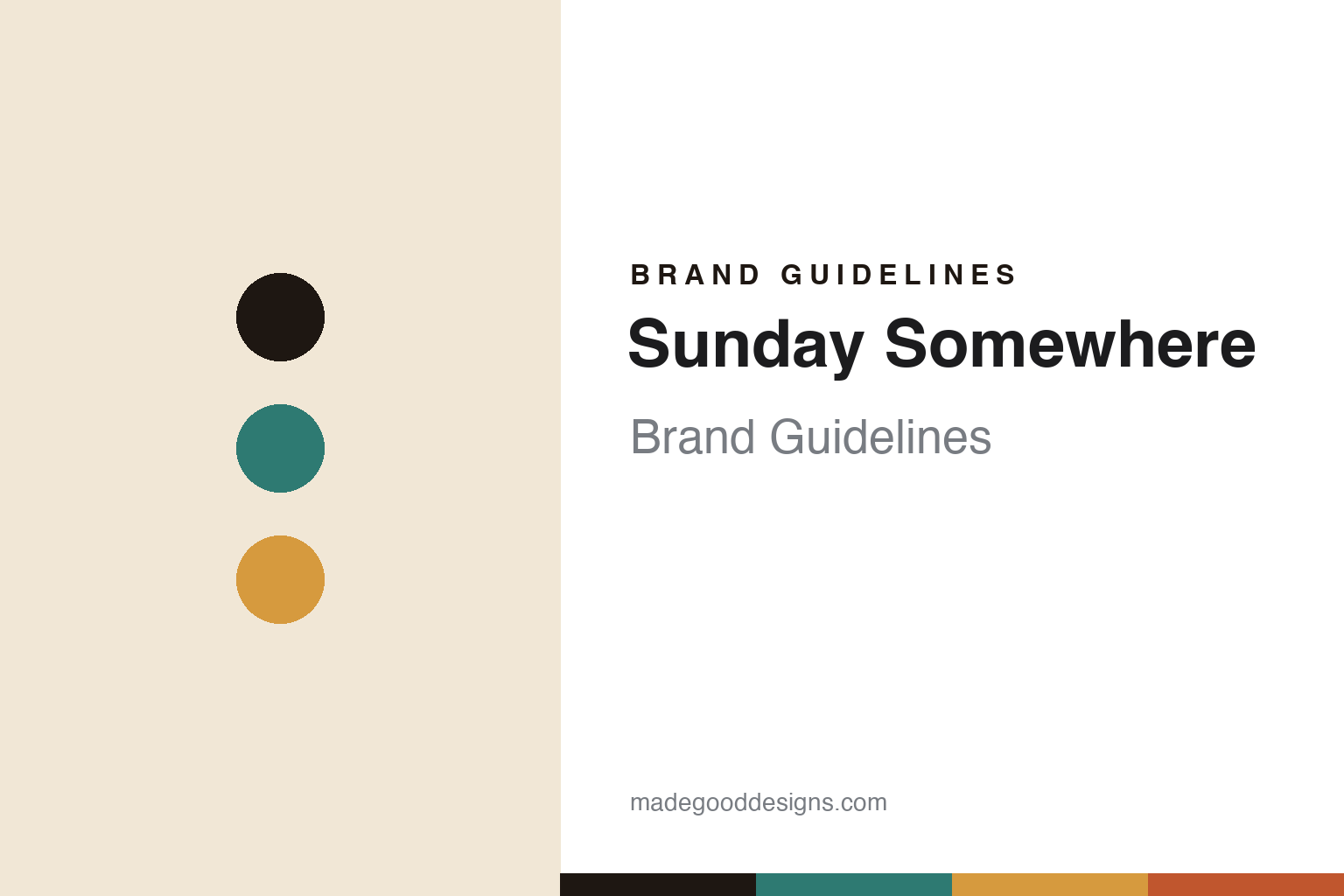
Sunday Somewhere Brand Guidelines
Under the Australian sun.
Aa
Two constants: a teal-and-mustard palette and a retro sans register. Abstract homage — not the Sunday Somewhere identity.
Under the Australian sun
Sunday Somewhere reworks 70s glamour with Japanese craft.
Sunday Somewhere is a lesson in an era as an identity. Founded in 2010 in Sydney by eyewear designer Dave Allison — “under the Australian sun” — it is an independent brand now expanding across North America through a 2025 distribution deal, with a sun launch slated for 2026.
Its identity is 1970s-inspired glamour: bold, oversized, curvy, “fun and uninhibited” frames that blend vintage shapes with modern detailing. The substance backs the style — Italian Mazzucchelli acetate, a premium collection made entirely in Japan, Carl Zeiss lenses and German OBE spring hinges with gold detailing. A genuine A-list trail (Beyoncé wore the gold “Charlie”; Rihanna, Lady Gaga and Anne Hathaway followed) cemented the fashion-forward register.
(Honest notes: Sunday Somewhere was founded in 2010 (not 2011) by Dave Allison — not “Wendy Yang.” Its premium line is made in Japan with Italian acetate, so it isn’t “Italian-made throughout.” We don’t repeat an unverified “Soft Blink hingeless” claim — it uses visible German hinges. The identity is founder-led, and there’s no official brand hex, so these tones are an unofficial interpretation.)
Colour
Sunday Somewhere lives in a teal-and-mustard palette. Click a swatch to copy the hex.
Sunday Somewhere’s identity is warm, retro and glamorous — an ink, a teal, a mustard, a rust, and a cream. The palette pairs a 70s teal with warm mustard and rust — the register of sun-soaked, vintage glamour. It signals fun and nostalgia rather than restraint. The honest caveat: with no published brand hex, these tones are an original, unofficial interpretation, not first-party values.
The lesson is a 70s teal with mustard and rust signals sun-soaked glamour. Sunday Somewhere’s world is a bold frame in warm light. For designers, it is a reminder that a retro, sun-warmed palette reads as fun and glamorous — right for a brand built on a decade. The takeaways: pick an era and commit (the 70s); pair a cool anchor with warm accents; back the style with real craft (Japanese-made, Zeiss lenses); and treat any single hex as unofficial.
Typography
The register is a retro sans — warm, glamorous, sun-soaked.
Sunday Somewhere’s identity carries a warm, glamorous, sun-soaked spirit — 70s shapes and Japanese craft. A retro sans captures the mood: it is characterful and confident, the register of vintage glamour. Set in a teal-and-mustard palette, the retro sans feels warm and glamorous — exactly the personality Sunday Somewhere carries. It is nostalgic rather than austere, mirroring bold, oversized frames. (Sunday Somewhere’s real frames and wordmark are works we describe but do not reproduce, and the exact typeface is not ours to use.) Because it is not ours to use, the honest description is “a retro sans spirit,” shown here in a stand-in. The type behaves like the brand: warm, glamorous and sun-soaked.
Aa
A retro sans spirit — warm and glamorous. (Specimen set in Kanit, a retro sans STAND-IN; NOT the Sunday Somewhere identity.)
An era as identity
Sunday Somewhere stands for the 70s, made now.
Sunday Somewhere is a lesson in making an era the identity. A teal-and-mustard palette, a retro sans and 70s shapes make sun-soaked glamour the whole brand — warm, bold, fashion-forward. The era is the differentiator. The differentiator is a 1970s-glamour, Japanese-made identity.
For designers and brand-builders, Sunday Somewhere offers a clear takeaway: own a decade, and back it with craft. The lessons: commit to an era (the 70s); make the frames bold and joyful; and let real substance carry the style (Mazzucchelli acetate, Japanese making, Zeiss lenses). It is also a reminder to stay accurate: it’s a 2010 Dave Allison brand, made in Japan, and the palette here is an unofficial interpretation. Sunday Somewhere made an era the brand — proof that a decade can be the difference.
Explore & save
Keep Sunday Somewhere’s identity on hand — save it to a board in the Made Good inspiration library.
Sunday Somewhere identity set
Pin the teal-and-mustard palette and the retro-sans register to your own board.