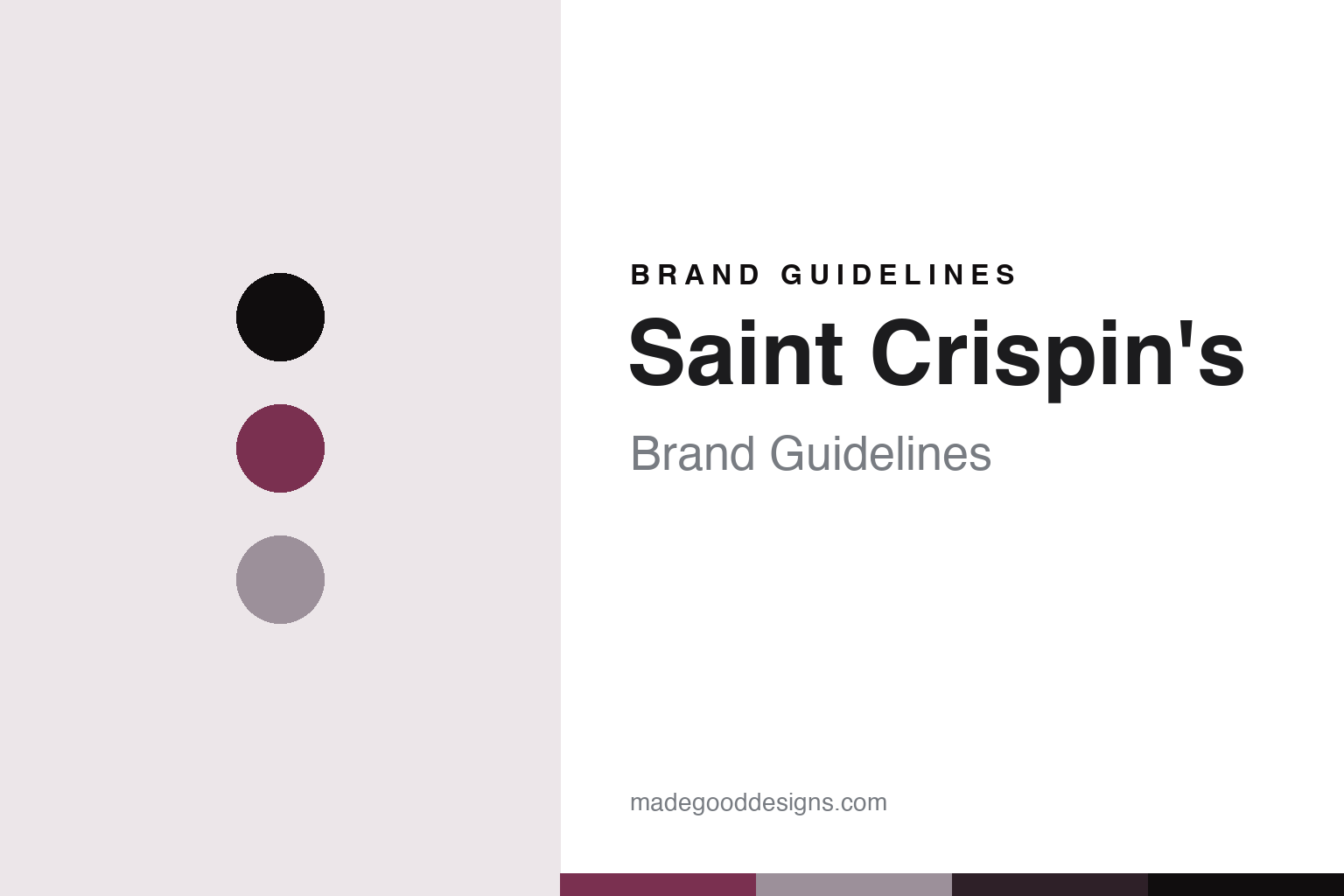
Saint Crispin’s Brand Guidelines
The Vienna-designed, Romania-made welt.
Aa
Two constants: a craft-plum palette and a craft-sans register. Abstract homage — not a Saint Crispin’s shoe, last or wordmark.
The Vienna-designed, Romania-made welt
Saint Crispin’s is a tiny high-craft house, hand-welted and made in Brașov, Romania, designed and registered in Vienna.
Saint Crispin’s is a lesson in how a house lasts by staying tiny and hand-made. It makes hand-welted shoes — the welt sewn by hand, the highest-craft version of the construction — in a small Romanian workshop, capping output at around fifteen hundred pairs a year. Its answer to how a house endures is scale: stay small, keep the hand-work, and never grow past what the hands can hold. A welted shoe kept rare on purpose.
Its identity is the hand-welted shoe, made small in Romania. Saint Crispin’s hand-welting, its Brașov workshop and its capped output are the work it is known for. A craft, kept deliberately scarce. A house that lasted by refusing to scale.
(Honest notes, so the story stays precise, because its geography is often muddled. Saint Crispin’s shoes are genuinely made in Brașov, Romania, by a small workshop of around twenty-eight people producing roughly fifteen hundred pairs a year — so Romania is where the craft happens. Its founding and design side is Austrian: the name was registered in Austria in 1992, its origins run to about 1985, and it keeps a Vienna office and showroom where designs are developed. So we call it a Vienna-designed, Romania-made house, and we do not describe it as Austrian-made, Vienna-made or Italian-made. Its construction is hand-welting, as the brand states, not machine Goodyear welting. It is family-owned and independent; the original founder is not named on its own site, so we do not assert one. Its designs, lasts and marks are its IP, described but never reproduced, and there is no official brand hex — these tones are an unofficial interpretation. This is design commentary and does not promote any product.)
Colour
Saint Crispin’s lives in a craft-plum palette. Click a swatch to copy the hex.
Saint Crispin’s identity is craft-led, quiet and rare — a craft plum, an ink, a calf grey, an umber, and a chalk. The palette leans craft plum and grey: the register of a considered, hand-made object and a small workshop. It signals rarity and hand-work over volume. The honest caveat: with no published brand hex, these values are an original, unofficial interpretation, not first-party colours.
The lesson is a craft-plum palette signals a hand-welted, small-batch identity. Saint Crispin’s world is a hand-sewn, capped-output, Romania-made object. For designers, it is a reminder that a muted plum and a soft grey can carry a brand built on rarity — a restrained palette for a scarce object. Because these tones can fail as small text, keep type dark and let the colour live in the accents, palette and band. The takeaways: stay small; keep the hand-work; be exact about where you make; and treat any single hex as unofficial.
Typography
The register is a craft sans — plain, precise, understated.
Saint Crispin’s identity carries a plain, precise, understated spirit — a craft house, not a marketing machine. A craft sans captures the mood: clean, exact and quiet, the register of a small hand-welting workshop. Set in a craft-plum palette, the craft sans feels plain and precise — exactly the personality Saint Crispin’s carries. It is understated rather than loud, mirroring a hand-welted shoe. (Saint Crispin’s real designs and marks are things we describe but do not reproduce, and the exact typeface is not ours to use.) Because it is not ours to use, the honest description is “a craft-sans spirit,” shown here in a stand-in. The type behaves like the house: plain, precise and understated.
Aa
A craft-sans spirit — plain and precise. (Specimen set in Archivo, a craft-sans STAND-IN; NOT the Saint Crispin’s wordmark or any shoe design.)
The houses that lasted
Saint Crispin’s stands for lasting by staying small.
Saint Crispin’s is a lesson in how a house lasts by refusing to scale. A craft-plum palette, a craft sans and a hand-welted shoe make one thing — a rare, hand-sewn welt made in small numbers — the whole house: craft-led, quiet and rare. The hand-welt is the craft, and the capped output is the survival. The point is a genuinely hand-welted object, made in Brașov, by a house that kept its numbers small so the hands could hold the quality.
Put to work, the identity is deliberate scarcity as design. A house in this spirit would cap its output, keep the hand-work central, and be precise about where the craft actually happens rather than where the name was born. It would let being small be the point. A brand learning from it would see that deliberate scarcity is a durable identity — that a house making fifteen hundred pairs a year by hand offers something volume cannot — and that being exact, made in Romania though designed in Vienna, and hand-welted rather than machine Goodyear, is more honest and more compelling than borrowing a grander nationality. A brand learning from it would also decline to invent a founder it cannot name. It would treat the gap between where a name is registered and where the hands actually work as something to state plainly, since a customer paying for hand craft deserves to know the workshop that makes the shoe, not only the city on the box. The lesson Saint Crispin’s teaches is that scarcity, plus a real hand-craft, can hold an identity: the hand-welt gives it substance, and the small scale gives it meaning. The craft is the personality, and the hand-welted shoe is the proof.
For designers and brand-builders, Saint Crispin’s closes this round about the houses that lasted on the scarcity pole: stay small, and be exact about where the craft happens. The lessons: cap the output; keep it hand-made; locate the craft honestly; and never reproduce a protected design or invent a founder. It is also a reminder to stay precise: Saint Crispin’s is a tiny, family-owned, hand-welted house whose shoes are made in Brașov, Romania and designed and registered in Vienna — with the palette here an unofficial interpretation. Saint Crispin’s lasted by staying small — proof that scarcity can be the difference.
Explore & save
Keep Saint Crispin’s’s identity on hand — save it to a board in the Made Good inspiration library.
Saint Crispin’s identity set
Pin the craft-plum palette and the craft-sans register to your own board.