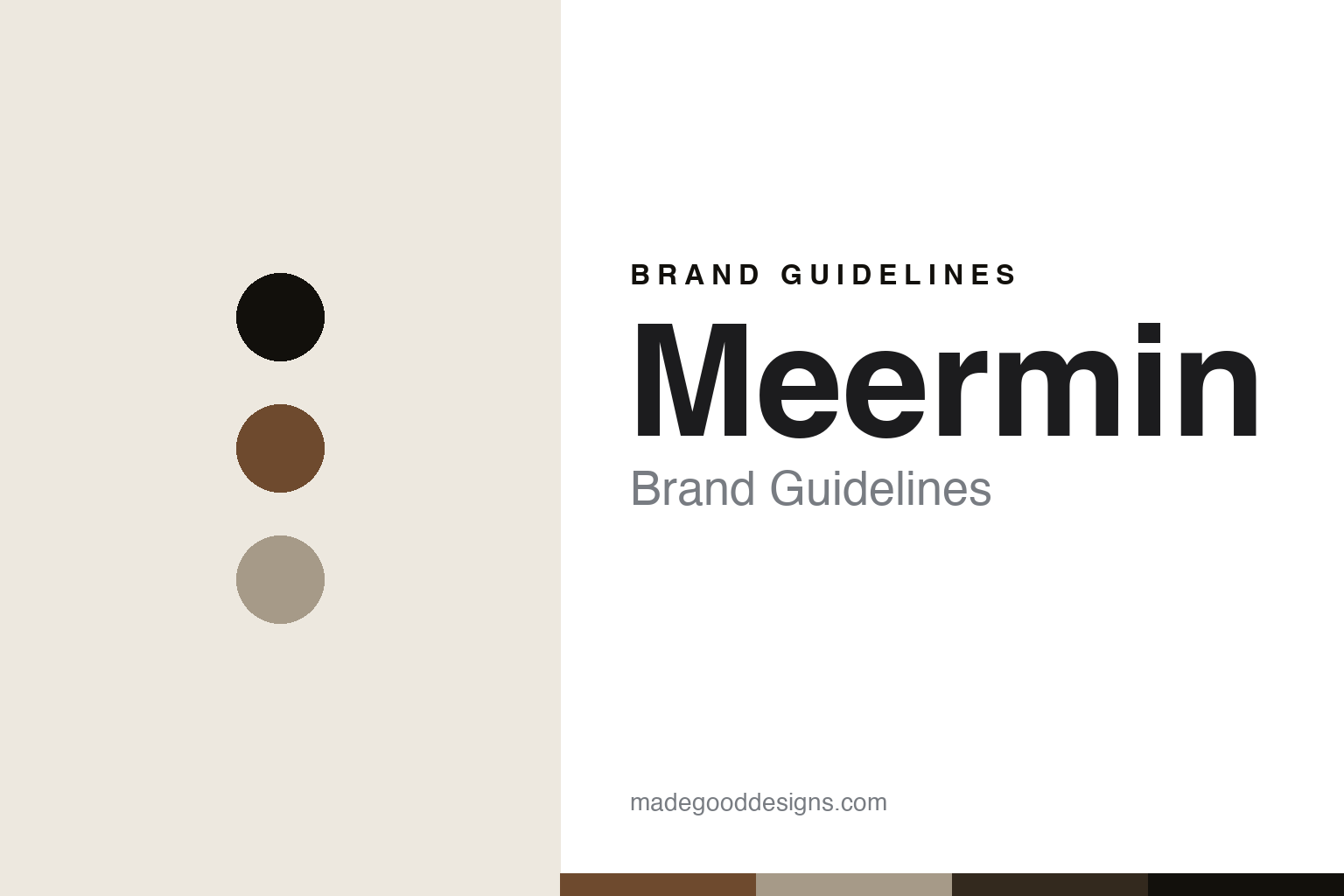
Meermin Brand Guidelines
The radical-price welt.
Aa
Two constants: a value-chestnut palette and a value-sans register. Abstract homage — not a Meermin shoe, last or wordmark.
The radical-price welt
Meermin is the Mallorcan family’s direct-to-consumer house, whose Goodyear-welted shoes hit a radical price by making value lines in China and premium lines in Spain.
Meermin is a lesson in how a new maker chases price honestly — through where it makes. A Mallorcan family runs it as a pure direct-to-consumer house, selling Goodyear-welted shoes at what it calls a radical price. Its answer to the modern maker’s question is a two-tier one: make the value line where it is cheaper to make, and the premium line where the craft runs deepest. A welted shoe whose low price is built into its geography.
Its identity is the radical-price welted shoe, made in two places. Meermin’s Goodyear welting, its direct-to-consumer model and its split production are the work it is known for. A method and a price, made a signature. A family that made entry-level welting affordable.
(Honest notes, so the story stays precise, because the geography is the point. Meermin is a Mallorca-based, family-owned, pure direct-to-consumer company, and its shoes are genuinely Goodyear-welted. Its price rests on a widely-reported two-tier model: its value Classic line is made in the family’s own factory in China, while its premium hand-welted Linea Maestro is made in Spain, in Mallorca — we report that split as widely documented rather than freshly confirmed. One honest observation: the brand’s current marketing foregrounds “Mallorca, Spain” and does not itself disclose the China production, so we note the gap between the marketing geography and the manufacturing one. The family — the Albaladejo family of Inca — is the same Mallorcan shoemaking family behind Carmina, covered elsewhere, but Meermin is a separate company, not Carmina’s budget line. Its founding year and founder are commonly cited but we hedge them as unverified. Its designs and marks are its IP, described but never reproduced, and there is no official brand hex — these tones are an unofficial interpretation. This is design commentary and does not promote any product.)
Colour
Meermin lives in a value-chestnut palette. Click a swatch to copy the hex.
Meermin’s identity is practical, direct and value-first — a value chestnut, an ink, a calf sand, an umber, and a chalk. The palette leans value chestnut and sand: the register of an honest brown dress shoe and a direct-to-consumer bench. It signals access and price over prestige. The honest caveat: with no published brand hex, these values are an original, unofficial interpretation, not first-party colours.
The lesson is a value-chestnut palette signals a welted, radical-price identity. Meermin’s world is a resoleable, direct-sold, two-tier object. For designers, it is a reminder that a warm chestnut and a soft sand can carry a brand built on price — the brown of an accessible shoe and the sand of the last. Because these tones can fail as small text, keep type dark and let the colour live in the accents, palette and band. The takeaways: sell direct; be clear about where each tier is made; keep the welt genuine; and treat any single hex as unofficial.
Typography
The register is a value sans — plain, clear, unpretentious.
Meermin’s identity carries a plain, clear, unpretentious spirit — a value house, not a luxury one. A value sans captures the mood: even, readable and honest, the register of a direct-to-consumer brand. Set in a value-chestnut palette, the value sans feels plain and clear — exactly the personality Meermin carries. It is unpretentious rather than grand, mirroring an accessible welted shoe. (Meermin’s real designs and marks are things we describe but do not reproduce, and the exact typeface is not ours to use.) Because it is not ours to use, the honest description is “a value-sans spirit,” shown here in a stand-in. The type behaves like the maker: plain, clear and unpretentious.
Aa
A value-sans spirit — plain and clear. (Specimen set in Manrope, a value-sans STAND-IN; NOT the Meermin wordmark or any shoe design.)
The new makers
Meermin stands for the radical-price welt.
Meermin is a lesson in how a new maker makes welting affordable. A value-chestnut palette, a value sans and a Goodyear-welted shoe make one thing — a genuinely welted shoe at an entry price — the whole maker: practical, direct and value-first. The welt is the craft, and the two-tier geography is the mechanism. The point is a real welted object sold direct, its price built on making the value line where it is cheaper and the premium line where the craft is deepest.
Put to work, the identity is a price strategy as design. A new maker in this spirit would sell direct, use genuine construction even at the entry level, and be clear about which tier is made where rather than blur it. It would let access — real welting that more people can afford — be the mission. A brand learning from it would see that a radical price, honestly built, is a powerful modern identity — that being the shoe that introduces people to welted construction earns lasting goodwill — but also that the one weak spot is transparency: foregrounding a Mallorca base while a value line is made in China invites the very confusion honesty would avoid. A brand learning from it would close that gap, naming both making places plainly. The lesson Meermin teaches is that a welted construction plus a direct, two-tier model can hold an identity: the method gives it substance, and the price gives it reach. The craft is the personality, and the welted shoe is the proof.
For designers and brand-builders, Meermin holds the value pole in this round about the new makers: sell direct, keep the welt genuine, and be transparent about where each tier is made. The lessons: cut out the middle; use real construction; disclose both making places; and never reproduce a protected design. It is also a reminder to stay precise: Meermin is a Mallorcan family’s direct-to-consumer house whose Goodyear-welted shoes hit a radical price through a China-value, Spain-premium split — with the palette here an unofficial interpretation, and its exact founding details hedged. Meermin made the radical-price welt the identity — proof that an honest price strategy can be the difference.
Explore & save
Keep Meermin’s identity on hand — save it to a board in the Made Good inspiration library.
Meermin identity set
Pin the value-chestnut palette and the value-sans register to your own board.