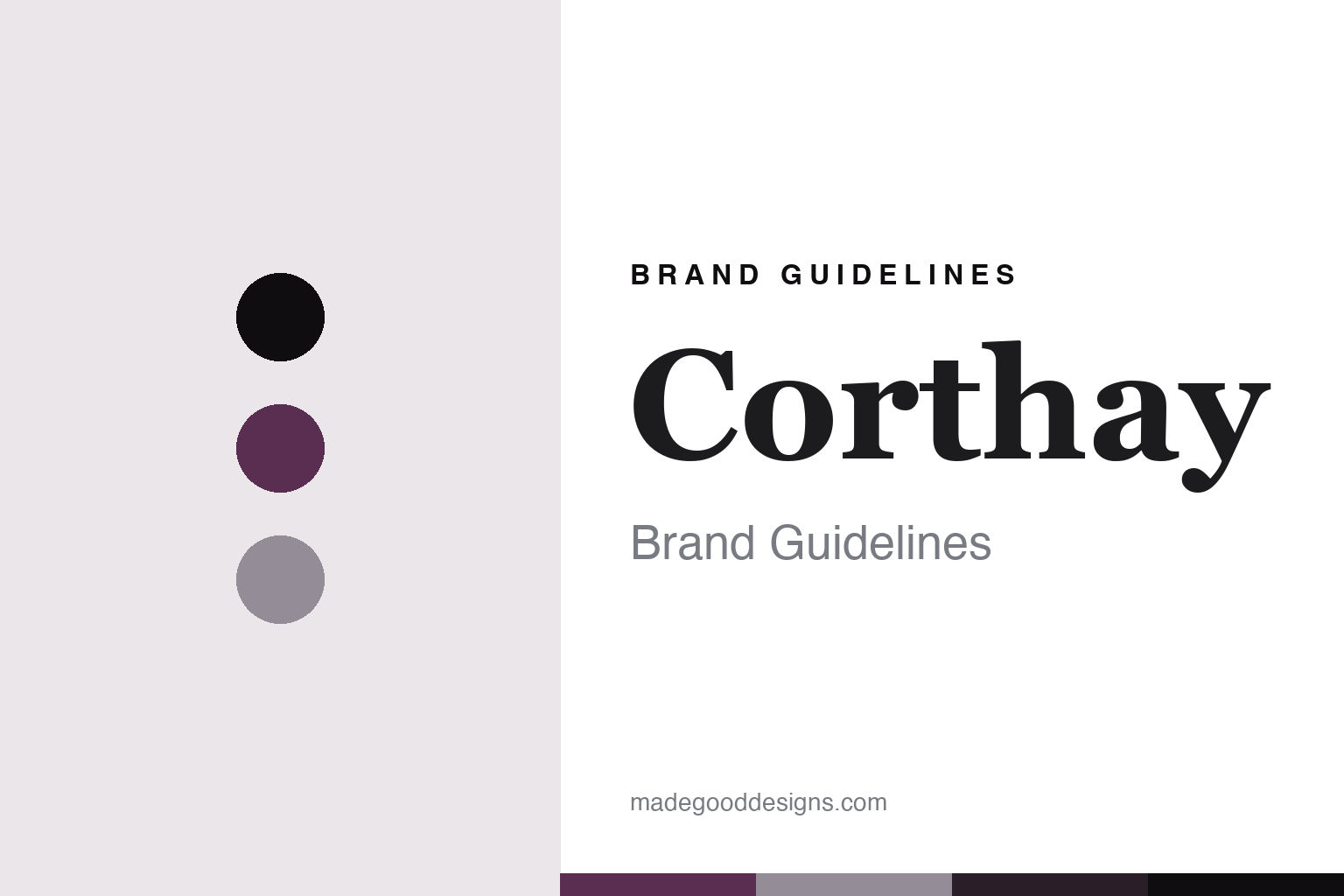
Corthay Brand Guidelines
The Parisian patina bottier.
Aa
Two constants: a patina-plum palette and a bottier-serif register. Abstract homage — not a Corthay shoe, patina or wordmark.
The Parisian patina bottier
Corthay is the Parisian bottier of Pierre Corthay, whose bespoke is hand-made in Paris and whose patina is its art.
Corthay is a lesson in how a bespoke house makes colour its signature. From its Paris atelier it makes bespoke shoes by hand and, on a separate French factory line, Goodyear-welted ready-to-wear — but what sets it apart is patina, the hand-applied colouring that turns leather into an artwork. Its answer to the bespoke bench is the finish: build the shoe, then paint it by hand. A bottier whose art is the colour.
Its identity is the Parisian bespoke shoe, hand-patinated. Corthay’s Paris bespoke, its French-made ready-to-wear and its patina artistry are the work it is known for. A craft and a colour, made a signature. A bottier founded by a master of the trade.
(Honest notes, so the story stays precise, about a living maker and an honest geography. Corthay was founded in 1990 by Pierre Corthay — who trained through the Compagnons du Devoir and worked at John Lobb’s Paris house and then as workshop chief at Berluti before starting his own — and we report his public craft record only. He was named a Maître d’art, a French Ministry of Culture distinction, in 2008; we do not call him a Meilleur Ouvrier de France, a different title we could not confirm. Its two tracks are honest to separate: bespoke is hand-welted in the Paris atelier, while its ready-to-wear is Goodyear-welted and made at a French factory in Beaupréau — not in Italy. Its signature is patina, a hand-colouring artistry, alongside its tapered Parisian lasts; the house is led today by a president who joined in 2010, and we do not assert any outside-investor story we cannot verify. Its designs, models and marks are its IP, described but never reproduced, and there is no official brand hex — these tones are an unofficial interpretation. This is design commentary and does not promote any product.)
Colour
Corthay lives in a patina-plum palette. Click a swatch to copy the hex.
Corthay’s identity is Parisian, artful and expressive — a patina plum, an ink, a calf grey, an umber, and a chalk. The palette leans patina plum and grey: the register of a hand-coloured leather and a Paris bottier’s bench. It signals colour and craft over restraint. The honest caveat: with no published brand hex, these values are an original, unofficial interpretation, not first-party colours — an abstract nod to patina, not any sampled colourway.
The lesson is a patina-plum palette signals a bespoke, patinated identity. Corthay’s world is a hand-lasted, hand-coloured, French object. For designers, it is a reminder that a rich plum and a soft grey can carry a brand built on colour — a patina tone and the grey of the last. Because these tones can fail as small text, keep type dark and let the colour live in the accents, palette and band. The takeaways: master the trade; own the finish; keep bespoke and RTW honest; and treat any single hex as unofficial.
Typography
The register is a bottier serif — elegant, French, expressive.
Corthay’s identity carries an elegant, French, expressive spirit — a master bottier, not a mass brand. A bottier serif captures the mood: graceful, high-contrast and artful, the register of a Paris atelier. Set in a patina-plum palette, the bottier serif feels elegant and expressive — exactly the personality Corthay carries. It is artful rather than plain, mirroring a hand-patinated bespoke shoe. (Corthay’s real designs, patina and marks are things we describe but do not reproduce, and the exact typeface is not ours to use.) Because it is not ours to use, the honest description is “a bottier-serif spirit,” shown here in a stand-in. The type behaves like the house: elegant, French and expressive.
Aa
A bottier-serif spirit — elegant and expressive. (Specimen set in Cormorant Garamond, a bottier-serif STAND-IN; NOT the Corthay wordmark, its patina, or any shoe design.)
The bespoke bench
Corthay stands for the patina as signature.
Corthay is a lesson in how a bespoke house makes a finish its identity. A patina-plum palette, a bottier serif and a hand-patinated bespoke shoe make one thing — a Parisian shoe coloured by hand — the whole house: Parisian, artful and expressive. The bespoke craft is the substance, and the patina is the signature. The point is a genuinely bespoke object, hand-made in Paris by a master of the trade, made unmistakable by hand-applied colour.
Put to work, the identity is a finish as design. A house in this spirit would earn the craft first — a real bottier’s pedigree — then own a distinctive finish, and be honest about which of its lines is hand-made bespoke and which is factory ready-to-wear. It would claim only the titles it holds. A brand learning from it would see that owning a finish like patina is a powerful identity — that colour, done by hand, can make a classic shoe an artwork — and that being precise, Maître d’art rather than an unverified MOF, Paris bespoke versus French-factory RTW, and no invented investor story, keeps the prestige credible. A brand learning from it would also separate the founder’s craft from the company’s management honestly. It would treat colour as a discipline rather than a gimmick, since a patina measured pigment by pigment is closer to painting than to dyeing, and that rigour is what lets a finish carry a house. The lesson Corthay teaches is that a bespoke craft plus an owned finish can hold an identity: the hand-work gives it substance, and the patina gives it art. The craft is the personality, and the patinated shoe is the proof.
For designers and brand-builders, Corthay holds the finish pole in this round about the bespoke bench: earn the craft, own a finish, and claim only what is true. The lessons: master the trade; own the patina; separate bespoke from RTW; and never reproduce a protected design or overstate a title. It is also a reminder to stay precise: Corthay is the Parisian bottier of Pierre Corthay, founded 1990, its bespoke hand-made in Paris and its Goodyear-welted RTW made in France — with the palette here an unofficial interpretation. Corthay made patina the signature — proof that a finish can be the difference.
Explore & save
Keep Corthay’s identity on hand — save it to a board in the Made Good inspiration library.
Corthay identity set
Pin the patina-plum palette and the bottier-serif register to your own board.