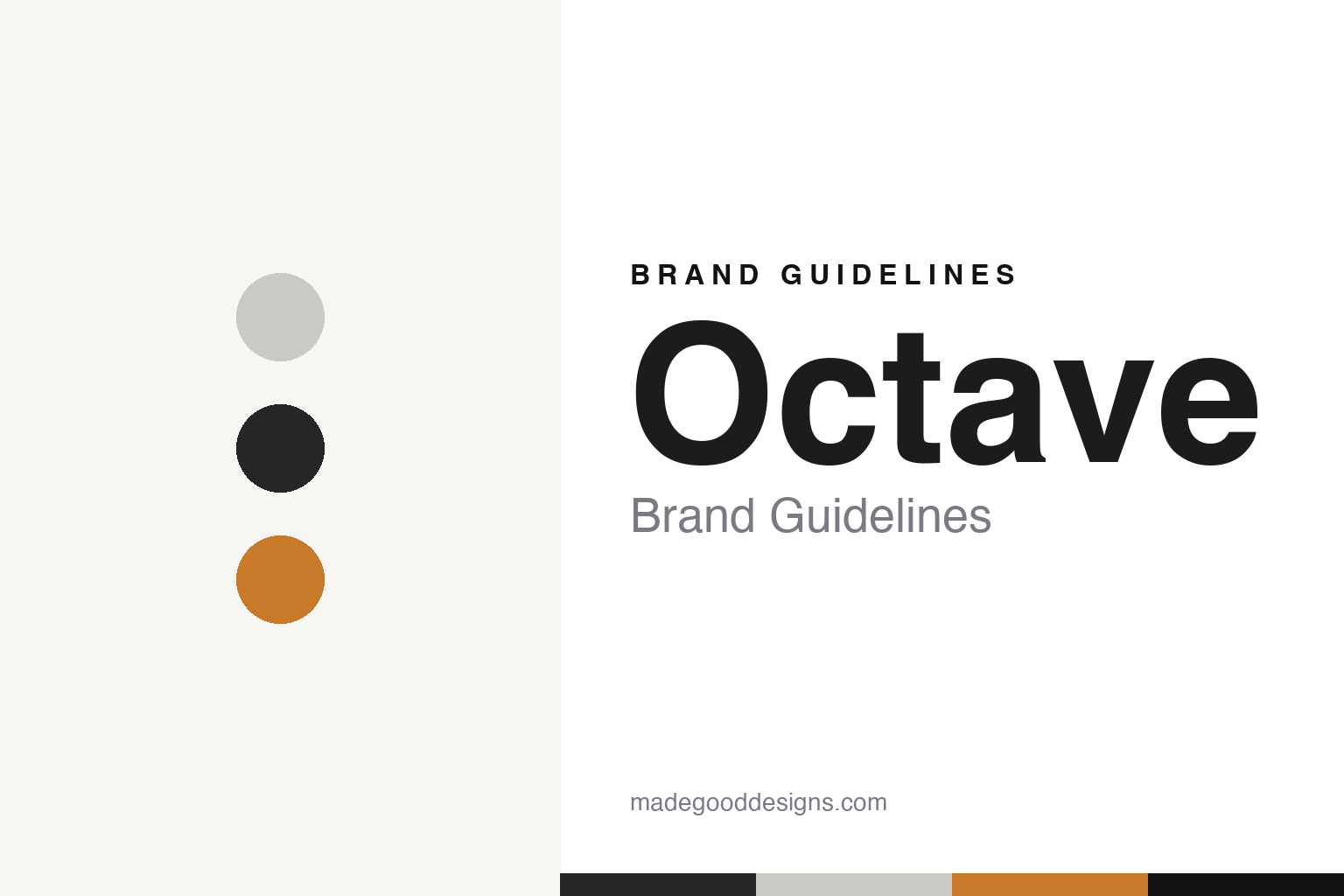
Octave Brand Guidelines
The Karlsbad valve-amplifier maker that winds its own transformers.
Aa
Two constants: a black, silver and valve-amber palette and a technical sans register. Abstract homage — not an Octave product or mark; no amplifier, logo or nameplate is reproduced.
The transformer works
A father’s winding shop and a son who preferred valves.
Octave’s roots are in transformers. The company’s English-language history says that in 1968 “Mr. Hofmann senior” founded a transformer-winding business, Hofmann, in Karlsbad, a municipality south-east of Karlsruhe on the northern edge of the Black Forest; its German site says sustainability and longevity have been its watchwords “seit 1968.” The founder’s son, Andreas Hofmann, began building amplifiers on both transistor and valve circuits in 1975, the company says, and in 1977 decided that the valve was “das musikalischere Bauteil” — the more musical component. His approach, as the company puts it, uses valves for the circuit stages that shape the sound and modern semiconductors for the power supplies and control circuits around them.
Sources differ on when Octave itself began. In a 2014 factory tour for SoundStage! Global, Doug Schneider wrote that the business “officially began in 1980.” Holger Biermann of the German site LowBeats, who said he relied on Hofmann as a source on valves when he joined AUDIO magazine in the early 1990s, wrote in 2025 that Hofmann turned his calling into a profession in 1988. Octave’s own timeline gives no founding year for the brand; it names 1986, when AUDIO published its first test of the HP 500 preamplifier, as the breakthrough.
The ownership has stayed in the family. The company says Andreas Hofmann took over the Hofmann firm as the sole proprietorship A. Hofmann, OCTAVE Audio and moved it to an industrial estate — in 2000 according to its English history, 2001 according to the German one. Its imprint today names “OCTAVE Audio Inh. Andreas Hofmann,” meaning Hofmann is the proprietor.
Colour
From the HP 500 to the Jubilee line.
Octave builds valve amplifiers and little else: preamplifiers, power amplifiers, integrated amplifiers, phono stages and add-on power supplies. Its timeline treats a few products as turning points. The HP 500 preamplifier stayed on sale, in successive versions, from 1986 to 2018, the company says. A 1992 AUDIO test of the smaller HP 200 brought Octave its first “Goldenes Ohr,” a readers’ award. The V 50 integrated amplifier of 1997, which the company calls an “ugly duckling” with a wonderful sound, was followed by the V 40, V 70, V 80 and V 110; the V 80 SE, launched in 2015 with KT150 output valves, was introduced by the company as its new flagship integrated amplifier.
At the top sits the Jubilee line, begun with a preamplifier in 1998 and joined by mono power amplifiers in 2003. The company says the Jubilee 300B single-ended amplifier, shown at the High End show in 2019 after more than five years of development, earned Hofmann the stereoplay innovation prize in 2020; we have not seen the award in the magazine itself. The Jubilee Mono Ultimate of 2023 uses eight KT170 valves per channel. Octave also sells the Black Box, an external power-supply extension first developed in 1993 so that owners could upgrade amplifiers they already had — part of a policy of long model lives and upgrades that the company presents as sustainability.
Octave’s products have been reviewed widely in English as well as German, including by Stereophile and SoundStage!; LowBeats wrote in 2025 that the V 70 Class A had become its reference integrated amplifier in the €10,000 class since its test.
Typography
German hi-fi and its makers.
Several of Germany’s best-known loudspeaker names have spent decades under American owners. German Wikipedia says the US group Recoton bought the Heco brand rights in 1996, and that Audiovox — renamed Voxx International in 2012 — bought the insolvent Recoton in 2003. Today Magnat and Heco are brands of Premium Audio Company Germany GmbH in Pulheim, near Cologne, according to their legal notices, and Voxx itself was bought by the US company Gentex in April 2025, English Wikipedia says.
At the other end of the trade are small specialist workshops, and several are in Baden-Württemberg. Two are in the district of Karlsruhe: Octave, in Karlsbad, whose owner, Andreas Hofmann, says he turned from transistors to valve amplifiers in 1977, and AVM, at Malsch, whose legal name, Audio Video Manufaktur GmbH, uses the German word for a craft workshop. Accustic Arts is based at Lauffen am Neckar, in the same state.
The trade’s main meeting place has moved. The HIGH END show, held in Munich until 2025, took place in Vienna from 4 to 7 June 2026, and Acapella was among the exhibitors there, according to its website.
The makers in this guide are spread out: AVM in Malsch, Octave in Karlsbad and Accustic Arts in Lauffen am Neckar; Lindemann at Wörthsee, west of Munich; Magnat and Heco in Pulheim; and Acapella in Duisburg, with a showroom at Isen near Munich, according to the legal notices on their websites.
This guide sets out what can be checked about each brand — who founded it, who owns it, and what it says about where its products are made — and marks clearly what rests only on the company’s own word.
Aa
A technical sans for front plates that are milled, anodised and screen-printed. (Specimen set in IBM Plex Sans, a sans STAND-IN; NOT the Octave logo.)
Wound in Karlsbad
Transformers in-house, circuit boards and metalwork from partners.
Octave says it develops and builds every amplifier by hand at its premises in Karlsbad, and its own account of production is specific about what is done in-house and what is not. Transformers are wound on site — “Da Octave einmal aus einer Trafowickelei hervorgegangen ist,” because Octave grew out of a transformer works, it explains. Circuit boards are made by ISO-certified board manufacturers and populated with components Octave supplies, then tested and adjusted in Karlsbad; metal parts come from specialist firms nearby. A front plate, the company says, passes through CNC milling, glass-bead blasting, partial grinding, anodising in two colours and screen printing in two colours, with checks after each step.
LowBeats visited in 2025 and reported 16 employees, six of them in production, at least 50 units leaving the factory each month, and Germany taking only 15 to 20 percent of them. Hofmann told it that “an den Trafos hängt die Hälfte der Performance” — half of an amplifier’s performance depends on the transformers. In May 2021, the company says, Octave moved into a new building on the edge of the Ittersbach industrial estate, still within Karlsbad; LowBeats described a 1,200-square-metre timber-built hall costing more than €2.5 million. Hofmann remains the designer: “Bei Octave entwickelt der Chef,” the company writes — the boss develops the electronics, the design and the mechanics.
A naming note: the brand site is octave.de, and the firm is unrelated to the GNU Octave software or to other businesses using the word.
For a design guide, Octave shows how a component maker’s craft can become a brand’s whole argument — the transformer works is still the story. Compare AVM, another amplifier maker a short drive away in Malsch, and Burmester. For this guide we use anodised black, satin silver and a valve amber with a sans, an unofficial interpretation; no product or logo is reproduced.
Explore & save
Keep Octave’s identity on hand — save it to a board in the Made Good inspiration library.
Octave identity set
Pin the Octave black, silver and valve-amber palette and the technical sans register to your own board.