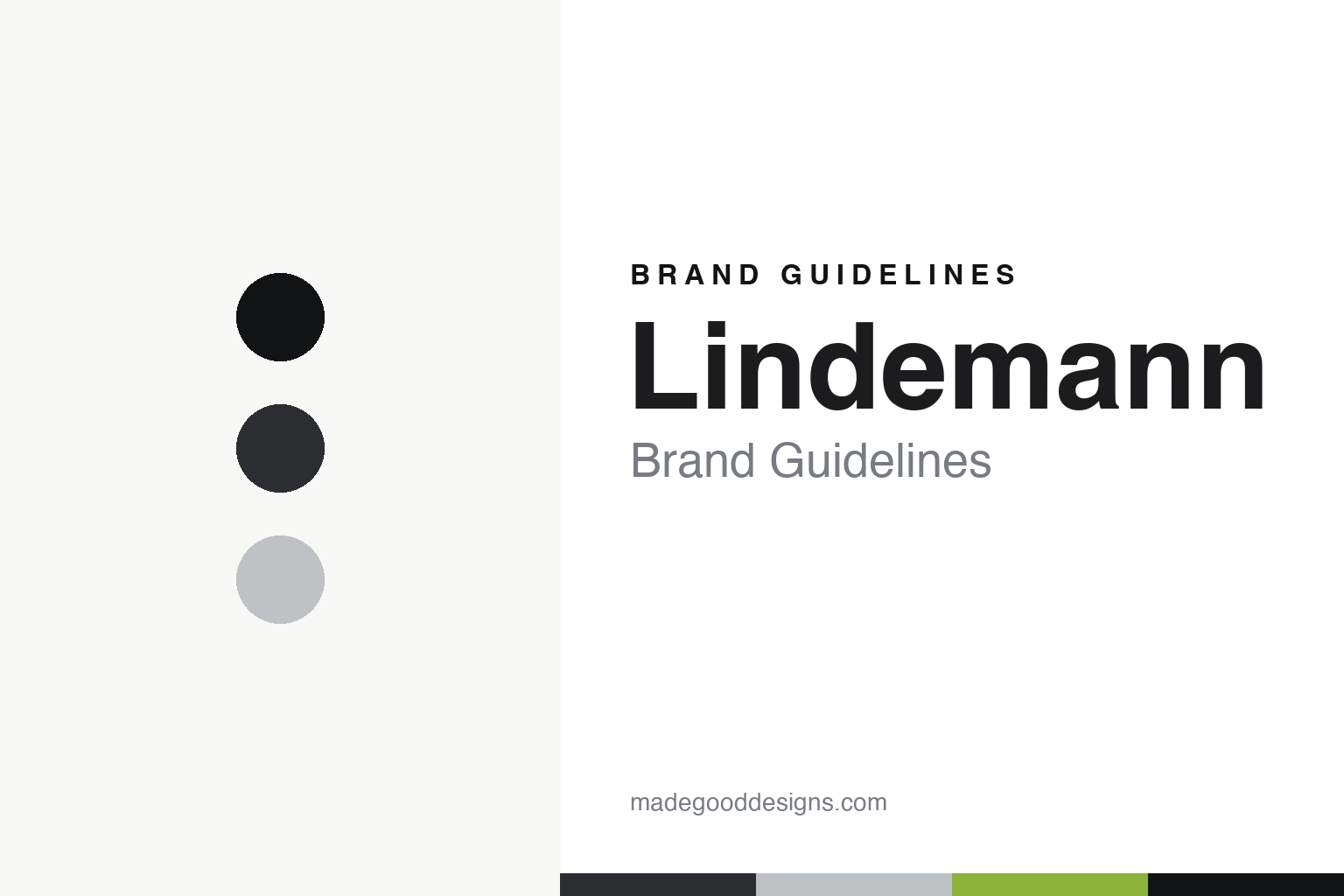
Lindemann Brand Guidelines
Norbert Lindemann’s Bavarian maker of SACD players and Musicbooks.
Aa
Two constants: a Lindemann graphite, silver and lime palette and a Geometric sans register. Abstract homage — not a Lindemann product or mark; no component, logo or nameplate is reproduced.
Lindemann audiotechnik
An engineer’s company west of Munich.
Lindemann audiotechnik is the company of the engineer Norbert Lindemann, and it has stayed that way. It is based today in Wörthsee, a lakeside municipality in Upper Bavaria west of Munich, at Inninger Straße 21, and its website names Elisabeth Junker and Norbert Lindemann as the people who run it. The company writes its name with a lower-case “audiotechnik”; its products carry the name in capitals.
Its founding year is given two ways. The company now dates itself to 1993, the year of its first products — the AMP1 integrated amplifier and, according to the webzine 6moons, the BOX1 loudspeaker — and it marked 25 years in 2018 and 30 years in 2024. Older sources say 1992: a 2014 press release announcing its North American distributor, published by The Absolute Sound, said “Lindemann was founded in 1992 by Norbert Lindemann,” and the German user-edited reference Hifi-Wiki gives the same year. Both may be right if the company was set up a year before its first products appeared; we have not found a document that settles it.
The company has moved around the western edge of Munich. The commercial-register record available online begins in 2001, when the firm — then called Lindemann audiotechnik Produktions- und Vertriebsgesellschaft für hochwertige HiFi-Komponenten mbH — had its seat in Gilching, with two managing directors. It took the shorter name Lindemann audiotechnik GmbH in 2004, moved its seat to Krailling in 2008 and to Wörthsee in 2015, according to register notices summarised by North Data. Hifi-Wiki and the 2014 release describe it as based in Krailling near Munich, which was true for those years.
Colour
Amplifiers first, then digital.
Lindemann’s early reputation rested on test results in the German press. In its own history, published for its 25th anniversary in 2018, the company says the AMP1 won a surprise test victory in STEREO in 1993; that the AMP 4 of 1996, one of the first integrated amplifiers with current feedback, passed the 100-point mark in AUDIO; and that the CD1 of 1999 was one of the first CD players with upsampling. Loudspeakers called Venice and Spain followed in the late 1990s, 6moons noted.
The product that made the name abroad was a disc player. The company says the D680 of 2001 was the first Super Audio CD player from a German maker, and the 2014 distributor release repeated that claim; 6moons dated its launch to 2002 and wrote that a small German specialist building a flagship for a new disc format “took the hifi community by surprise.” The company says exports reached 80 per cent of its business at that time. The 820 SACD player opened an 800 series in 2004; it was followed by the USB-DDC, a USB interface the company dates to 2007 and the distributor release to 2008, and by the 885 integrated amplifier in 2011.
In 2013 the range changed course. hi-fi+ wrote in 2017 that Norbert Lindemann “realised that the market was changing” and slimmed the line down to the Musicbook series of compact network players, DACs and amplifiers. The 2014 release described casework of 6.5mm solid aluminium with no visible screws, an OLED display and a selection wheel. The Musicbook 25 DSD, reviewed by hi-fi+ in 2017, could upsample every digital input to DSD, and the company calls the Musicbook DSD its best-selling product. The less expensive Limetree series followed in 2018; the Musicbook Combo, the first Lindemann streamer with a built-in amplifier according to The Ear, in 2022; and in 2024 the Move compact loudspeaker and the Groove active bass extension.
Typography
German hi-fi, documented.
Several of Germany’s best-known loudspeaker names have spent decades under American owners. German Wikipedia says the US group Recoton bought the Heco brand rights in 1996, and that Audiovox — renamed Voxx International in 2012 — bought the insolvent Recoton in 2003. Today Magnat and Heco are brands of Premium Audio Company Germany GmbH in Pulheim, near Cologne, according to their legal notices, and Voxx itself was bought by the US company Gentex in April 2025, English Wikipedia says.
At the other end of the trade are small specialist workshops, and several are in Baden-Württemberg. Two are in the district of Karlsruhe: Octave, in Karlsbad, whose owner, Andreas Hofmann, says he turned from transistors to valve amplifiers in 1977, and AVM, at Malsch, whose legal name, Audio Video Manufaktur GmbH, uses the German word for a craft workshop. Accustic Arts is based at Lauffen am Neckar, in the same state.
The trade’s main meeting place has moved. The HIGH END show, held in Munich until 2025, took place in Vienna from 4 to 7 June 2026, and Acapella was among the exhibitors there, according to its website.
The makers in this guide are spread out: AVM in Malsch, Octave in Karlsbad and Accustic Arts in Lauffen am Neckar; Lindemann at Wörthsee, west of Munich; Magnat and Heco in Pulheim; and Acapella in Duisburg, with a showroom at Isen near Munich, according to the legal notices on their websites.
This guide sets out what can be checked about each brand — who founded it, who owns it, and what it says about where its products are made — and marks clearly what rests only on the company’s own word.
Aa
A geometric sans, plain as brushed aluminium. (Specimen set in Jost, a sans STAND-IN; NOT the Lindemann logo.)
Lindemann
Founder-led, and made in Germany, it says.
We found no sale, merger or outside investor in the sources we checked. The same two managing directors appear in the register record from 2001, and the company’s current pages still present Norbert Lindemann as the engineer who measures every device; The Ear in 2022 called him “the man behind the company.” Shareholdings are not shown in the free register summaries, so we describe the company as founder-led rather than state who owns it.
On manufacturing, the company says: “We develop in Germany. And manufacture here in small quantities.” The 2014 North American release said the Musicbook was “engineered and manufactured in Germany.” These are the statements of the company and its distributor; we did not find an independent account of where its circuit boards and cases are made. In 2024 Lindemann marked its 30th anniversary with a “HIGH END Preview” event at a dealer in Elfershausen, FIDELITY reported, with Norbert Lindemann demonstrating the new products himself.
For a design guide, Lindemann shows how a small engineering company can change its whole product format — from full-size amplifiers and SACD players to compact aluminium books — without changing its name or its founder. Compare T+A, another German maker of digital sources and amplifiers, and AVM. For this guide we use graphite, anodised silver and a lime green with a geometric sans, an unofficial interpretation; no product or logo is reproduced.
Explore & save
Keep Lindemann’s identity on hand — save it to a board in the Made Good inspiration library.
Lindemann identity set
Pin the Lindemann graphite, silver and lime palette and the Geometric sans register to your own board.