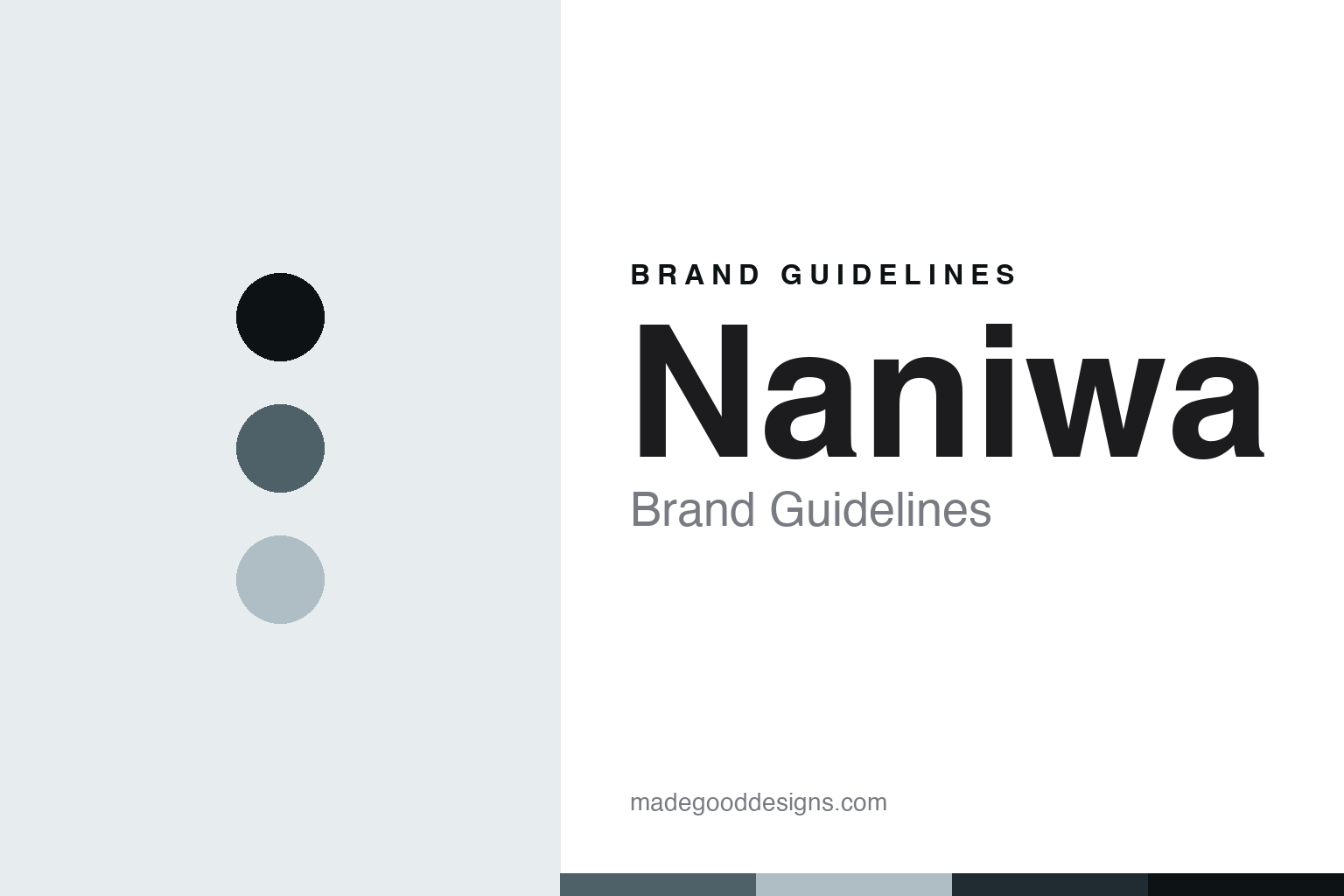
Naniwa Brand Guidelines
The Japanese sharpening stones.
Aa
Two constants: a slate-stone palette and a stone-sans register. Abstract homage — not a Naniwa whetstone or mark.
The Japanese sharpening stones
Naniwa is the Japanese abrasives house (Naniwa Abrasive Mfg. Co.) founded in 1941, making its whetstones in Japan and headed by the founding Sadakin family.
Naniwa closes the round with the tool that keeps the others sharp. From Osaka, in Japan, Naniwa Abrasive Mfg. Co. makes sharpening stones — synthetic and ceramic waterstones, from coarse grinding to fine polishing — for chisels, plane blades and knives. Its answer to how a maker becomes a name is the edge behind the edge: make the stones that sharpen the tools, in Japan, to a grit for every stage. A Japanese whetstone, made where the craft of the edge is old.
Its identity is the Japanese sharpening stones. Naniwa’s Japanese-made whetstones, its full grit range and its long Osaka lineage are the work it is known for. A stone, made in Japan. The tool that finishes every other tool.
(Honest notes, so the story stays precise. Naniwa Abrasive Mfg. Co., Ltd. was founded in 1941 as a small Osaka workshop by the Sadakin family and incorporated in 1952; its corporate site is naniwa-kenma.co.jp, with an English site at naniwa-abrasive.com. On what it makes, it is a broad abrasives manufacturer — diamond tools, grinding wheels and more — of which sharpening stones are one important line, so we do not imply it makes only kitchen stones. On where it is made — a theme of this round — its whetstones are made in Japan, at its Shiga factory; honestly, the company also runs a plant in Vietnam and does not publicly break out which lines are made where, so we say the whetstones are made in Japan without claiming that everything Naniwa makes is Japanese-made. On ownership, the current president shares the founder’s Sadakin surname, so the founding family name still heads the company; we present this as a name-based continuity rather than assert unbroken family ownership. On its lines, the export names widely used abroad — such as Chosera and Snow White — we attribute as reported rather than map to specific Japanese line names first-hand; the splash-and-go versus soaking distinction and the use by woodworkers and chefs are widely reported. It should not be confused with King whetstones, which are made by a separate company, Matsunaga. Its name and marks, including its Ebi (shrimp) mark, are IP, described but never reproduced, and there is no official brand hex; these tones are an unofficial interpretation. This is design commentary and does not promote any product.)
Colour
Naniwa lives in a slate-stone palette. Click a swatch to copy the hex.
Naniwa’s identity is mineral, Japanese and precise — a slate stone, an ink, a grit, a deep slate, and a paper. The palette leans slate stone and grit: the register of a whetstone and its abrasive surface. It signals the craft of the edge. The honest caveat: with no published brand hex, these values are an original, unofficial interpretation, not first-party colours.
The lesson is a slate-stone palette signals a mineral, made-in-Japan identity. Naniwa’s world is a mineral, stone, Japanese object. For designers, it is a reminder that a cool slate stone and a soft grit can carry a maker built on abrasives — the blue-grey of a whetstone and the neutral of its grit. Because these tones can fail as small text, keep type dark and let the colour live in the accents, palette and band. The takeaways: make the tool behind the tools; make it at home; cover every grit; and treat any single hex as unofficial.
Typography
The register is a stone sans — clean, fine, made.
Naniwa’s identity carries a clean, fine, made spirit — an abrasives house, not a lifestyle brand. A stone sans captures the mood: even, precise and quiet, the register of a grinding shop. Set in a slate-stone palette, the stone sans feels clean and made — exactly the personality Naniwa carries. It is the craft of the edge rather than a logo, mirroring a fine waterstone. (Naniwa’s real wordmark and its Ebi shrimp mark are things we describe but do not reproduce, and the exact typeface is not ours to use.) Because it is not ours to use, the honest description is “a stone-sans spirit,” shown here in a stand-in. The type behaves like the house: clean, fine and made.
Aa
A stone-sans spirit — fine and made. (Specimen set in Mulish, a stone-sans STAND-IN; NOT the Naniwa logo or Ebi mark.)
The hand-tool makers
Naniwa stands for the whetstone made in Japan.
Naniwa closes the round with the quietest idea: the tool that finishes every other tool. A slate-stone palette, a stone sans and a whetstone make one thing — the Japanese sharpening stones — the whole identity: mineral, Japanese and precise. The Japanese-made whetstones are the differentiator, and the full grit range is the meaning. The point is an Osaka abrasives house that makes the stones that sharpen the chisels, plane blades and axes the rest of this round forges — the edge behind the edge.
Put to work, the identity is the craft of the edge, honestly told, as design. A house in this spirit would make the enabling tool, make it at home, and cover every stage — synthetic and ceramic waterstones, coarse to fine, made in Japan. A brand learning from it would see that owning a hidden, essential step is a durable identity — that the stone which sharpens every other maker’s tool carries a quiet importance a finished blade takes for granted — and that being precise, founded 1941, incorporated 1952, an Osaka abrasives house, keeps the story honest. Naniwa closes the round on its where-made note, with the round’s most careful caveat: its whetstones are made in Japan at Shiga, but because the company also runs a Vietnam plant and does not break out the lines, we say the whetstones are Japanese-made without claiming everything is. The discipline is in the caveats: presenting the Sadakin continuity as a name-based link rather than asserted unbroken ownership, attributing the export names and the splash-and-go distinction as reported, and keeping Naniwa clearly separate from King (Matsunaga). The lesson Naniwa teaches is that an essential, hidden step can hold an identity: the Japanese making gives it substance, and the honesty about what is and isn’t Japan-made keeps it credible. The edge is the personality, and the Japan-made whetstone is the proof.
For designers and brand-builders, Naniwa closes the hand-tool makers, from Japan: own the essential, hidden step, and make it at home. The lessons: make the tool behind the tools; make in-country; be honest about split manufacturing; attribute the export names; and never reproduce a logo. It is also a reminder to stay precise: Naniwa is the Japanese abrasives house (Naniwa Abrasive Mfg. Co.) founded in 1941, making its whetstones in Japan and headed by the founding Sadakin family — with the palette here an unofficial interpretation. Naniwa made the craft of the edge the identity — proof that a whetstone made in Japan, honestly told, can be the difference.
Explore & save
Keep Naniwa’s identity on hand — save it to a board in the Made Good inspiration library.
Naniwa identity set
Pin the slate-stone palette and the stone-sans register to your own board.