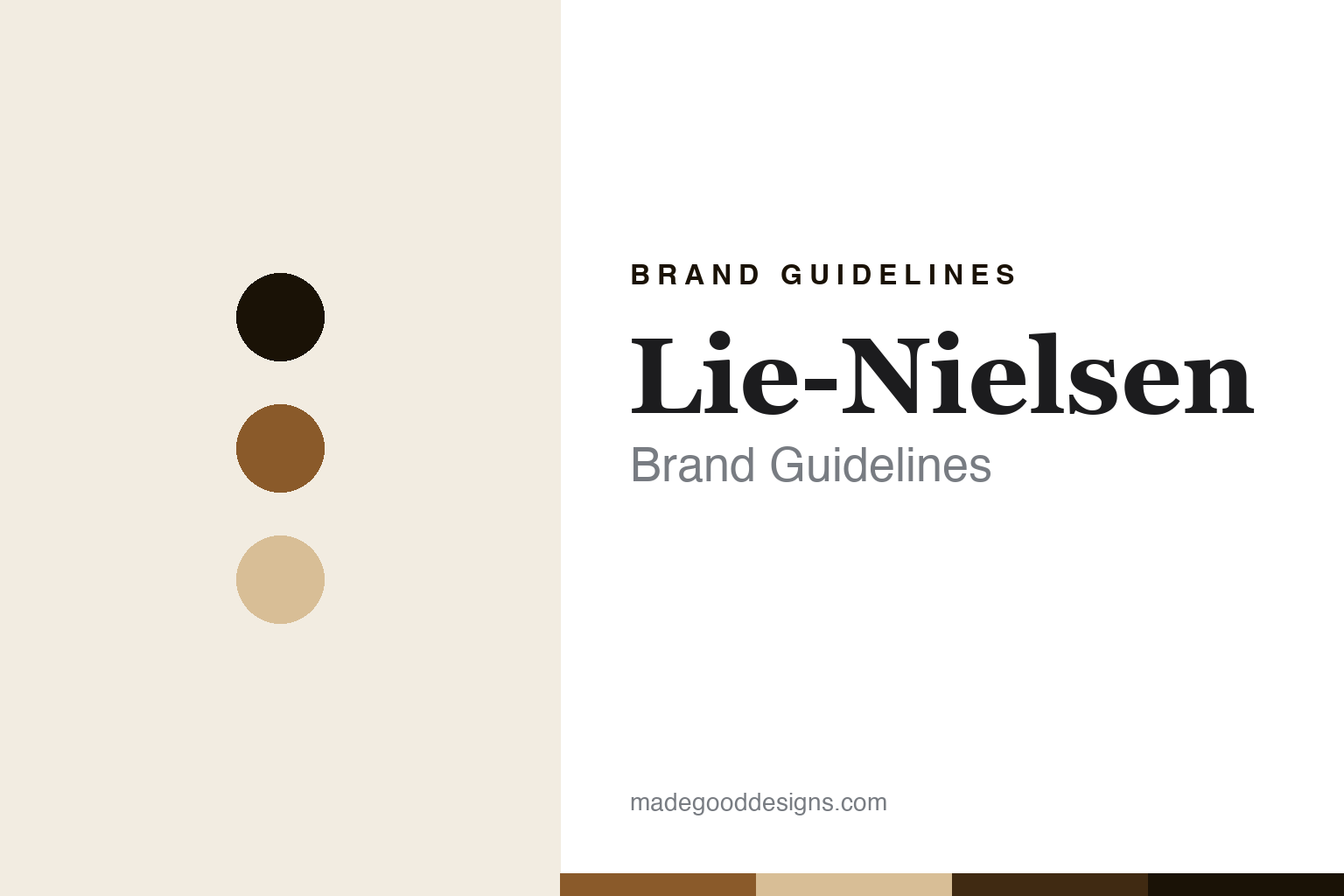
Lie-Nielsen Brand Guidelines
The Maine plane maker.
Aa
Two constants: a bronze palette and a heritage-serif register. Abstract homage — not a Lie-Nielsen plane or mark.
The Maine plane maker
Lie-Nielsen Toolworks is the American maker of heirloom hand planes, founded in 1981 by Thomas Lie-Nielsen and made in-house in Warren, Maine.
Lie-Nielsen opens the round — the hand-tool makers — from mid-coast Maine. It makes premium woodworking hand tools, and it is known above all for hand planes: bench planes, block planes and specialty planes, made to be used for a lifetime. Its answer to how a maker becomes a name is heirloom quality made at home: revive the best discontinued designs, cast and machine them properly, and build tools that outlast their owners. An American plane, made in Maine.
Its identity is the Maine plane maker. Lie-Nielsen’s made-in-USA craft, its heirloom planes and its revival of classic designs are the work it is known for. A plane, made in Maine. A tool built to be handed down.
(Honest notes, so the story stays precise. Lie-Nielsen Toolworks was founded in 1981 by Thomas Lie-Nielsen; production began in a small shop in West Rockport, Maine, and moved to its Warren, Maine facility in 1988 — so we say founded 1981 in Maine, based in Warren, not founded in Warren. On what it makes, it is hand planes above all, plus saws, chisels, spokeshaves, workbenches and sharpening supplies. On where it is made — the heart of this round — it manufactures in-house in Maine: it states that its castings come from local New England foundries and are then machined and finished under its own roof, so we say made in the USA, machined and finished in-house, without claiming every step including casting happens in one building. Its plane bodies use manganese bronze and ductile iron; its blades are cryogenically treated A-2 steel. It describes its mission as reviving discontinued but useful designs, and its bench planes are widely reported to follow the early-twentieth-century Stanley Bedrock pattern — we reference that as design heritage and reproduce no Stanley mark. On ownership, it is an independent, family-owned company associated with founder Thomas Lie-Nielsen; we do not assert his present-day operating role as fact. Its production figures and its Hand Tool Events we attribute as the company’s own. Its name and marks are IP, described but never reproduced, and there is no official brand hex; these tones are an unofficial interpretation. This is design commentary and does not promote any product.)
Colour
Lie-Nielsen lives in a bronze palette. Click a swatch to copy the hex.
Lie-Nielsen’s identity is heirloom, American and made — a bronze, an ink, a maple, a deep bronze, and a paper. The palette leans bronze and maple: the register of a manganese-bronze plane body and a maple workbench. It signals metal you keep and wood you work. The honest caveat: with no published brand hex, these values are an original, unofficial interpretation, not first-party colours.
The lesson is a bronze palette signals an heirloom, made-in-USA identity. Lie-Nielsen’s world is a heirloom, metal-and-wood, American object. For designers, it is a reminder that a warm bronze and a soft maple can carry a maker built on tools you hand down — the gold of cast bronze and the neutral of a bench top. Because these tones can fail as small text, keep type dark and let the colour live in the accents, palette and band. The takeaways: build to outlast the owner; make it at home; revive the best of the past; and treat any single hex as unofficial.
Typography
The register is a heritage serif — classical, warm, made.
Lie-Nielsen’s identity carries a classical, warm, made spirit — a heirloom-tool house, not a fashion label. A heritage serif captures the mood: traditional, dignified and steady, the register of a maker reviving old designs. Set in a bronze palette, the heritage serif feels classical and made — exactly the personality Lie-Nielsen carries. It is craft and heritage rather than a logo, mirroring a bench plane built to last. (Lie-Nielsen’s real wordmark and any tool profile are things we describe but do not reproduce, and the exact typeface is not ours to use.) Because it is not ours to use, the honest description is “a heritage-serif spirit,” shown here in a stand-in. The type behaves like the house: classical, warm and made.
Aa
A heritage-serif spirit — classical and made. (Specimen set in Cormorant Garamond, a heritage-serif STAND-IN; NOT the Lie-Nielsen logo or wordmark.)
The hand-tool makers
Lie-Nielsen stands for the heirloom plane, made in Maine.
Lie-Nielsen opens the round with a durable idea: the tool built to be handed down. A bronze palette, a heritage serif and a hand plane make one thing — the Maine plane maker — the whole identity: heirloom, American and made. The made-in-USA, in-house craft is the differentiator, and the revival of classic designs is the meaning. The point is a house that took the best discontinued plane designs, made them properly in Maine, and built tools meant to outlast their owners.
Put to work, the identity is heirloom craft, honestly told, as design. A house in this spirit would build to last, make it at home, and revive the best of the past — bronze and ductile-iron planes, cryo-treated blades, machined and finished in Maine. A brand learning from it would see that heirloom quality plus home making is a durable identity — that a plane cast at a local foundry and finished under its own roof carries a permanence a disposable tool cannot — and that being precise, founded 1981 in Maine, based in Warren since 1988, castings from local foundries then machined and finished in-house, keeps the story honest. Lie-Nielsen opens the hand-tool round on the theme the whole round returns to — made by hand, at home, to a standard — and the honest editorial move is small but real: not saying it was founded in Warren, not implying one-roof casting, and not asserting the founder’s present role. The discipline is in the caveats: referencing the Stanley Bedrock lineage as design heritage without reproducing a Stanley mark, and attributing the production figures and events to the company. The lesson Lie-Nielsen teaches is that heirloom quality can hold an identity: the in-house Maine making gives it substance, and the honesty about foundries and history keeps it credible. The permanence is the personality, and the Maine-made plane is the proof.
For designers and brand-builders, Lie-Nielsen opens the hand-tool makers, from the United States: build to outlast the owner, and make it at home. The lessons: make in-country; revive the best of the past; be precise about where and how; attribute the figures; and never reproduce a logo. It is also a reminder to stay precise: Lie-Nielsen Toolworks is the American maker of heirloom hand planes, founded in 1981 by Thomas Lie-Nielsen and made in-house in Warren, Maine — with the palette here an unofficial interpretation. Lie-Nielsen made heirloom quality the identity — proof that a plane built to be handed down, honestly told, can be the difference.
Explore & save
Keep Lie-Nielsen’s identity on hand — save it to a board in the Made Good inspiration library.
Lie-Nielsen identity set
Pin the bronze palette and the heritage-serif register to your own board.