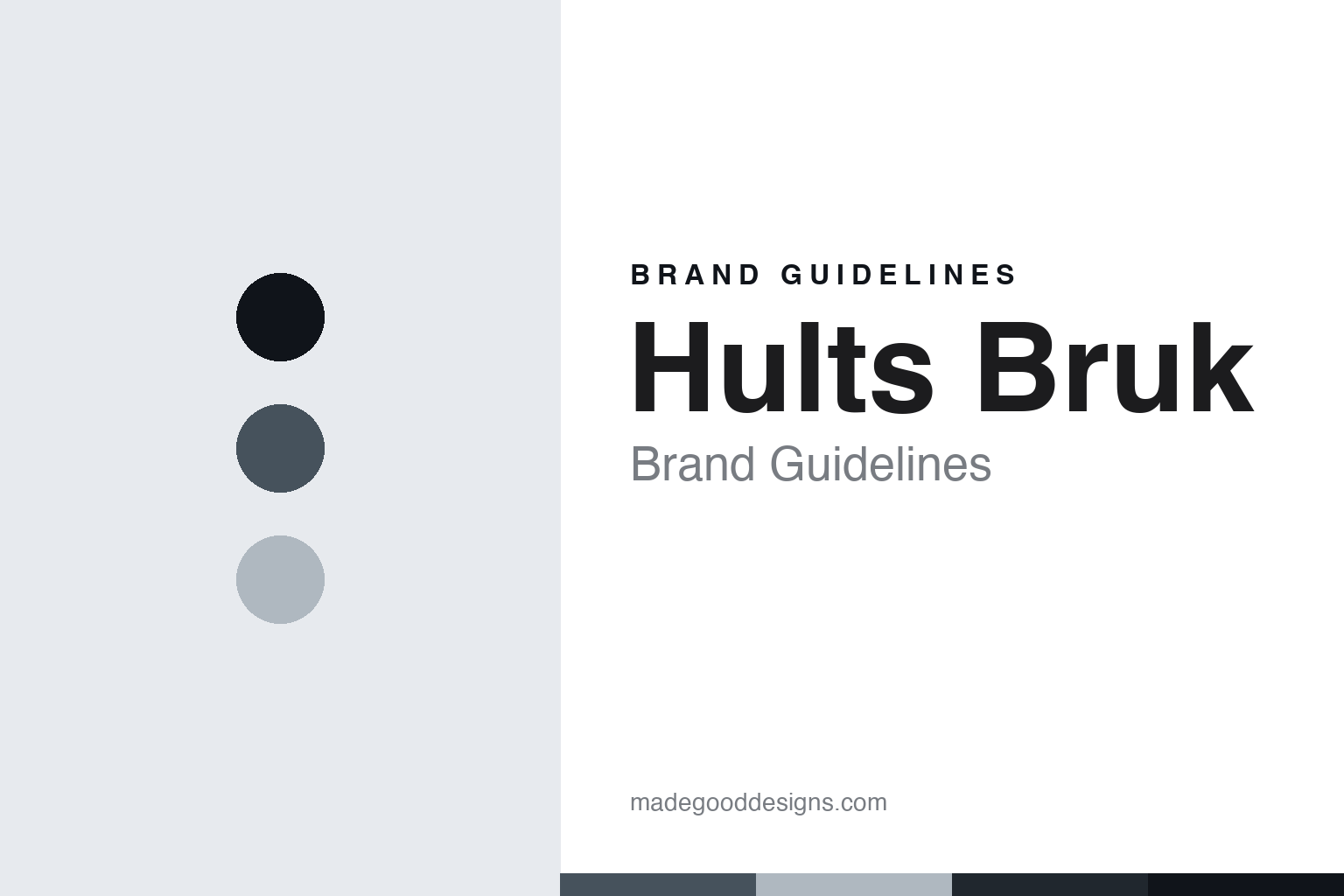
Hults Bruk Brand Guidelines
The 1697 forge.
Aa
Two constants: a gunmetal palette and a forge-sans register. Abstract homage — not a Hults Bruk axe or mark.
The 1697 forge
Hults Bruk is one of the world’s oldest surviving forges, established in Sweden in 1697 and making hand-forged axes since the late nineteenth century.
Hults Bruk opens the round — the old toolmakers — with the oldest date of all. In the Swedish locality of Hult, in Östergötland, an ironworks was established in 1697, and it still forges today. It makes hand-forged axes — felling and splitting axes, hatchets and carving axes — from Swedish steel, on the same site. Its answer to how a maker becomes a name is simply endurance: keep a forge running for more than three centuries. A Swedish axe, from a 1697 forge.
Its identity is the 1697 forge. Hults Bruk’s great age, its hand-forged axes and its unbroken Swedish site are the work it is known for. An axe, forged in Sweden. A works older than most countries’ constitutions.
(Honest notes, so the story stays precise, because the date needs care. The Hults Bruk ironworks was established in 1697 — but 1697 is the age of the forge, not of its axes: the early works made nails, bar iron, chain and castings, and axe-making began only around the 1850s and industrially in the late nineteenth century. So we say a forge established in 1697 that has made axes since the late nineteenth century, and we do not write “forging axes since 1697” or lean on a bare “oldest axe maker” claim. On what it makes, hand-forged axes are the core; we say “and other forged tools” rather than list products we could not confirm. On where it is made — a theme of this round — the axes are made in Sweden, at Hults Bruk, from ore-based Swedish steel, hand-forged in a press and hand-finished; genuinely Swedish-made. On ownership — the honest heart of this entry — Hults Bruk was for years part of the Hultafors Group, itself owned by the listed Investment AB Latour; as of 2026 it no longer appears in that group’s brand portfolio and is being relaunched as an independently operated Swedish business, so we say its current ownership is not confirmed rather than name a present owner. Its sister axe brand Wetterlings, and the reported date it joined, we attribute as reported. Its name and marks, including its historic head stamp, are IP, described but never reproduced, and there is no official brand hex; these tones are an unofficial interpretation. This is design commentary and does not promote any product.)
Colour
Hults Bruk lives in a gunmetal palette. Click a swatch to copy the hex.
Hults Bruk’s identity is ancient, Swedish and forged — a gunmetal, an ink, a frost, a deep steel, and a paper. The palette leans gunmetal and frost: the register of a forged axe head and a cold northern light. It signals age and iron. The honest caveat: with no published brand hex, these values are an original, unofficial interpretation, not first-party colours.
The lesson is a gunmetal palette signals an ancient, made-in-Sweden identity. Hults Bruk’s world is an ancient, forged, Swedish object. For designers, it is a reminder that a cold gunmetal and a soft frost can carry a forge older than three centuries — the grey of forged steel and the neutral of a northern winter. Because these tones can fail as small text, keep type dark and let the colour live in the accents, palette and band. The takeaways: endure; keep the site; forge it at home; and treat any single hex as unofficial.
Typography
The register is a forge sans — plain, old, made.
Hults Bruk’s identity carries a plain, old, made spirit — a three-century forge, not a fashion label. A forge sans captures the mood: even, sturdy and unadorned, the register of an ancient Swedish works. Set in a gunmetal palette, the forge sans feels old and made — exactly the personality Hults Bruk carries. It is endurance rather than a logo, mirroring a forged axe. (Hults Bruk’s real wordmark and head stamp are things we describe but do not reproduce, and the exact typeface is not ours to use.) Because it is not ours to use, the honest description is “a forge-sans spirit,” shown here in a stand-in. The type behaves like the works: plain, old and made.
Aa
A forge-sans spirit — old and made. (Specimen set in Work Sans, a forge-sans STAND-IN; NOT the Hults Bruk logo or head stamp.)
The old toolmakers
Hults Bruk stands for the forge that has run since 1697.
Hults Bruk opens the round with the purest form of the theme: endurance itself. A gunmetal palette, a forge sans and a hand-forged axe make one thing — the 1697 forge — the whole identity: ancient, Swedish and forged. The great age is the differentiator, and the unbroken Swedish site is the meaning. The point is a forge that has run since 1697, and still forges axes on the same ground.
Put to work, the identity is endurance, honestly told, as design. A maker in this spirit would keep the fire lit, keep the site, and forge at home — hand-forged axes, Swedish steel, made at Hults Bruk. A brand learning from it would see that endurance is a durable identity — that an axe from a forge older than three centuries carries a depth a new brand cannot buy — and that being precise about the date, a forge established 1697 that has made axes since the late nineteenth century, keeps the story honest. Hults Bruk opens the old toolmakers on the round’s central discipline: the difference between the founding date and the honest date. The forge is genuinely from 1697; the axes are not, and the honest editorial move is to say so plainly, and to resist the tidy but false line that it has forged axes for three hundred years. The same discipline governs the ownership: it was part of the Hultafors Group under the listed Investment AB Latour, but as of 2026 it appears divested and is relaunching independently, so we say the current owner is unconfirmed rather than print an out-of-date chain. The lesson Hults Bruk teaches is that age can hold an identity — if the age is stated precisely. The endurance is the personality, and the Swedish-forged axe is the proof.
For designers and brand-builders, Hults Bruk opens the old toolmakers, from Sweden: let endurance be the identity — and state the date precisely. The lessons: keep the site; forge at home; separate the forge’s age from the product’s age; keep the ownership current; and never reproduce a logo. It is also a reminder to stay precise: Hults Bruk is one of the world’s oldest surviving forges, established in Sweden in 1697 and making hand-forged axes since the late nineteenth century — with the palette here an unofficial interpretation. Hults Bruk made endurance the identity — proof that a forge running since 1697, honestly dated, can be the difference.
Explore & save
Keep Hults Bruk’s identity on hand — save it to a board in the Made Good inspiration library.
Hults Bruk identity set
Pin the gunmetal palette and the forge-sans register to your own board.