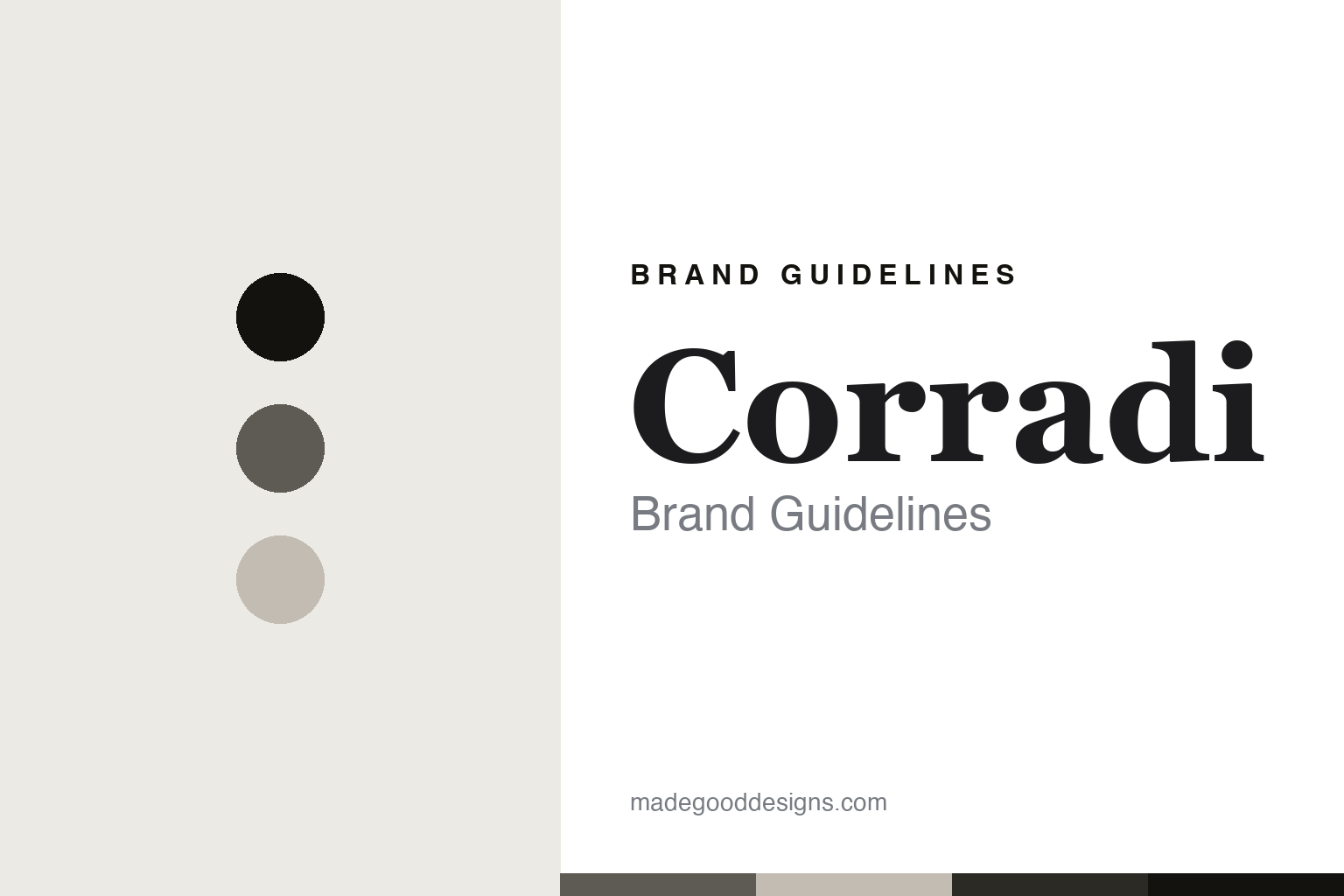
Corradi Brand Guidelines
The Italian precision file.
Aa
Two constants: a precision-steel palette and a precision-serif register. Abstract homage — not a Corradi file or mark.
The Italian precision file
Corradi is the Italian maker of precision files and rasps, founded by the Corradi brothers in 1910 and made in Maser, Veneto — machine-cut, not hand-stitched.
Corradi is the round’s Italian answer to the file, and its honesty is in its method. From Maser, in the Veneto, Corradi makes precision files and rasps — for woodworking, lutherie, sculpture, goldsmithing and farriery — and it makes them by machine, to a deliberately even cut. Its answer to how a maker becomes a name is precision, not hand-craft romance: engineer a file whose teeth are more uniform than a hand-cut one, and become the Italian name in precision. An Italian file, cut to a machine’s evenness.
Its identity is the Italian precision file. Corradi’s made-in-Italy manufacture, its precision files and rasps and its machine-cut evenness are the work it is known for. A file, made in Italy. A precise counterpoint to the hand-cut rasp.
(Honest notes, so the story stays precise, and one correction matters. Corradi rasps are not hand-stitched: the company machine-stitches its teeth, on CNC tooling, and openly presents this as more uniform than hand cutting — so the hand-stitched craft belongs to the French makers, and Corradi is the Italian name in machine-cut precision. This is the maker of files and rasps, not the Italian pergola brand of the same name. On what it makes, precision files, needle and riffler files, stainless CORINOX files, and precision rasps, used across woodworking, lutherie, sculpture, jewellery and farriery; it calls itself the only Italian maker of precision files. On founding, it dates to 1910, begun by the Corradi brothers, and names no single founder. On where it is made — the theme of this round — it is made in Italy, at Maser in the province of Treviso, Veneto, not Milan. On ownership, it describes itself as an independent, family-owned company run by the fourth and fifth generations, which we present as its own account. Its claims — the only Italian precision-file maker, each tool individually tested, a rasp range trialled for months — we attribute as reported, and we note it is shown at the Cremona violin-making fair without naming specific luthier users. Its name and marks are IP, described but never reproduced, and there is no official brand hex; these tones are an unofficial interpretation. This is design commentary and does not promote any product.)
Colour
Corradi lives in a precision-steel palette. Click a swatch to copy the hex.
Corradi’s identity is precise, Italian and made — a precision steel, an ink, a silver, a deep steel, and a paper. The palette leans precision steel and silver: the register of a finely-cut file and a polished blank. It signals evenness and control. The honest caveat: with no published brand hex, these values are an original, unofficial interpretation, not first-party colours.
The lesson is a precision-steel palette signals a precise, made-in-Italy identity. Corradi’s world is a precise, steel, Italian object. For designers, it is a reminder that a cool precision steel and a soft silver can carry a maker built on evenness — the grey of finished steel and the neutral of a polished blank. Because these tones can fail as small text, keep type dark and let the colour live in the accents, palette and band. The takeaways: engineer the evenness; make it in-country; test every tool; and treat any single hex as unofficial.
Typography
The register is a precision serif — fine, exact, made.
Corradi’s identity carries a fine, exact, made spirit — a precision file house, not a hand-craft workshop. A precision serif captures the mood: refined, controlled and Italian, the register of a Veneto tool factory. Set in a precision-steel palette, the serif feels fine and made — exactly the personality Corradi carries. It is engineering rather than romance, mirroring a machine-cut file. (Corradi’s real wordmark and its registered marks are things we describe but do not reproduce, and the exact typeface is not ours to use.) Because it is not ours to use, the honest description is “a precision-serif spirit,” shown here in a stand-in. The type behaves like the file: fine, exact and made.
Aa
A precision-serif spirit — fine and made. (Specimen set in Playfair Display, a precision-serif STAND-IN; NOT the Corradi logo or marks.)
The tool around the world
Corradi stands for the Italian file, cut by machine to an even edge.
Corradi is a lesson in how a method, honestly named, can be an identity. A precision-steel palette, a precision serif and a machine-cut file make one thing — the Italian precision file — the whole identity: precise, Italian and made. The made-in-Italy manufacture is the differentiator, and the machine-cut evenness is the meaning. The point is an Italian house that chose precision over hand-craft romance, and says so plainly — engineering a file whose teeth are more uniform than a hand-cut one.
Put to work, the identity is a method, honestly told, as design. A maker in this spirit would engineer the evenness, make it in-country, and test every tool — precision files and rasps, machine-cut, made in Maser. A brand learning from it would see that an honest method is a durable identity — that a maker who says “we cut by machine, and here is why that is better for this job” earns a different kind of trust than one that borrows the language of hand-craft — and that being precise, founded 1910 by the Corradi brothers, made in the Veneto, keeps the story honest. Corradi holds the Italy pole of the world tour, and it makes the round’s sharpest thread: set beside the hand-stitched French rasp of the last round, Corradi is the other national answer to the same tool — machine-cut, not hand-cut — and the honest editorial move is to correct the common assumption and let the two methods stand as equals. The discipline is in the caveats: naming it machine-cut, fixing the town to Maser in the Veneto, attributing the family-ownership and the superlatives, and not inventing luthier endorsements. The lesson Corradi teaches is that a method can hold an identity: the Italian making gives it substance, and the honesty about how it cuts keeps it credible. The method is the personality, and the Italian-made file is the proof.
For designers and brand-builders, Corradi holds the Italy pole in the tool around the world: name your method honestly, and make it in-country. The lessons: own your process; make in-country; test the product; attribute the claims; and never reproduce a logo. It is also a reminder to stay precise: Corradi is the Italian maker of precision files and rasps, founded by the Corradi brothers in 1910 and made in Maser, Veneto — machine-cut, not hand-stitched — with the palette here an unofficial interpretation. Corradi made a method the identity — proof that an Italian file, honestly told, can be the difference.
Explore & save
Keep Corradi’s identity on hand — save it to a board in the Made Good inspiration library.
Corradi identity set
Pin the precision-steel palette and the precision-serif register to your own board.