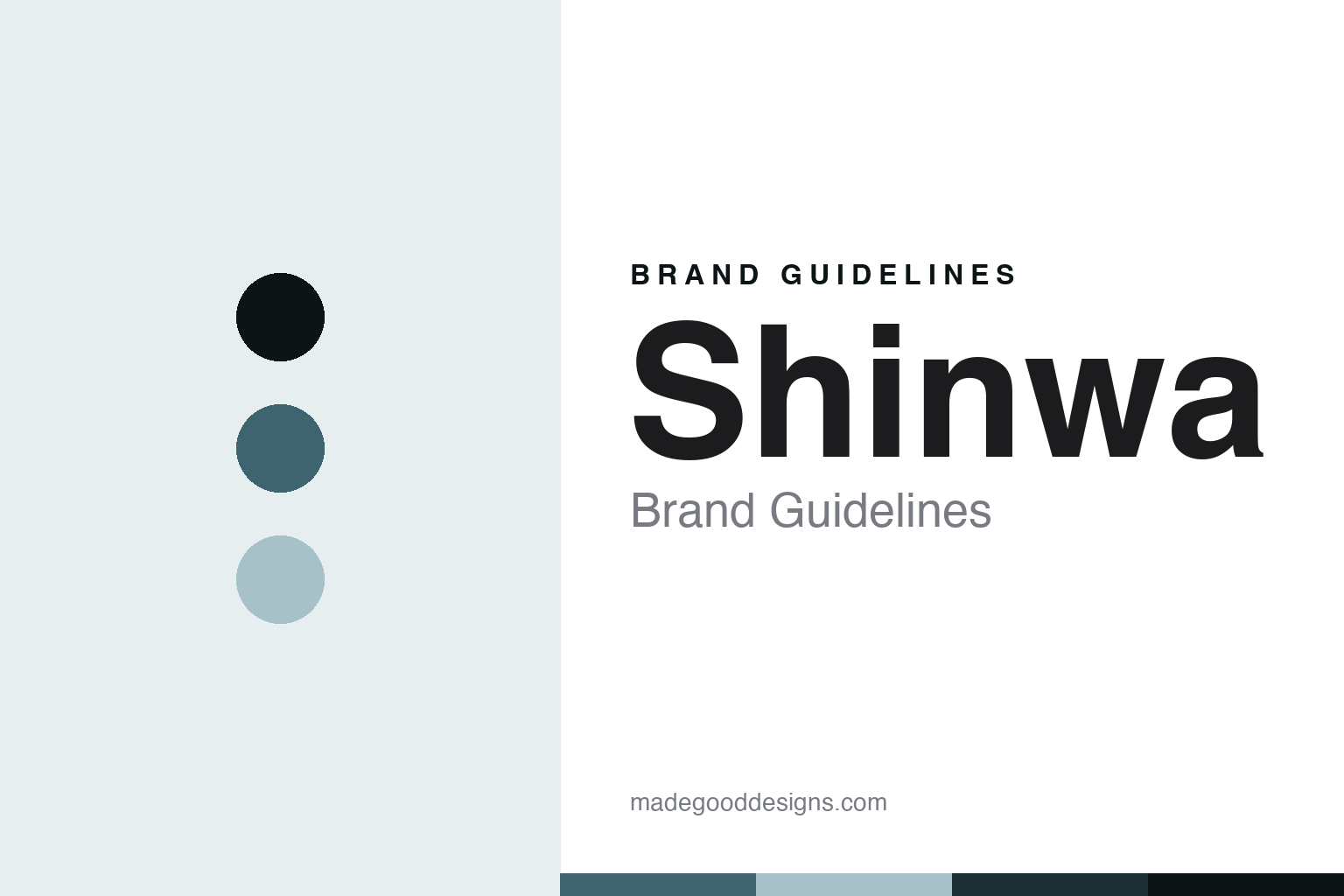
Shinwa Brand Guidelines
The Japanese square.
Aa
Two constants: a measuring-teal palette and a measured-sans register. Abstract homage — not a Shinwa square or mark.
The Japanese square
Shinwa is the Japanese maker of measuring and layout tools from the Tsubame-Sanjo region, honest that its tools are made both in Japan and at its own factory in China.
Shinwa is the round’s measuring house, and its honesty is in where it is made. From Sanjo, in Niigata — the heart of Japan’s Tsubame-Sanjo metalworking district — Shinwa makes squares, rules, protractors, bevels, levels and layout tools. Its answer to how a maker becomes a name is precision at a fair price: make the square woodworkers and builders reach for, from a region that has worked metal for generations. A Japanese square, from a metalworking town.
Its identity is the Japanese square. Shinwa’s Tsubame-Sanjo heritage, its measuring and layout tools and its honest where-made story are the work it is known for. A square, from Niigata. A tool that tells you the truth about its edge — and about where it is made.
(Honest notes, so the story stays precise, because this entry turns on where-made. Shinwa — Shinwa Sokutei, long known in English as Shinwa Rules — is based in Sanjo, Niigata, in the Tsubame-Sanjo region; its roots reach to 1950, and the present company was formed in 1971 by the merger of three metal-rule makers. On what it makes, measuring and layout tools: squares, steel rules, protractors, sliding bevels, levels, marking tools, and a wider range of measuring instruments. On where it is made — the crux of this round — Shinwa manufactures both in Niigata, Japan and at its own factory in Dalian, China, established in the early 1990s; country of origin varies by product, so we do not make a blanket made-in-Japan claim, and the honest line is that some lines are Japan-made and others are made at its Dalian plant. On ownership, it is a private, independent Japanese company, led by a Watanabe, a surname from its founding lineage; we say led by a Watanabe rather than assert family ownership outright. On features often marketed — laser-engraved graduations, affordable precision trusted by trades — we attribute as reported. Its name and logo carry formal usage guidelines and are IP, described but never reproduced, and there is no official brand hex; these tones are an unofficial interpretation. This is design commentary and does not promote any product.)
Colour
Shinwa lives in a measuring-teal palette. Click a swatch to copy the hex.
Shinwa’s identity is precise, Japanese and honest — a measuring teal, an ink, a steel frost, a deep teal, and a paper. The palette leans measuring teal and frost: the register of a stainless rule and a cool graduated face. It signals precision and a plain honesty. The honest caveat: with no published brand hex, these values are an original, unofficial interpretation, not first-party colours.
The lesson is a measuring-teal palette signals a precise, Tsubame-Sanjo identity. Shinwa’s world is a precise, steel, Japanese object. For designers, it is a reminder that a cool measuring teal and a soft frost can carry a maker built on layout — the blue-green of a steel rule and the neutral of a graduated face. Because these tones can fail as small text, keep type dark and let the colour live in the accents, palette and band. The takeaways: make precision affordable; root it in a craft region; be honest about where each line is made; and treat any single hex as unofficial.
Typography
The register is a measured sans — clean, exact, honest.
Shinwa’s identity carries a clean, exact, honest spirit — a measuring-tool maker, not a lifestyle brand. A measured sans captures the mood: even, precise and plain, the register of a Niigata metalworking shop. Set in a measuring-teal palette, the measured sans feels exact and honest — exactly the personality Shinwa carries. It is precision and plain-dealing rather than a logo, mirroring a graduated square. (Shinwa’s real wordmark and logomark carry usage guidelines and are things we describe but do not reproduce, and the exact typeface is not ours to use.) Because it is not ours to use, the honest description is “a measured-sans spirit,” shown here in a stand-in. The type behaves like the tool: clean, exact and honest.
Aa
A measured-sans spirit — exact and honest. (Specimen set in Libre Franklin, a measured-sans STAND-IN; NOT the Shinwa logo or any scale.)
The tool around the world
Shinwa stands for the Japanese square, honest about where it is made.
Shinwa is a lesson in how honesty about where-made can be an identity. A measuring-teal palette, a measured sans and a square make one thing — the Japanese square — the whole identity: precise, Japanese and honest. The Tsubame-Sanjo heritage is the differentiator, and the plain honesty about manufacture is the meaning. The point is a Japanese measuring-tool company from a famous metalworking region that makes some tools in Japan and others at its own factory in China — and does not pretend otherwise.
Put to work, the identity is honest where-made, told as design. A maker in this spirit would root itself in a real craft region, make precision affordable, and be honest about where each line is made — squares and rules, Niigata and Dalian, country of origin by product. A brand learning from it would see that plain honesty about manufacture is a durable identity — that a company transparent about a mixed supply chain earns more trust than one that implies a blanket origin — and that being precise, roots to 1950, the company from a 1971 merger, based in Sanjo, Niigata, keeps the story honest. Shinwa holds the Japan pole of the world tour, and it carries the round’s most instructive where-made lesson: the world tour is not just about seven flags on a map, because one maker’s own supply chain crosses borders, and the honest thing is to say so — Japan and Dalian, origin by item — rather than sell a single clean nationality. The discipline is in the caveats: no blanket made-in-Japan, “led by a Watanabe” rather than a flat family claim, and attributing the marketed features. The lesson Shinwa teaches is that honesty can hold an identity: the Tsubame-Sanjo heritage gives it substance, and the truth about a mixed origin keeps it credible. The honesty is the personality, and the plainly-labelled square is the proof.
For designers and brand-builders, Shinwa holds the Japan pole in the tool around the world: root in a real craft region, and be honest about where each line is made. The lessons: make precision affordable; claim only the origin you can stand behind; don’t imply a single nationality for a mixed chain; attribute the features; and never reproduce a logo. It is also a reminder to stay precise: Shinwa is the Japanese maker of measuring and layout tools from the Tsubame-Sanjo region, honest that its tools are made both in Japan and at its own factory in China — with the palette here an unofficial interpretation. Shinwa made honest where-made the identity — proof that a Japanese square, honestly told, can be the difference.
Explore & save
Keep Shinwa’s identity on hand — save it to a board in the Made Good inspiration library.
Shinwa identity set
Pin the measuring-teal palette and the measured-sans register to your own board.