Koyamaichi Brand Guidelines
The Japanese chisel smith.
Aa
Two constants: a forge-charcoal palette and a smith-sans register. Abstract homage — not a Koyamaichi chisel or mark.
The Japanese chisel smith
Koyamaichi is a traditional Japanese blacksmith making hand-forged woodworking chisels, reportedly in the Hyōgo region, sold through specialists with no official website.
Koyamaichi is the round’s living craft, and its heritage is the old tradition itself rather than a founding date. It is a Japanese blacksmith making hand-forged woodworking chisels — bench chisels, oire nomi — with laminated blades in the Japanese manner, prized by woodworkers who seek them out. Its answer to how a maker becomes a name is the forge: a small workshop that heats the oven for hours, forge-welds hard steel to a soft body, and turns out chisels one at a time. A Japanese chisel, hand-forged in a small workshop.
Its identity is the Japanese chisel smith. Koyamaichi’s hand-forged chisels, its traditional craft and its small-workshop scale are the work it is known for. A chisel, forged in Japan. A living craft, not a corporate date.
(Honest notes, so the story stays precise, because this entry is deliberately the round’s least-documented — and that is the point. Koyamaichi is a real, hand-forging Japanese chisel smith, but it is thin on the documented web: there is no official website, and it is sold through Japanese-tool specialists, which for a small traditional smith is normal, not a warning sign. On what it makes, bench chisels are confirmed, with white-oak handles; the blades are laminated hard-over-soft in the Japanese tradition, which we frame as tradition-general rather than a cited Koyamaichi spec, and we do not assert plane blades, which we could not confirm. On where it is made — the theme of this round — it is genuinely made in Japan, hand-forged in a physical forge with a few workers, reportedly in the Hyōgo region of western Japan, near the Kobe and Miki tool-making area; we say reportedly, and we do not place it in Sanjo or Niigata, which appears to be wrong. On its heritage, we do not invent a founding year, a generation count, or the individual smith’s name, none of which we could verify — so its “old” is the age of the craft it continues, not a documented company age. Its steel grade, and whether a maker’s mark is struck on the blades, we could not confirm, so we omit them. That it is coveted by Western woodworkers we attribute as reported. We reproduce no maker’s stamp or motif; the Japanese blacksmith tradition is referenced factually and with respect. There is no official brand hex; these tones are an unofficial interpretation. This is design commentary and does not promote any product.)
Colour
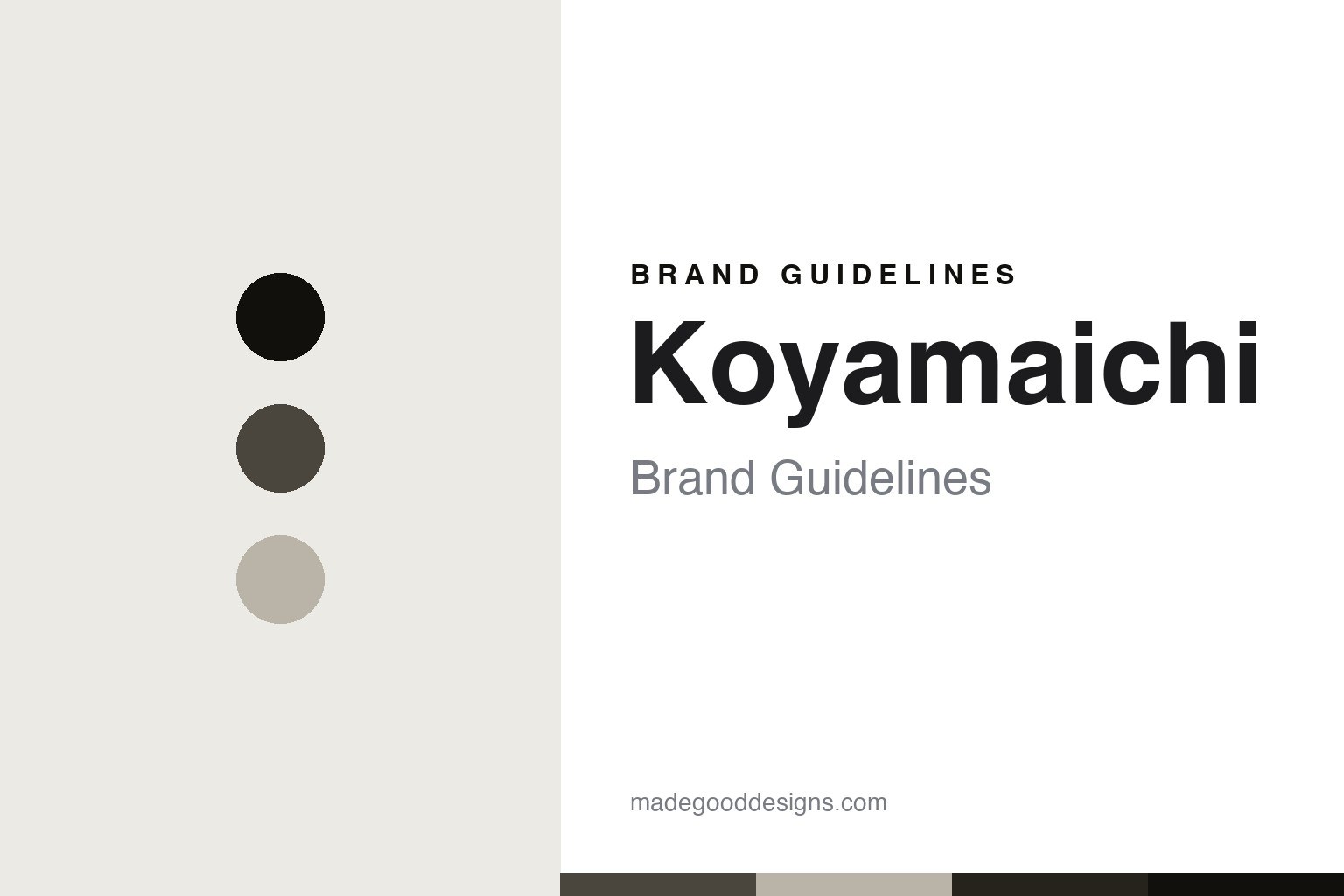
Koyamaichi lives in a forge-charcoal palette. Click a swatch to copy the hex.
Koyamaichi’s identity is forged, Japanese and traditional — a forge charcoal, an ink, a white oak, a deep charcoal, and a paper. The palette leans forge charcoal and oak: the register of a hand-forged blade and a white-oak handle. It signals a small forge and an old craft. The honest caveat: with no published brand hex, these values are an original, unofficial interpretation, not first-party colours.
The lesson is a forge-charcoal palette signals a forged, made-in-Japan identity. Koyamaichi’s world is a forged, steel-and-oak, Japanese object. For designers, it is a reminder that a warm forge charcoal and a soft white oak can carry a traditional smith — the near-black of forged steel and the neutral of an oak handle. Because these tones can fail as small text, keep type dark and let the colour live in the accents, palette and band. The takeaways: keep the forge; make it by hand; let the craft be the heritage; and treat any single hex as unofficial.
Typography
The register is a smith sans — plain, quiet, made.
Koyamaichi’s identity carries a plain, quiet, made spirit — a small forge, not a brand machine. A smith sans captures the mood: even, understated and practical, the register of a Japanese workshop. Set in a forge-charcoal palette, the smith sans feels quiet and made — exactly the personality Koyamaichi carries. It is a living craft rather than a logo, mirroring a hand-forged chisel. (Whether Koyamaichi strikes a maker’s mark on its blades we could not confirm, so we describe no wordmark, and the exact typeface is not ours to use.) Because we invent nothing, the honest description is “a smith-sans spirit,” shown here in a stand-in. The type behaves like the smith: plain, quiet and made.
Aa
A smith-sans spirit — quiet and made. (Specimen set in Mulish, a smith-sans STAND-IN; no Koyamaichi mark is known or reproduced.)
The old toolmakers
Koyamaichi stands for the living craft, hand-forged in Japan.
Koyamaichi is a lesson in how a living craft can be an identity — and how to write one honestly when the record is thin. A forge-charcoal palette, a smith sans and a hand-forged chisel make one thing — the Japanese chisel smith — the whole identity: forged, Japanese and traditional. The hand-forging is the differentiator, and the continuation of an old craft is the meaning. The point is a small Japanese forge that still makes chisels by hand, sought out by woodworkers who know them, with almost no corporate footprint.
Put to work, the identity is a living craft, honestly told, as design. A maker in this spirit would keep the forge, make by hand, and let the craft carry the heritage — hand-forged chisels, laminated blades, made in Japan. A brand learning from it would see that a living craft is a durable identity — that a chisel forged one at a time in a small workshop carries a depth a factory cannot — and that being precise, hand-forged in Japan, reportedly in the Hyōgo region, sold through specialists, keeps the story honest. Koyamaichi is the round’s deliberate counterpoint: where the others are dated houses with founding years and ownership records, this is a smith whose age we cannot document — so its place among the old toolmakers rests on the age of the craft, not the company, and the honest editorial move is to say exactly that. The discipline is entirely in the caveats: no invented founding year, the region marked reportedly and corrected away from Sanjo, no claimed steel grade or maker’s mark, and the covetedness attributed. The lesson Koyamaichi teaches is that a craft can hold an identity: the Japanese forging gives it substance, and the honesty about everything we cannot confirm keeps it credible. The craft is the personality, and the hand-forged chisel is the proof.
For designers and brand-builders, Koyamaichi holds the Japan pole in the old toolmakers: let the craft be the heritage, and never invent the record. The lessons: keep the forge; make by hand; claim only what you can confirm; correct the assumptions; and reproduce no mark. It is also a reminder to stay precise: Koyamaichi is a traditional Japanese blacksmith making hand-forged woodworking chisels, reportedly in the Hyōgo region, sold through specialists with no official website — with the palette here an unofficial interpretation. Koyamaichi made a living craft the identity — proof that a hand-forged Japanese chisel, honestly told, can be the difference.
Explore & save
Keep Koyamaichi’s identity on hand — save it to a board in the Made Good inspiration library.
Koyamaichi identity set
Pin the forge-charcoal palette and the smith-sans register to your own board.