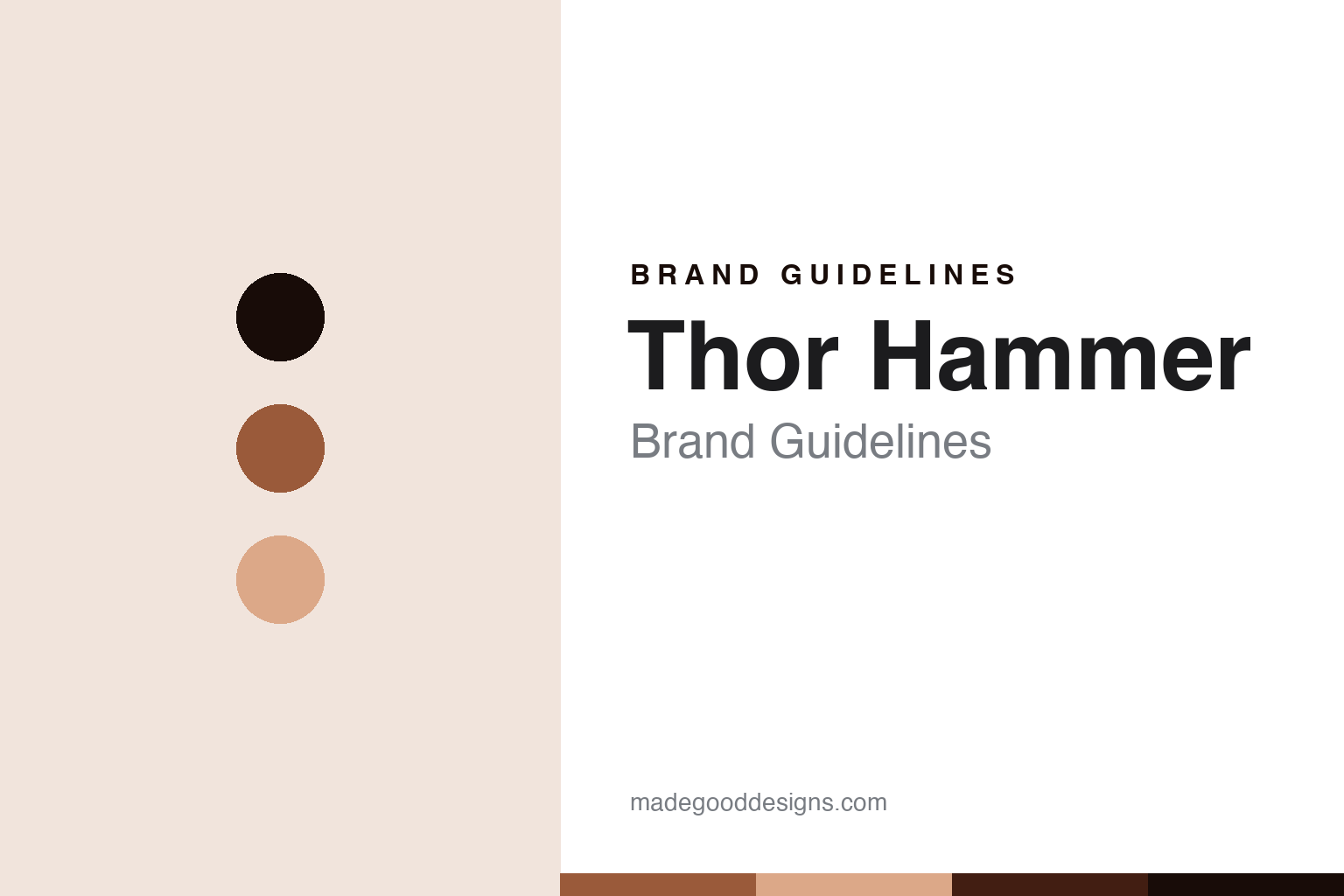
Thor Hammer Brand Guidelines
The soft-face mallet.
Aa
Two constants: a copper palette and an engineer-sans register. Abstract homage — not a Thor mallet or mark.
The soft-face mallet
Thor Hammer is the British family maker of soft-face copper and hide mallets, made in the West Midlands with hammer-making roots to the early 1930s.
Thor Hammer is the round’s soft-face maker, the mallet that strikes without marring. From Shirley, on the edge of Birmingham, the Thor Hammer Company makes soft-face hammers and mallets — copper, rawhide, copper-hide, nylon, dead-blow and split-head — with replaceable faces. Its answer to how a maker becomes a name is the soft face: strike hard without damaging the work, and let the copper-and-hide hammer become the shop standard. A British mallet, made in the Midlands.
Its identity is the soft-face mallet. Thor’s copper and hide mallets, its replaceable faces and its British making are the work it is known for. A mallet, made in Britain. A blow that does not mar.
(Honest notes, so the story stays precise. The Thor Hammer Company Limited traces its roots to belting firms incorporated in 1923, but hammer-making began around 1930, when the founder Walter Runciman Stephens named the brand “Thor,” and the present company was renamed in 1966; we say roots to 1923 and hammer-making from the early 1930s. On what it makes, soft-face hammers and mallets — copper and rawhide the signature, plus copper-hide, nylon, plastic, rubber, dead-blow and split-head — with a large replaceable-face program. On where it is made — a theme of this round — its hammers are made in Britain, at Shirley, on the southern edge of Birmingham, which is administratively in Solihull, West Midlands; we say made in Britain as the company states, while noting that inputs such as copper and rawhide are raw materials, not a claim that everything is British-origin. On ownership — welcome in a round of consolidation — Thor states it is still a family-owned business, with the Stephens family on its board; we present that as its own current statement. Its heritage stories — wartime use, a place in the toolkit of early Jaguar cars — we attribute as the company’s account. On the name: Thor is named for the Norse god of thunder and his hammer, which we can note in words, while reproducing no mythological imagery. Its marks are IP, described but never reproduced, and there is no official brand hex; these tones are an unofficial interpretation. This is design commentary and does not promote any product.)
Colour
Thor Hammer lives in a copper palette. Click a swatch to copy the hex.
Thor’s identity is soft-faced, British and made — a copper, an ink, a hide, a deep copper, and a paper. The palette leans copper and hide: the register of a copper face and a rawhide face. It signals a non-marring blow. The honest caveat: with no published brand hex, these values are an original, unofficial interpretation, not first-party colours.
The lesson is a copper palette signals a soft-face, made-in-Britain identity. Thor’s world is a soft-faced, copper-and-hide, British object. For designers, it is a reminder that a warm copper and a soft hide can carry a mallet maker — the orange-brown of a copper face and the tan of rawhide. Because these tones can fail as small text, keep type dark and let the colour live in the accents, palette and band. The takeaways: strike without marring; make it replaceable; make it in Britain; and treat any single hex as unofficial.
Typography
The register is an engineer sans — plain, sturdy, made.
Thor’s identity carries a plain, sturdy, made spirit — an engineering-hammer maker, not a fashion label. An engineer sans captures the mood: even, solid and practical, the register of a Midlands works. Set in a copper palette, the engineer sans feels sturdy and made — exactly the personality Thor carries. It is soft-face engineering rather than a logo, mirroring a copper-hide mallet. (Thor’s real lowercase wordmark and its face shapes are things we describe but do not reproduce, and the exact typeface is not ours to use.) Because it is not ours to use, the honest description is “an engineer-sans spirit,” shown here in a stand-in. The type behaves like the mallet: plain, sturdy and made.
Aa
An engineer-sans spirit — sturdy and made. (Specimen set in Space Grotesk, an engineer-sans STAND-IN; NOT the Thor wordmark or face shapes.)
The striking & digging tools
Thor Hammer stands for the soft-face mallet, still family-made in Britain.
Thor Hammer is a lesson in how a specialised blow can be an identity. A copper palette, an engineer sans and a soft-face mallet make one thing — the soft-face mallet — the whole identity: soft-faced, British and made. The copper and hide mallets are the differentiator, and the non-marring blow is the meaning. The point is a maker that specialised in the soft-face hammer — the tool that strikes hard without damaging the work — and made it a British engineering standard.
Put to work, the identity is a specialised blow, honestly told, as design. A maker in this spirit would specialise the face, make it replaceable, and make it at home — copper and hide mallets, replaceable faces, made in Britain. A brand learning from it would see that a specialised tool is a durable identity — that a mallet that protects the work carries a value a plain hammer cannot — and that being precise, roots to 1923, hammer-making from the early 1930s, made in Britain, keeps the story honest. In a round about consolidation, Thor is one of the family holdouts: it states it is still family-owned, the Stephens family on the board, where the German and American hammer makers around it have passed into groups. The honest editorial moves are to date the hammer-making from the early 1930s rather than the 1923 parent firms, to place it precisely at Shirley on Birmingham’s edge, and to mention the Norse-god naming in words while keeping every visual abstract. The lesson Thor teaches is that a specialised blow can hold an identity: the British soft-face making gives it substance, and the honesty about dates and materials keeps it credible. The soft face is the personality, and the British-made mallet is the proof.
For designers and brand-builders, Thor holds the England pole in the striking & digging tools: specialise the blow, and keep it family-made. The lessons: solve a specific problem (a non-marring strike); make it replaceable; make in-country; date the craft honestly; and never reproduce a logo. It is also a reminder to stay precise: Thor Hammer is the British family maker of soft-face copper and hide mallets, made in the West Midlands with hammer-making roots to the early 1930s — with the palette here an unofficial interpretation. Thor made the soft-face mallet the identity — proof that a British soft-face mallet, honestly told, can be the difference.
Explore & save
Keep Thor Hammer’s identity on hand — save it to a board in the Made Good inspiration library.
Thor Hammer identity set
Pin the copper palette and the engineer-sans register to your own board.