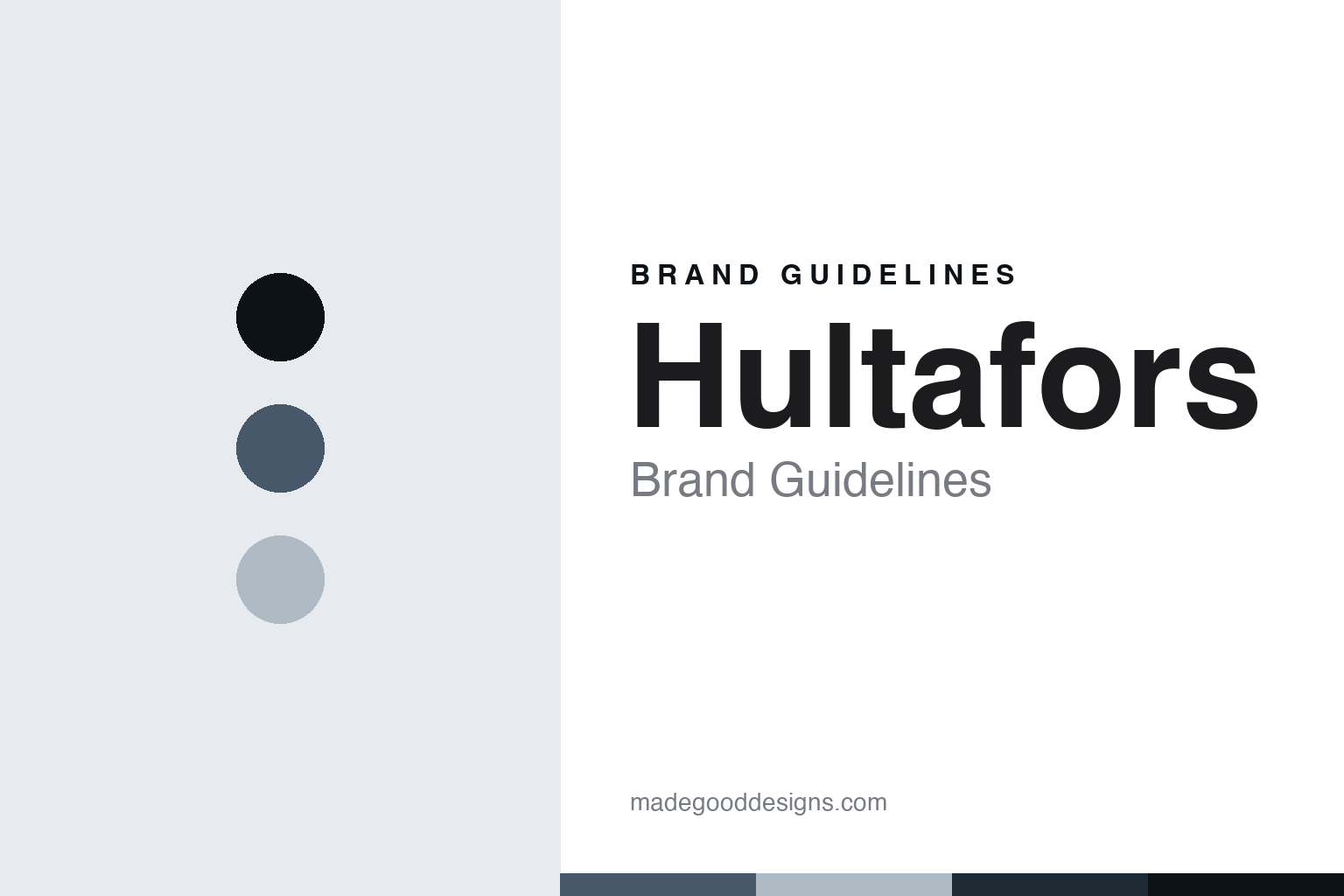
Hultafors Brand Guidelines
The Swedish hand tool.
Aa
Two constants: a steel-blue palette and a trade-sans register. Abstract homage — not a Hultafors tool or mark.
The Swedish hand tool
Hultafors is the Swedish hand-tool brand of hammers, chisels and the famous folding rule, dating to 1883 and now part of a group owned by Latour.
Hultafors is the round’s Swedish hand-tool house, best known for the tool that measures but making the tools that strike too. From Sweden, Hultafors makes hammers, chisels, saws, tape measures and its famous folding rule, for the trades. Its answer to how a maker becomes a name is a single classic tool that built a brand: invent the folding rule, and grow into a full trade-tool line. A Swedish hand tool, from an 1883 name.
Its identity is the Swedish hand tool. Hultafors’s hammers and chisels, its 1883 folding-rule heritage and its trade range are the work it is known for. A hand tool, from Sweden. A brand built on a folding rule.
(Honest notes, so the story stays precise, because the ownership and the made-where both need care. Hultafors dates to 1883, when Karl-Hilmer Johansson Kollén invented the folding rule — the tumstock — that made the name; today Hultafors is the hand-tool brand within the Hultafors Group, which is a wholly-owned company of the listed Swedish investment company Investment AB Latour. On what it makes, hammers, chisels, saws, tape measures, spirit levels, knives and the red-tipped folding rule; for this round we focus on its hammers and striking tools. On where it is made — the crux of this entry — only the folding rules are confirmed Swedish-made, produced in Sweden in the millions of metres a year; the hammers, chisels, tapes and levels we could not confirm as Swedish-made, and as a brand inside a large multinational group some ranges are likely made elsewhere, so we do not claim a blanket made in Sweden. On a distinction that matters: Hultafors the hand-tool brand is not Hults Bruk, the separate Swedish axe forge covered earlier in this vein; both sat under the Hultafors Group, and Hultafors’s own marketing even references Hults Bruk axes, so we keep them apart and do not borrow the axe forge’s hand-forged heritage. Its production figures and “over 140 years” we attribute as the brand’s own. Its wordmark and its red-tipped folding rule are IP, described but never reproduced, and there is no official brand hex; these tones are an unofficial interpretation. This is design commentary and does not promote any product.)
Colour
Hultafors lives in a steel-blue palette. Click a swatch to copy the hex.
Hultafors’s identity is practical, Swedish and trade — a steel blue, an ink, a frost, a deep steel, and a paper. The palette leans steel blue and frost: the register of a working hand tool and a cool steel. It signals the trades. The honest caveat: with no published brand hex, these values are an original, unofficial interpretation, not first-party colours — and the palette avoids the brand’s red-tipped yellow rule, which is trade dress.
The lesson is a steel-blue palette signals a practical, Swedish hand-tool identity. Hultafors’s world is a practical, steel, Swedish object. For designers, it is a reminder that a cool steel blue and a soft frost can carry a trade-tool brand — the blue of tool steel and the neutral of a working edge. Because these tones can fail as small text, keep type dark and let the colour live in the accents, palette and band. The takeaways: build on one classic tool; serve the trades; be honest about where each line is made; and treat any single hex as unofficial.
Typography
The register is a trade sans — plain, useful, made.
Hultafors’s identity carries a plain, useful, made spirit — a trade-tool brand, not a luxury label. A trade sans captures the mood: even, practical and modern, the register of a working site. Set in a steel-blue palette, the trade sans feels useful and made — exactly the personality Hultafors carries. It is trade heritage rather than a logo, mirroring a working hand tool. (Hultafors’s real wordmark and its red-tipped folding rule are things we describe but do not reproduce, and the exact typeface is not ours to use.) Because it is not ours to use, the honest description is “a trade-sans spirit,” shown here in a stand-in. The type behaves like the tool: plain, useful and made.
Aa
A trade-sans spirit — useful and made. (Specimen set in Manrope, a trade-sans STAND-IN; NOT the Hultafors logo or folding rule.)
The striking & digging tools
Hultafors stands for the Swedish hand tool, honest about where it is made.
Hultafors is a lesson in how a classic tool and an honest where-made can be an identity. A steel-blue palette, a trade sans and a hammer make one thing — the Swedish hand tool — the whole identity: practical, Swedish and trade. The 1883 folding-rule heritage is the differentiator, and the full trade range is the meaning. The point is a brand that grew from a single classic tool — the folding rule — into a full trade-tool line, now inside a large Swedish-owned group.
Put to work, the identity is a trade brand, honestly told, as design. A maker in this spirit would build on one classic tool, serve the trades, and be honest about where each line is made — hammers, chisels, the folding rule, a Swedish heritage. A brand learning from it would see that a classic origin plus honesty is a durable identity — that a name built on the folding rule carries a heritage a new brand cannot — and that being precise, founded 1883 by Karl-Hilmer Johansson Kollén, part of a group owned by Latour, keeps the story honest. Hultafors carries two of the round’s threads: ownership, as a heritage brand now inside the Latour-owned Hultafors Group; and where-made, where the honest answer is careful — the folding rules are Swedish-made, but the rest of the range we could not confirm, so a blanket made-in-Sweden would be wrong. It also completes a callback from earlier in this vein: the same group once held Hults Bruk, the axe forge, which appears to have left it, while Hultafors the hand-tool brand stayed. The lesson Hultafors teaches is that a classic tool can hold an identity: the folding-rule heritage gives it substance, and the honesty about make and owner keeps it credible. The classic tool is the personality, and the honestly-labelled hand tool is the proof.
For designers and brand-builders, Hultafors holds the Sweden pole in the striking & digging tools: build on a classic tool, and claim only the origin you can stand behind. The lessons: grow from one classic; serve the trades; confirm made-in line by line; keep confusable brands distinct; and never reproduce a logo. It is also a reminder to stay precise: Hultafors is the Swedish hand-tool brand of hammers, chisels and the famous folding rule, dating to 1883 and now part of a group owned by Latour — with the palette here an unofficial interpretation. Hultafors made a classic tool the identity — proof that a Swedish hand tool, honestly told, can be the difference.
Explore & save
Keep Hultafors’s identity on hand — save it to a board in the Made Good inspiration library.
Hultafors identity set
Pin the steel-blue palette and the trade-sans register to your own board.