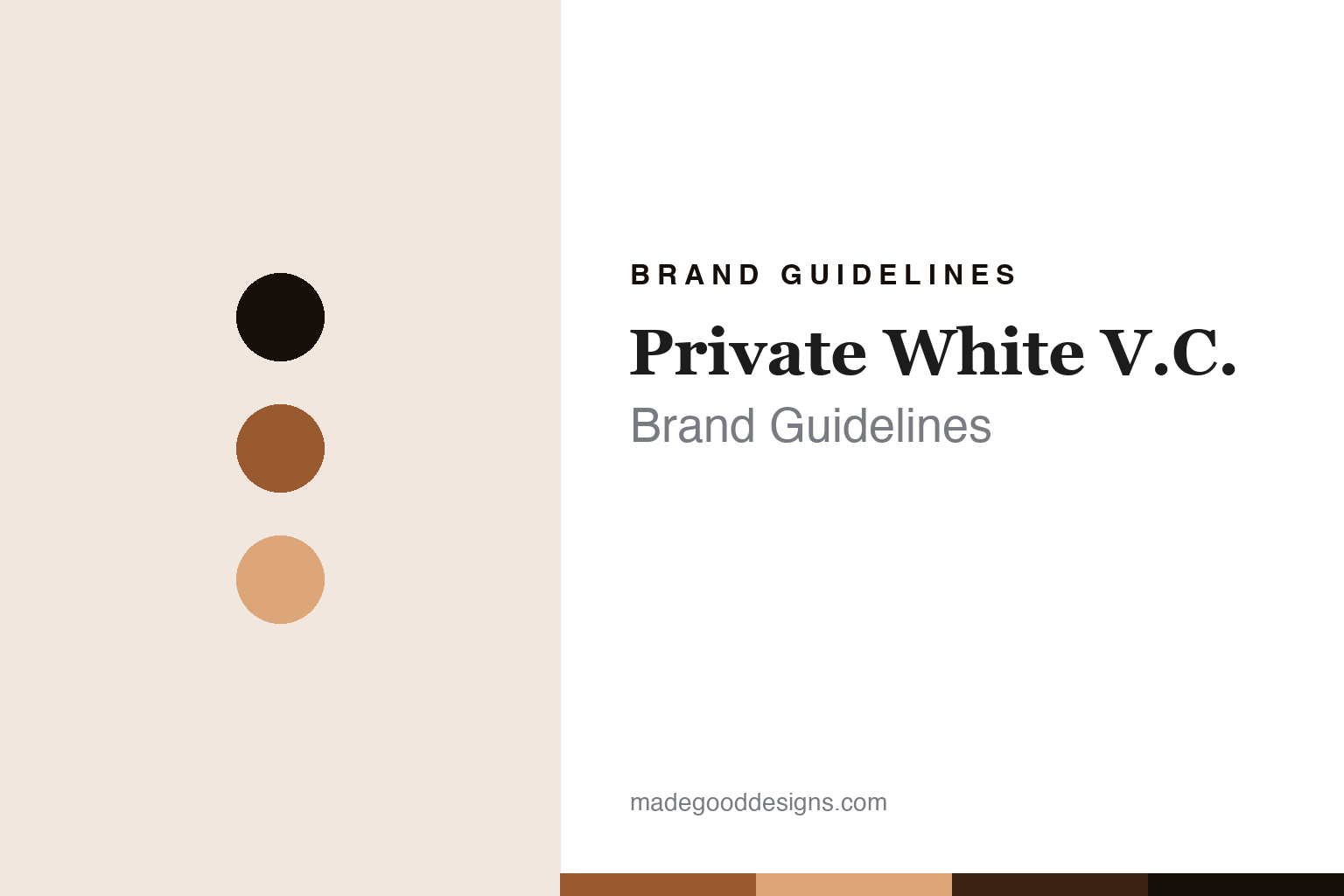
Private White V.C. Brand Guidelines
The factory it owns.
Aa
Two constants: a copper palette and a heritage-serif register. Abstract homage — not a Private White V.C. garment or mark.
The factory it owns
Private White V.C. is the British outerwear house that designs and makes in its own Manchester (Salford) factory, named for a WWI Victoria Cross recipient.
Private White V.C. opens the round with the clearest answer to its central question — who owns the factory, and where is it? From Salford, in Greater Manchester, Private White V.C. makes outerwear-led heritage menswear — Ventile macs, harringtons, peacoats and flight jackets, with knitwear and shirting — in its own factory. Its answer to how a maker becomes a name is vertical integration: design and manufacture the finest coats under one Manchester roof, and own the making. A British coat, made in the house that designs it.
Its identity is the factory it owns. Private White V.C.’s own Manchester making, its Ventile outerwear and its honest heritage are the work it is known for. A coat, made in England. A house that owns its factory.
(Honest notes, so the story stays precise. Private White V.C. — at privatewhitevc.com — designs and manufactures in its own Cottenham House factory, which is technically in Salford, part of Greater Manchester; the brand’s “Manchester” is the metropolitan shorthand, and the honest phrasing is Salford, Manchester. The factory is the shared premises of its in-house manufacturer, Cooper & Stollbrand, and public records support the vertical-integration claim: the manufacturer and the brand are registered at the same address, and the “Stoll” manufacturing link is a real directorship, not decoration. On founding, the brand was incorporated in 2010 and launched around 2011 by James Eden, who is still a director and owner in 2026; it is independent and Eden-family-owned, with no external investor named in its filings. On its name — a theme of this round — “V.C.” honours the Victoria Cross, and the brand is named for Jack White, a real First World War Victoria Cross recipient, born Jacob Weiss, who after the war became a Manchester garment manufacturer; we treat him respectfully and factually and reproduce no medal, ribbon or insignia. Two lineage details rest on the family’s own telling: that James Eden is Jack White’s great-grandson, and that the factory has operated unbroken since Jack White’s era — the limited companies date to 1999 and 2010, so we present the deeper continuity as reported, on a site the family has manufactured at for generations. Its name and marks are IP, described but never reproduced, and there is no official brand hex; these tones are an unofficial interpretation. This is design commentary and does not promote any product.)
Colour
Private White V.C. lives in a copper palette. Click a swatch to copy the hex.
Private White V.C.’s identity is made, British and honest — a copper, an ink, a sand, a deep copper, and a paper. The palette leans copper and sand: the register of copper hardware and a natural Ventile cotton, the “copper and courage” the house talks about. It signals a made-in-England coat. The honest caveat: with no published brand hex, these values are an original, unofficial interpretation, not first-party colours.
The lesson is a copper palette signals a made, vertically-integrated identity. Private White V.C.’s world is a made, cotton, British object. For designers, it is a reminder that a warm copper and a soft sand can carry an outerwear house — the metal of the hardware and the neutral of the cloth. Because these tones can fail as small text, keep type dark and let the colour live in the accents, palette and band. The takeaways: own the factory; make it at home; be honest about the lineage; and treat any single hex as unofficial.
Typography
The register is a heritage serif — classical, British, made.
Private White V.C.’s identity carries a classical, British, made spirit — a Manchester outerwear house, not a fashion label. A heritage serif captures the mood: traditional, dignified and precise, the register of a working factory with a war-hero’s name. Set in a copper palette, the heritage serif feels classical and made — exactly the personality Private White V.C. carries. It is British making rather than a logo, mirroring a Ventile mac. (Private White V.C.’s real wordmark, and the Victoria Cross it honours, are things we describe but never reproduce, and the exact typeface is not ours to use.) Because it is not ours to use, the honest description is “a heritage-serif spirit,” shown here in a stand-in. The type behaves like the coat: classical, British and made.
Aa
A heritage-serif spirit — classical and made. (Specimen set in Cormorant Garamond, a heritage-serif STAND-IN; NOT the Private White V.C. logo or any Victoria Cross imagery.)
The workwear houses around the world
Private White V.C. stands for the factory a house owns, at home.
Private White V.C. opens the round with its cleanest case: a house that owns its factory, at home. A copper palette, a heritage serif and a Ventile coat make one thing — its own Manchester making — the whole identity: made, British and honest. The owned factory is the differentiator, and the honesty about the lineage is the meaning. The point is an outerwear house that designs and manufactures under one Salford roof, and tells its heritage straight.
Put to work, the identity is vertical integration, honestly told, as design. A maker in this spirit would own the making, keep it in-country, and be precise about the story — outerwear, Ventile, made in its own factory. A brand learning from it would see that owning the factory is a durable identity — that a house which can point to the premises where its coats are cut and sewn holds a proof a marketing claim cannot — and that being precise, incorporated 2010 and launched around 2011 by James Eden, independent and family-owned, keeps the story honest. Private White V.C. sets the round’s question and answers it at one pole: who owns the factory, and where is it? Here, the house owns it, and it is at home in Salford. It also carries the round’s name thread with dignity, honouring a real Victoria Cross recipient without reproducing his decoration, and the revival-versus-continuous thread from the honest side, presenting the deeper family continuity as reported while the companies themselves date to 1999 and 2010. The honest editorial moves are to say Salford, Manchester rather than Manchester alone, to attribute the great-grandson relationship and the unbroken-factory claim, and to reproduce no medal or insignia. The lesson Private White V.C. teaches is that an owned factory can hold an identity: the making gives it substance, and the honesty about the lineage keeps it credible. The factory is the personality, and the made-in-England coat is the proof.
For designers and brand-builders, Private White V.C. opens the workwear houses around the world, from Britain: own the factory, and make it at home. The lessons: control the making; manufacture in-country; honour a name with dignity; attribute the parts of a heritage you cannot document; and never reproduce a logo. It is also a reminder to stay precise: Private White V.C. is the British outerwear house that designs and makes in its own Manchester (Salford) factory, named for a WWI Victoria Cross recipient — with the palette here an unofficial interpretation. Private White V.C. made an owned factory the identity — proof that a British coat, honestly told, can be the difference.
Explore & save
Keep Private White V.C.’s identity on hand — save it to a board in the Made Good inspiration library.
Private White V.C. identity set
Pin the copper palette and the heritage-serif register to your own board.