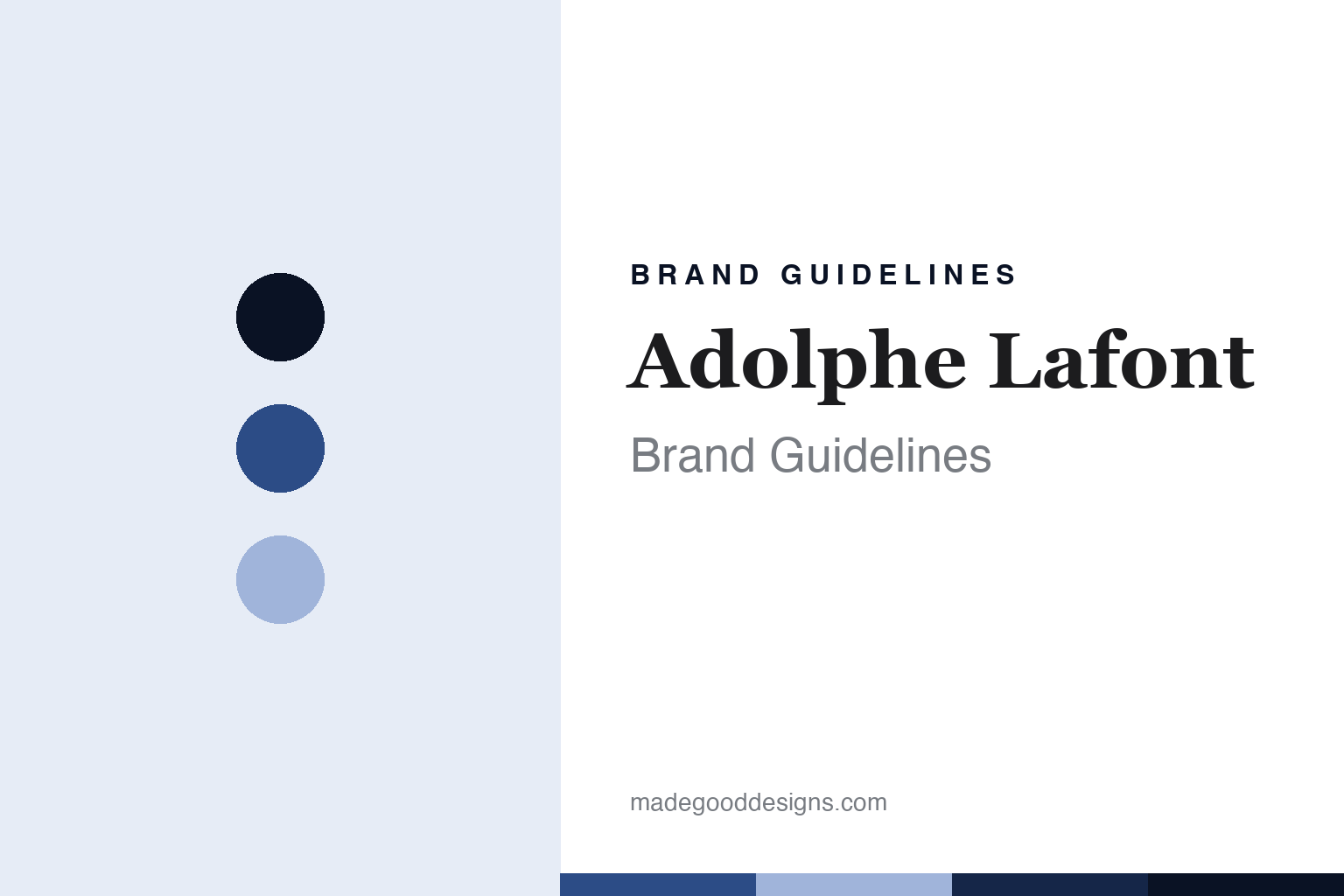
Adolphe Lafont Brand Guidelines
The French work overall.
Aa
Two constants: a cobalt-blue palette and an atelier-serif register. Abstract homage — not an Adolphe Lafont garment or mark.
The French work overall
Adolphe Lafont is the Lyon workwear house from 1844 that carries the French salopette, now a professional-workwear brand made offshore.
Adolphe Lafont is the round’s French answer — the house of the salopette. From Lyon, Adolphe Lafont carries the French work overall — the salopette, or cotte à bretelles, the bib-and-brace the brand says it was first to build with a central tool pocket — alongside modern professional and industrial workwear for the trades. Its answer to how a maker becomes a name is a garment it helped define: the French work overall, born with the industrial age. A salopette, in the French mould.
Its identity is the French work overall. Adolphe Lafont’s salopette, its 1844 Lyon heritage and its professional-workwear present are the work it is known for. An overall, in French blue. The cotte à bretelles.
(Honest notes, so the story stays precise, with two caveats. Adolphe Lafont — at a-lafont.com, not the unrelated Lafont eyewear company — is one of the oldest French workwear houses, founded in 1844 in Lyon; its heritage signature is the salopette, or cotte à bretelles, which it presents as the first carpenter’s overall with a central tool pocket. The founder’s name carries a conflict: the brand credits the man Adolphe Lafont, while reference sources name a Louis Lafont as founder with Adolphe Lafont as the enterprise name — so we say founded in 1844 in Lyon under the Adolphe Lafont name, and hedge the individual. On where it is made — the crux of this round — do not read it as made in France: the brand flies a “French since 1844” banner but does not say where garments are sewn, and reference sources place manufacturing offshore, in Tunisia, Morocco, China and Bangladesh, with design, fabric choice and quality control kept near Lyon; we present the offshore make as reported. On ownership and status, it has been part of the Cepovett Group since 2016 and reads today as a professional and industrial workwear brand rather than a heritage-consumer label. The French cotte and bleu de travail are culturally iconic; we reference them in words only and reproduce no salopette or trade-dress. Its name and marks are IP, described but never reproduced, and there is no official brand hex; these tones are an unofficial interpretation. This is design commentary and does not promote any product.)
Colour
Adolphe Lafont lives in a cobalt-blue palette. Click a swatch to copy the hex.
Adolphe Lafont’s identity is French, industrial and made-abroad — a cobalt blue, an ink, a sky, a deep cobalt, and a paper. The palette leans cobalt blue and sky: the register of a French bleu-de-travail salopette and a worn drill. It signals a French work overall. The honest caveat: with no published brand hex, these values are an original, unofficial interpretation, not first-party colours.
The lesson is a cobalt-blue palette signals a French work-overall identity. Adolphe Lafont’s world is a French, cotton, industrial object. For designers, it is a reminder that a cobalt blue and a soft sky can carry a French workwear house — the blue of the bleu de travail and the neutral of a worn drill. Because these tones can fail as small text, keep type dark and let the colour live in the accents, palette and band. The takeaways: own a national garment; tell the age honestly; don’t claim a make you can’t verify; and treat any single hex as unofficial.
Typography
The register is an atelier serif — classical, French, made.
Adolphe Lafont’s identity carries a classical, French, industrial spirit — an old workwear house, now a professional-workwear brand. An atelier serif captures the mood: traditional, upright and French, the register of a Lyon workwear name. Set in a cobalt-blue palette, the atelier serif feels classical and French — exactly the personality Adolphe Lafont carries. It is a national garment rather than a logo, mirroring a salopette. (Adolphe Lafont’s real wordmark and the cotte silhouette are things we describe but never reproduce, and the exact typeface is not ours to use.) Because it is not ours to use, the honest description is “an atelier-serif spirit,” shown here in a stand-in. The type behaves like the overall: classical, French and made.
Aa
An atelier-serif spirit — classical and French. (Specimen set in Playfair Display, an atelier-serif STAND-IN; NOT the Adolphe Lafont logo.)
The overall, the dungaree and the boilersuit
Adolphe Lafont stands for the French work overall, made offshore.
Adolphe Lafont is a lesson in how a house can own a national garment and still change with the century. A cobalt-blue palette, an atelier serif and a salopette make one thing — the French work overall — the whole identity: French, industrial and made-abroad. The salopette is the differentiator, and the honest reading of the age and the make is the meaning. The point is one of the oldest French workwear houses, carrying the garment it helped define, now a professional-workwear brand made offshore.
Put to work, the identity is a national garment, read honestly, as design. A maker in this spirit would own a garment its country invented and keep it central — the salopette, the cotte à bretelles. A reader in this spirit would hold three honest facts: the house is genuinely old, 1844 in Lyon; the founder’s name is contested, so the man is hedged and the name stated; and the make is offshore, not French, whatever the banner says. Adolphe Lafont carries the round’s where-made question from the French side — a heritage house whose garments are now sewn abroad — and its status thread as the heritage name turned industrial-workwear brand. It sits beside the American icons as another old overall name that no longer makes at home. The honest editorial moves are to state 1844 and Lyon plainly, to hedge the founder, to present the offshore make and the Cepovett ownership as reported, and to reproduce no cotte. The lesson Adolphe Lafont teaches is that a national garment can hold an identity across two centuries: the salopette gives it substance, and the honesty about the age and the make keeps it credible. The French work overall is the personality, and the honest geography is the proof.
For designers and brand-builders, Adolphe Lafont holds the France pole in the overall, the dungaree and the boilersuit: own a national garment — and be honest about the age and the make. The lessons: carry a garment your country defined; state a real founding and hedge a contested founder; don’t let a heritage banner imply a home-country make; place ownership plainly; and never reproduce a logo. It is also a reminder to stay precise: Adolphe Lafont is the Lyon workwear house from 1844 that carries the French salopette, now a professional-workwear brand made offshore — with the palette here an unofficial interpretation. Adolphe Lafont made the French work overall the identity — proof that a national garment, honestly told, can be the difference.
Explore & save
Keep Adolphe Lafont’s identity on hand — save it to a board in the Made Good inspiration library.
Adolphe Lafont identity set
Pin the cobalt-blue palette and the atelier-serif register to your own board.