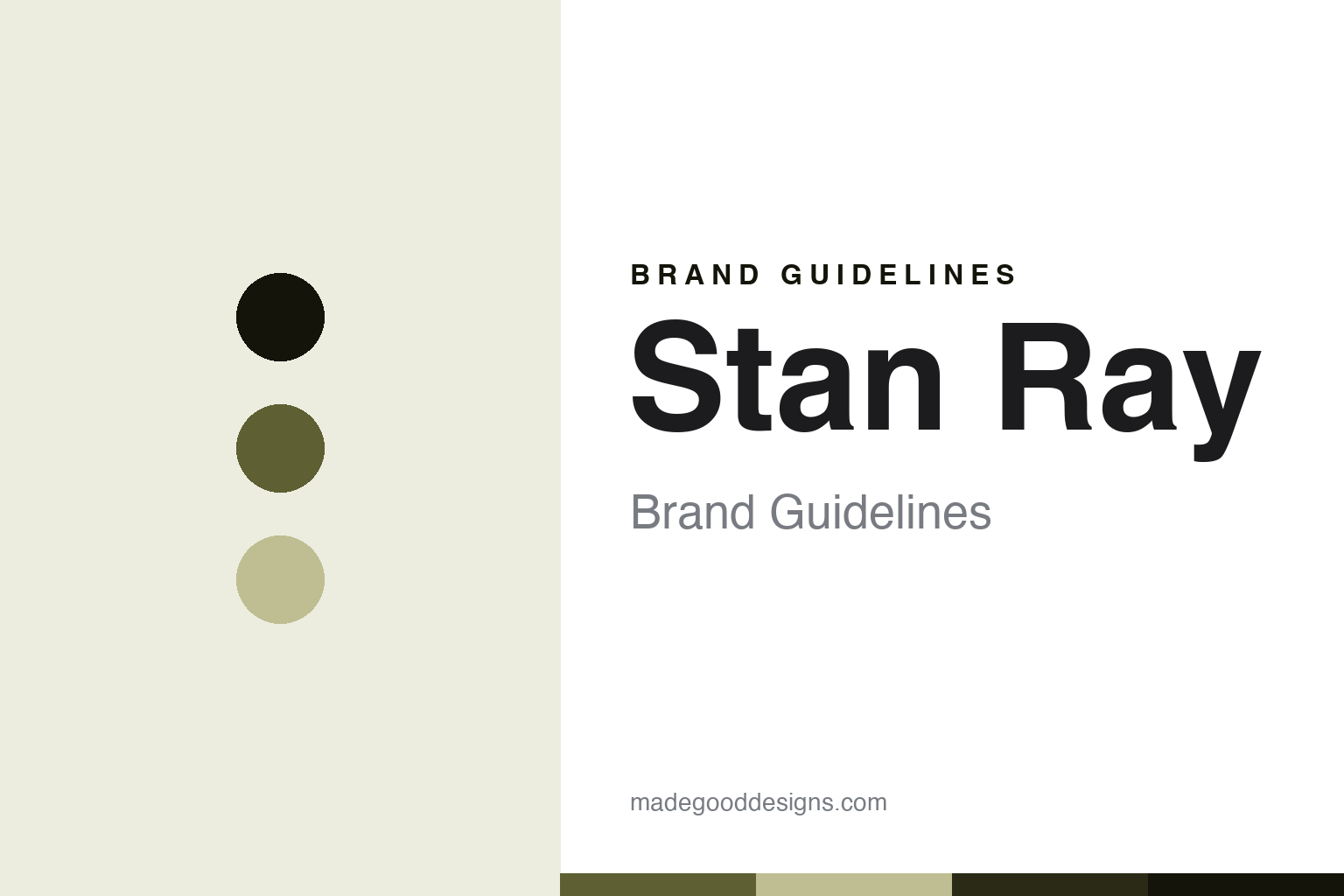
Stan Ray Brand Guidelines
The fatigue cloth.
Aa
Two constants: an olive-drab palette and a utility-sans register. Abstract homage — not a Stan Ray garment or mark.
The fatigue cloth
Stan Ray is the fatigue- and painter-pant maker whose cotton sateen and drill are still cut in its family factory in Crockett, Texas since 1972.
Stan Ray is the round’s fatigue pant, made in one Texas town for over fifty years. From Crockett, Texas, Stan Ray makes the fatigue trouser and the painter pant — plus jackets, shirts and workwear — in cotton sateen and cotton drill. Its answer to how a maker becomes a name is a cloth and a construction kept honest: cut the army-fatigue trouser in cotton sateen and the painter pant in cotton drill, chain-stitched and bar-tacked, in the same family factory. A fatigue pant, made the real way.
Its identity is the fatigue cloth. Stan Ray’s cotton sateen and drill, its OG fatigue and painter pants and its Texas factory are the work it is known for. A trouser, made in the USA. Honest fatigue cloth.
(Honest notes, so the story stays precise. Stan Ray — at stanray.com, operated by the UK company Sunny-Up — takes its signature from two cloths and their construction: the OG fatigue trouser, modelled on the US Army OG-107 utility uniform, cut in cotton sateen, and the OG painter pant, cut in cotton drill and twill, both chain-stitched and bar-tacked with triple chain-stitched, flat-felled seams. On its history, Stan Ray grew from Earl’s Apparel, founded in 1972 in Crockett, Texas, by Earl Beard; it is still a family-run factory, and its fatigues became cult items through Japanese vintage buyers when US rivals moved offshore. A “Ramco” label lineage is sometimes cited; we could not confirm it, so we leave it out. On where it is made — the crux of this round — the core OG fatigue and painter pants are genuinely made in the USA, in the Crockett family factory, but the wider range of tops, sweats and jackets is imported, and the brand itself curates a “made in the USA” sub-collection that signals the rest is made elsewhere; so we say the pants are US-made and the wider range is mixed, not a blanket American claim. On ownership, the Texas factory is the Beard family’s, while the brand is operated by the UK’s Sunny-Up; we name no individuals as owner beyond the founder. Because it is modelled on a military uniform, we reference the concept only and reproduce no insignia. Its name and marks are IP, described but never reproduced, and there is no official brand hex; these tones are an unofficial interpretation. This is design commentary and does not promote any product.)
Colour
Stan Ray lives in an olive-drab palette. Click a swatch to copy the hex.
Stan Ray’s identity is utility, made and plain — an olive drab, an ink, a sage, a deep olive, and a paper. The palette leans olive drab and sage: the register of an army-sateen fatigue and a worn cotton drill. It signals honest utility clothing. The honest caveat: with no published brand hex, these values are an original, unofficial interpretation, not first-party colours.
The lesson is an olive-drab palette signals a utility, made-in-USA identity. Stan Ray’s world is a utility, cotton, American object. For designers, it is a reminder that an olive drab and a soft sage can carry a fatigue-pant maker — the green of army sateen and the neutral of worn drill. Because these tones can fail as small text, keep type dark and let the colour live in the accents, palette and band. The takeaways: keep the cloth and the stitch; make the core at home; be honest about the imports; and treat any single hex as unofficial.
Typography
The register is a utility sans — plain, even, made.
Stan Ray’s identity carries a plain, even, made spirit — a fatigue-pant factory, not a fashion label. A utility sans captures the mood: honest, functional and unfussy, the register of a Texas workroom. Set in an olive-drab palette, the utility sans feels plain and made — exactly the personality Stan Ray carries. It is honest utility rather than a logo, mirroring a fatigue trouser. (Stan Ray’s real wordmark, and any OG-107 fatigue-cut or military marking, are things we describe but never reproduce, and the exact typeface is not ours to use.) Because it is not ours to use, the honest description is “a utility-sans spirit,” shown here in a stand-in. The type behaves like the trouser: plain, even and made.
Aa
A utility-sans spirit — plain and made. (Specimen set in Work Sans, a utility-sans STAND-IN; NOT the Stan Ray logo or any insignia.)
How workwear is made
Stan Ray stands for the fatigue cloth, made the real way.
Stan Ray is a lesson in how a cloth and a stitch can be an identity. An olive-drab palette, a utility sans and a fatigue trouser make one thing — the fatigue cloth — the whole identity: utility, made and plain. The cotton sateen and drill, chain-stitched and bar-tacked, are the differentiator, and the Texas making is the meaning. The point is a family factory that has cut the same honest fatigue and painter cloths in the same town since 1972.
Put to work, the identity is a cloth and a construction, told straight, as design. A maker in this spirit would keep the fabric and the stitch honest and make the core at home — cotton sateen, cotton drill, chain-stitched in Texas. A brand learning from it would see that a construction can be an identity — that “made in our Texas factory since 1972” is a proof a graphic cannot fake — and that being precise about the imports keeps it honest: the pants are US-made, the wider range is not. Stan Ray carries the round’s cloth thread through construction, and its where-made thread from the transparent side, a maker that labels its American-made core and lets the sub-collection admit the rest is imported. The honest editorial moves are to name the two cloths and their real seams, to drop the unconfirmed Ramco lineage, to keep the OG-107 as a civilian reference with no insignia, and to say the core is US-made while the wider range is mixed. The lesson Stan Ray teaches is that a cloth and a stitch can hold an identity: the construction gives it substance, and the honesty about the make keeps it credible. The fatigue cloth is the personality, and the Texas-made pant is the proof.
For designers and brand-builders, Stan Ray holds a US pole in how workwear is made: keep the cloth and the stitch honest — and be straight about the imports. The lessons: own a fabric and a construction; make the core in-country; don’t claim blanket local make; keep a military reference civilian; and never reproduce a logo. It is also a reminder to stay precise: Stan Ray is the fatigue- and painter-pant maker whose cotton sateen and drill are still cut in its family factory in Crockett, Texas since 1972 — with the palette here an unofficial interpretation. Stan Ray made a fatigue cloth the identity — proof that a trouser, honestly made, can be the difference.
Explore & save
Keep Stan Ray’s identity on hand — save it to a board in the Made Good inspiration library.
Stan Ray identity set
Pin the olive-drab palette and the utility-sans register to your own board.