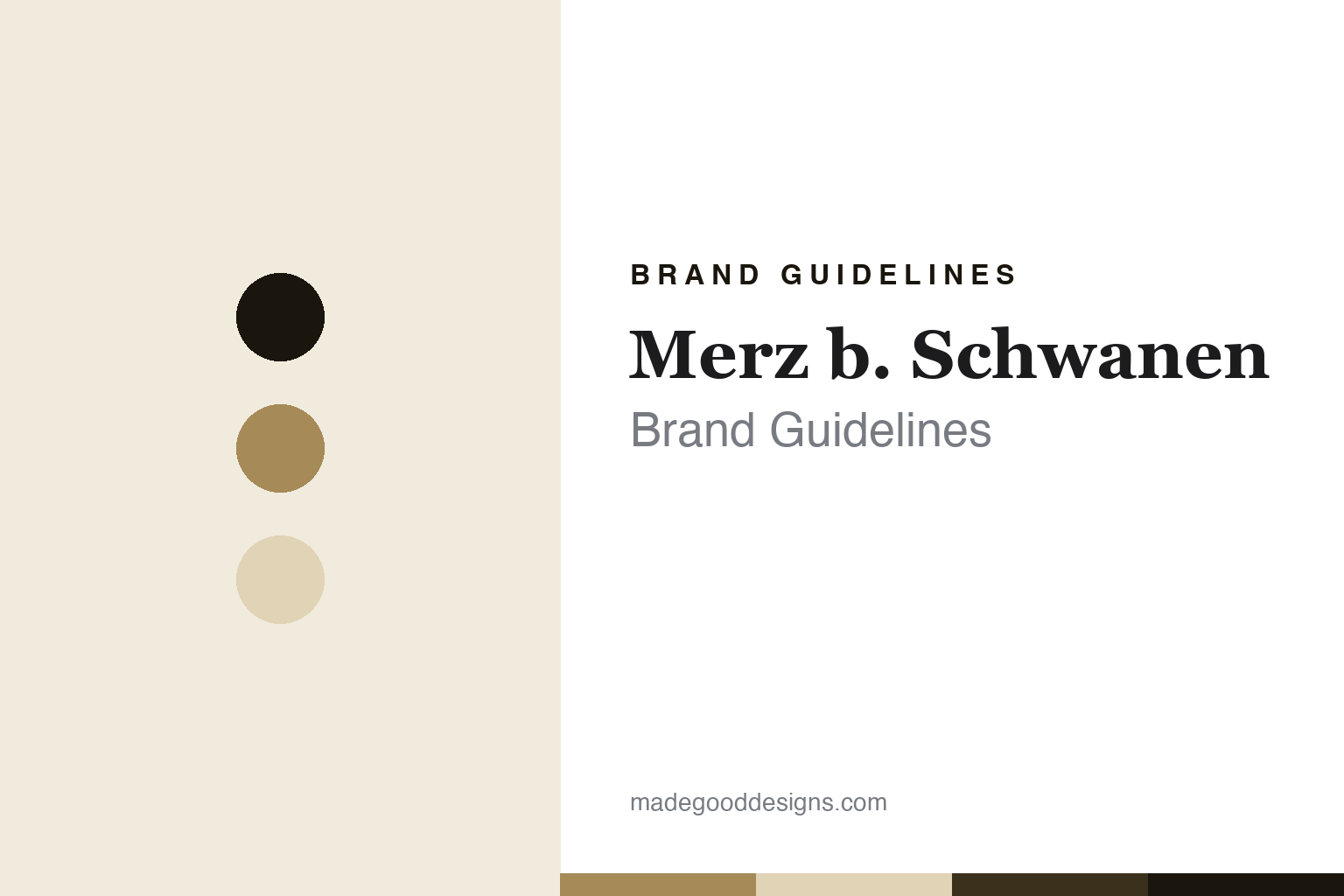
Merz b. Schwanen Brand Guidelines
The loopwheeled cloth.
Aa
Two constants: an oat palette and a heritage-serif register. Abstract homage — not a Merz b. Schwanen garment or mark.
The loopwheeled cloth
Merz b. Schwanen is the German heritage-knit house whose loopwheeled jersey is made on vintage circular-knit machines, founded 1911 and revived 2011.
Merz b. Schwanen opens the round with a cloth that is the whole identity — loopwheeled jersey. From Germany, Merz b. Schwanen makes heritage basics — the loopwheeled tee, henley, sweatshirt and knit underwear — in a soft, characterful jersey knitted on rare vintage machines. Its answer to how a maker becomes a name is a single construction: knit the cloth the old, slow way, on loopwheel machines, and let the fabric be the product. A tee, defined by how its cloth is made.
Its identity is the loopwheeled cloth. Merz b. Schwanen’s loopwheeled jersey, its heritage basics and its German making are the work it is known for. A knit, made the slow way. The cloth is the garment.
(Honest notes, so the story stays precise. Merz b. Schwanen — at merzbschwanen.com — takes its signature from loopwheel, or circular-knitting, machines: old, low-tension knitting machines that knit a soft, slightly irregular, tubular jersey with no side seams. The romance around them — that they are 1920s machines running at “the same tension as gravity,” that they are scarce and slow, that the woven labels use 19th-century punch-card looms — we present as the brand’s own telling. On its history, the original Merz b. Schwanen was a real Swabian knit-underwear maker founded in 1911 by Balthasar Merz, whose name means “Merz at the Swan”; it stayed family-owned until it closed around 2008, and was revived in 2011 by Peter Plotnicki and Gitta Banko, with the founding family’s permission — so the honest frame is founded 1911, revived 2011, not in business since 1911. On where it is made — a theme of this round — the signature loopwheeled Originals are made in Germany, in the Swabian region of the original firm, while a wider part of the collection is crafted in Portugal; we say Germany for the Originals and Portugal for the rest, not made in Germany across the board. On ownership, it is independent and founder-owned. Its name and marks are IP, described but never reproduced, and there is no official brand hex; these tones are an unofficial interpretation. This is design commentary and does not promote any product.)
Colour
Merz b. Schwanen lives in an oat palette. Click a swatch to copy the hex.
Merz b. Schwanen’s identity is natural, made and soft — an oat, an ink, an ecru, a deep oat, and a paper. The palette leans oat and ecru: the register of an undyed loopwheeled cotton and a soft heritage knit. It signals natural, slow-made cloth. The honest caveat: with no published brand hex, these values are an original, unofficial interpretation, not first-party colours.
The lesson is an oat palette signals a natural, cloth-first identity. Merz b. Schwanen’s world is a natural, cotton, made object. For designers, it is a reminder that a warm oat and a soft ecru can carry a heritage-knit house — the tone of an undyed jersey and the neutral of a natural cotton. Because these tones can fail as small text, keep type dark and let the colour live in the accents, palette and band. The takeaways: let the cloth lead; make it the slow way; be honest about the two-country make; and treat any single hex as unofficial.
Typography
The register is a heritage serif — classical, quiet, made.
Merz b. Schwanen’s identity carries a classical, quiet, made spirit — a heritage-knit house, not a fashion label. A heritage serif captures the mood: traditional, understated and German, the register of a Swabian knit maker. Set in an oat palette, the heritage serif feels classical and made — exactly the personality Merz b. Schwanen carries. It is a cloth heritage rather than a logo, mirroring a loopwheeled jersey. (Merz b. Schwanen’s real wordmark, and its loopwheel selvedge and side-seamless detailing, are things we describe but do not reproduce, and the exact typeface is not ours to use.) Because it is not ours to use, the honest description is “a heritage-serif spirit,” shown here in a stand-in. The type behaves like the cloth: classical, quiet and made.
Aa
A heritage-serif spirit — classical and made. (Specimen set in Playfair Display, a heritage-serif STAND-IN; NOT the Merz b. Schwanen logo.)
How workwear is made
Merz b. Schwanen stands for the cloth that is the whole identity.
Merz b. Schwanen opens the round with the round’s idea in its purest form: the cloth is the identity. An oat palette, a heritage serif and a loopwheeled jersey make one thing — the loopwheeled cloth — the whole identity: natural, made and soft. The loopwheel construction is the differentiator, and the German making is the meaning. The point is a house whose product is really a fabric — a jersey knitted the slow, old way — carried on a genuine 1911 name it is honest about reviving.
Put to work, the identity is a cloth, honestly told, as design. A maker in this spirit would find a construction worth owning and let it be the product — loopwheeled jersey, knitted in Germany. A brand learning from it would see that a cloth can be an identity — that “made on loopwheel machines” gives a plain tee a story no graphic can — and that being precise, founded 1911, revived 2011, made in Germany for the Originals and Portugal for the rest, keeps it honest. Merz b. Schwanen sets the round’s two threads. The first is the cloth: the fabric is the product, and everything else follows from it. The second is where-made: the signature Originals are genuinely German-made, while the wider line is Portuguese-made, so a reader should not assume the whole brand is made in Germany. It also carries the round’s revival-versus-continuous note from the honest side, a real old name brought back rather than a myth of unbroken trade. The honest editorial moves are to attribute the loopwheel romance, to frame the date as founded-and-revived, and to split the where-made two ways. The lesson Merz b. Schwanen teaches is that a cloth can hold an identity: the construction gives it substance, and the honesty about the making keeps it credible. The loopwheel is the personality, and the jersey is the proof.
For designers and brand-builders, Merz b. Schwanen opens how workwear is made, from Germany: let the cloth lead — and be honest about where each line is made. The lessons: own a construction; make it the slow way; split a where-made claim honestly; date a revival as a revival; and never reproduce a logo. It is also a reminder to stay precise: Merz b. Schwanen is the German heritage-knit house whose loopwheeled jersey is made on vintage circular-knit machines, founded 1911 and revived 2011 — with the palette here an unofficial interpretation. Merz b. Schwanen made a cloth the identity — proof that a jersey, honestly told, can be the difference.
Explore & save
Keep Merz b. Schwanen’s identity on hand — save it to a board in the Made Good inspiration library.
Merz b. Schwanen identity set
Pin the oat palette and the heritage-serif register to your own board.