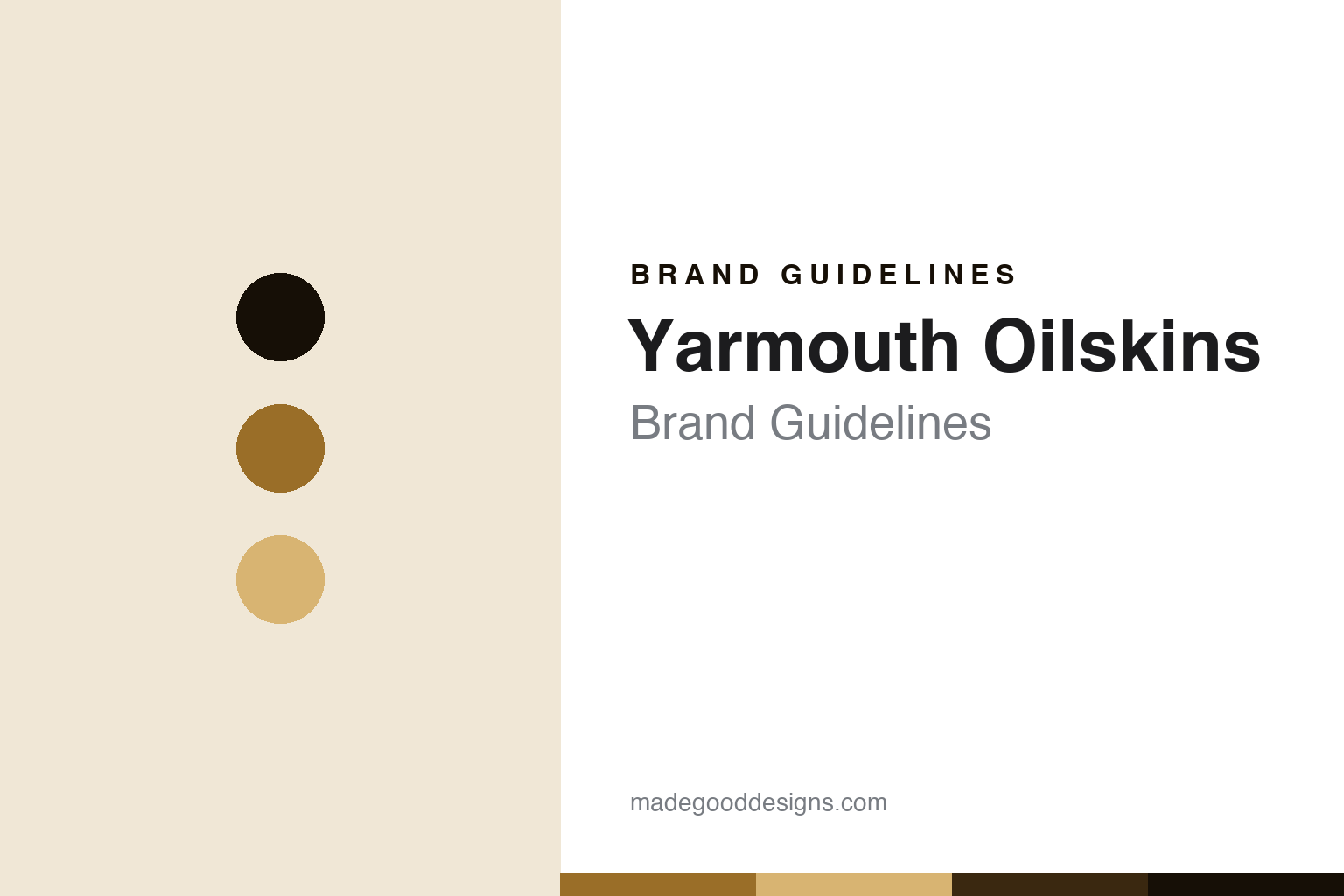
Yarmouth Oilskins Brand Guidelines
The oilskin cloth.
Aa
Two constants: an oilskin-ochre palette and a coastal-sans register. Abstract homage — not a Yarmouth Oilskins garment or mark.
The oilskin cloth
Yarmouth Oilskins is the English maker of oiled-cotton coastal workwear, trading on genuine 1898 Great Yarmouth heritage and still sewn in its own factory.
Yarmouth Oilskins is the round’s coastal cloth — oilskin, made where the herring boats once sailed. From Great Yarmouth, on the Norfolk coast, Yarmouth Oilskins makes oiled and waxed-cotton coastal workwear — the smock above all, with jackets, trousers and dungarees. Its answer to how a maker becomes a name is a protective cloth and a place: make oilskin workwear in Great Yarmouth, as the town did for its fishing fleet. A smock, in the town’s own oilskin.
Its identity is the oilskin cloth. Yarmouth Oilskins’ oiled cotton, its coastal smock and its made-in-Great-Yarmouth heritage are the work it is known for. A smock, in oilskin. Coastal workwear, from one town.
(Honest notes, so the story stays precise. Yarmouth Oilskins — at yarmouthoilskins.com — takes its signature from oilskin, the oiled and waxed cotton once made as protective clothing for the herring-fishing trade; the smock is its emblem. On its history, the company traces to 1898, when it was established as Yarmouth Stores Ltd in Great Yarmouth, Norfolk. A genuine and precise point of continuity: Yarmouth Oilskins is the heritage-clothing brand of that continuously-trading company, which survived by pivoting from fishing outfitter to wartime manufacturer to North Sea chandlery and on to today’s heritage clothing — so it trades on a real 1898 lineage, rather than being the same fashion label unchanged since 1898. On where it is made — a theme of this round — the company says it manufactures in its own factory in Great Yarmouth, with about twenty machinists and a “handmade in Great Yarmouth” line; we present that as the company’s own account, note that the everyday range today is largely natural-cotton drill with true oilskin as a heritage feature, and hedge that some items may be sourced within a UK-made framing. On ownership, it describes itself as family-owned and independent; we name no proprietor we could not confirm. Its name and marks are IP, described but never reproduced, and there is no official brand hex; these tones are an unofficial interpretation. This is design commentary and does not promote any product.)
Colour
Yarmouth Oilskins lives in an oilskin-ochre palette. Click a swatch to copy the hex.
Yarmouth Oilskins’ identity is coastal, made and weathered — an oilskin ochre, an ink, a tan, a deep oil, and a paper. The palette leans oilskin ochre and tan: the register of an oiled cotton and a weathered smock. It signals coastal oilskin workwear. The honest caveat: with no published brand hex, these values are an original, unofficial interpretation, not first-party colours.
The lesson is an oilskin-ochre palette signals a coastal, made-in-England identity. Yarmouth Oilskins’ world is a coastal, cotton, weathered object. For designers, it is a reminder that a warm oilskin ochre and a soft tan can carry a coastal maker — the yellow-brown of oiled cotton and the neutral of a weathered cloth. Because these tones can fail as small text, keep type dark and let the colour live in the accents, palette and band. The takeaways: lead with the coastal cloth; keep the factory in the town; attribute the made-here claim; and treat any single hex as unofficial.
Typography
The register is a coastal sans — plain, sturdy, made.
Yarmouth Oilskins’ identity carries a plain, sturdy, made spirit — a coastal workwear maker, not a fashion label. A coastal sans captures the mood: honest, robust and maritime, the register of a Great Yarmouth factory. Set in an oilskin-ochre palette, the coastal sans feels sturdy and made — exactly the personality Yarmouth Oilskins carries. It is a coastal cloth rather than a logo, mirroring an oilskin smock. (Yarmouth Oilskins’ real wordmark is a thing we describe but do not reproduce, and the exact typeface is not ours to use.) Because it is not ours to use, the honest description is “a coastal-sans spirit,” shown here in a stand-in. The type behaves like the cloth: plain, sturdy and made.
Aa
A coastal-sans spirit — sturdy and made. (Specimen set in Libre Franklin, a coastal-sans STAND-IN; NOT the Yarmouth Oilskins logo.)
How workwear is made
Yarmouth Oilskins stands for the oilskin cloth, made in its own town.
Yarmouth Oilskins is a lesson in how a coastal cloth and a genuine heritage can be an identity. An oilskin-ochre palette, a coastal sans and an oilskin smock make one thing — the oilskin cloth — the whole identity: coastal, made and weathered. The oiled cotton is the differentiator, and the made-in-Great-Yarmouth heritage is the meaning. The point is a maker that makes the town’s own protective cloth, in the town, on a real 1898 lineage it is honest about.
Put to work, the identity is a coastal cloth, honestly told, as design. A maker in this spirit would own a protective fabric and keep making it where it belongs — oilskin, in Great Yarmouth. A brand learning from it would see that a cloth plus a place can be an identity — that oilskin from the town that made it for its fishing fleet carries a heritage a new label cannot — and that being precise about the continuity keeps it honest: a real 1898 company that pivoted to survive, with today’s heritage-clothing brand its latest form. Yarmouth Oilskins carries the round’s cloth thread through a protective fabric, its where-made thread from the made-at-home end, and its revival-versus-continuous thread from the genuinely-continuous side. The honest editorial moves are to say it trades on real 1898 heritage rather than being unchanged since 1898, to present the own-factory and “twenty machinists” as the company’s account, and to note the everyday range is largely cotton drill with oilskin a heritage feature. The lesson Yarmouth Oilskins teaches is that a coastal cloth can hold an identity: the oilskin gives it substance, and the honesty about the heritage keeps it credible. The oilskin is the personality, and the Great Yarmouth smock is the proof.
For designers and brand-builders, Yarmouth Oilskins holds the England pole in how workwear is made: own a coastal cloth — and keep making it where it belongs. The lessons: build on a protective fabric; keep the factory in the town; trade on real, not invented, heritage; attribute a made-here claim to its source; and never reproduce a logo. It is also a reminder to stay precise: Yarmouth Oilskins is the English maker of oiled-cotton coastal workwear, trading on genuine 1898 Great Yarmouth heritage and still sewn in its own factory — with the palette here an unofficial interpretation. Yarmouth Oilskins made an oilskin cloth the identity — proof that a smock, honestly told, can be the difference.
Explore & save
Keep Yarmouth Oilskins’s identity on hand — save it to a board in the Made Good inspiration library.
Yarmouth Oilskins identity set
Pin the oilskin-ochre palette and the coastal-sans register to your own board.