Revox Brand Guidelines
Willi Studer’s tape-recorder name, from Regensdorf to the Black Forest.
Aa
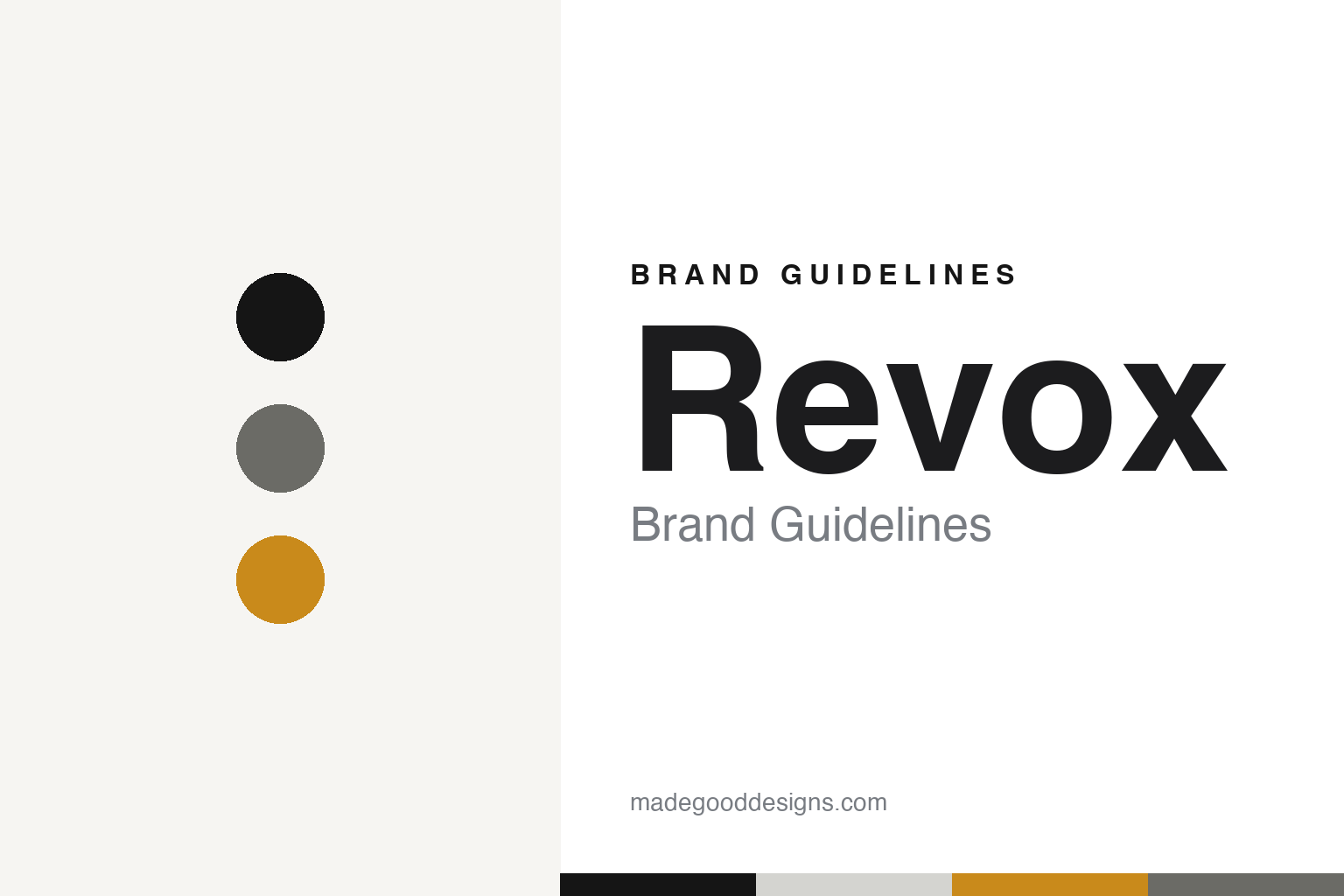
Two constants: a Revox black, silver and meter amber palette and a capital sans register. Abstract homage — not a Revox product or mark; no tape recorder, logo or nameplate is reproduced.
Willi Studer
One engineer, two brand names.
Revox dates itself to 1948, but that is the year of its founder’s company rather than of the name. On 5 January 1948 Willi Studer (1912–1996) registered a sole proprietorship, “Willi Studer, Fabrik für elektronische Apparate,” in Herisau, in eastern Switzerland, and in September moved it to Zurich, where he made high-voltage oscilloscopes, German Wikipedia says. Revox’s own milestones page tells the same story.
Tape recorders came next. In 1949, German Wikipedia says, Studer reworked imported American machines and then built his own; his first recorder went on sale before Christmas that year under the name Dynavox — another German Wikipedia article dates it to 1950. The Revox name followed: English Wikipedia, citing a 1979 company history, says Studer registered it on 27 March 1951, and German Wikipedia explains it as “Re” (give back) plus “Vox” (voice). The first Revox-branded recorder, the T26, is dated 1951 by the company and 1952 by English Wikipedia.
From then on Studer ran two brands: Studer for studio and broadcast machines and Revox for the home. The company says the split was fixed in 1952, when the Studer A27 studio recorder appeared. The Neue Zürcher Zeitung reported in 2025 that Swiss radio bought 70 T26 machines in 1950 and that the firm employed 120 people in Regensdorf by 1958.
Studer built his first plant at Regensdorf, north of Zurich, by 1960, and it became the headquarters. When Swiss authorities capped his workforce in 1962, German Wikipedia says, he opened the Willi Studer GmbH at Löffingen in Germany’s Black Forest, which made Revox recorders from 1966, and added German branch plants at Ewattingen, Bonndorf and Bad Säckingen. Studer kept as much as possible in-house — tape heads, transformers, motors and circuit boards.
Colour
The A77 and the B77.
Revox made its name with reel-to-reel tape recorders. The 36 series, which German Wikipedia dates from 1955 and English Wikipedia from 1954, introduced the three-motor transport — one motor for each reel and one for the capstan — that all later machines kept; the D36 of 1960 was the first stereo model, and more than 80,000 of the series were built before it ended in 1967.
Its successor, the transistorised A77, went into production in 1967 and became, in German Wikipedia’s words, the epitome of a high-quality tape machine for the home; English Wikipedia, citing a tape-recorder museum, says more than 460,000 were built. A matching A76 tuner and A50 (later A78) amplifier made it a complete system. The A700 of 1974 added digital transport logic. The B77, shown at the IFA fair in Berlin in 1977, kept the A77’s layout with logic control and stayed in production until 1999, alongside the B760 tuner, the B750 amplifier and the B790, a direct-drive turntable with a short linear-tracking arm. A cassette deck, the B710, followed in 1981 and the first Revox CD player, the B225, in 1984.
Revox also moved early into whole-house audio. The company says its “Easy Line” system and B200 controller of 1983 opened up multiroom technology; German Wikipedia repeats the claim that it was the world’s first, but its editors mark that sentence as lacking a source, so we give it as the company’s. Since 2000, German Wikipedia says, multiroom and home-control systems have been Revox’s main business.
The best-known studio story belongs to the other brand. The four-track machines used at Abbey Road for the Beatles’ Sgt. Pepper’s Lonely Hearts Club Band were Studer J37s, as German Wikipedia and Revox’s own milestones both say; some press accounts credit them to Revox. The logo is documented: English Wikipedia describes it as the word REVOX in capitals with a larger V, sometimes written “ReVox.”
Typography
Swiss and Austrian hi-fi.
Switzerland’s audio reputation was built largely on professional machines. Stefan Kudelski made the first Nagra tape recorder in 1951, and it became the standard for film sound from the 1960s to the 1990s, English Wikipedia says; the brand now belongs to Audio Technology Switzerland, near Lausanne. Willi Studer founded Studer in Zurich in 1948 and registered the Revox name for consumer equipment in 1951. Thorens is older still: it was registered at Sainte-Croix, in Vaud, in 1883.
Austria’s record centres on Vienna. AKG was founded there in the late 1940s by Rudolf Görike and Ernst Pless; its owner, Harman, closed its Vienna operations in 2017. Pro-Ject, founded by Heinz Lichtenegger in 1991, designs its turntables at Mistelbach, in Lower Austria, and makes them in the Czech Republic, Slovakia and Germany.
Vienna is now the trade’s meeting place too. In September 2024 the High End Society announced that its HIGH END show would leave Munich after 2025, StereoNET reported; the first Vienna edition was held at the Austria Center Vienna from 4 to 7 June 2026.
According to their own websites, Goldmund is at Satigny and darTZeel at Vessy, both in the canton of Geneva; CH Precision is at Préverenges, near Lausanne; Soulution’s maker, Spemot, is at Dulliken, in the canton of Solothurn; Piega is at Horgen, on Lake Zurich; Revox, Swiss by origin, is now run from Villingen-Schwenningen in Germany; and Vienna Acoustics is at Weigelsdorf, south of Vienna.
This guide sets out what can be checked about each brand — who founded it, who owns it, and what it says about where its products are made — and marks clearly what rests only on the company’s own word.
Aa
A capital sans, after a wordmark with an oversized V. (Specimen set in Archivo, a sans STAND-IN; NOT the Revox logo.)
Revox and Studer
Split, sold and revived.
In 1989 Willi Studer decided to retire; German Wikipedia says that year the group employed 1,576 people with sales of more than 215 million francs. He sold it to the Swiss holding company Motor-Columbus — in 1989 according to German Wikipedia, in 1990 according to English Wikipedia. In 1991 the group was split into Studer, Revox and a components division, and about 1,000 jobs had gone by 1993. In March 1994 Harman International bought Studer Revox AG for 100 Swiss francs and took on about 23 million francs of debt, English Wikipedia says, citing Harman’s filing with the US Securities and Exchange Commission; the Revox business was left out and sold to private investors. Willi Studer died on 1 March 1996.
The two names have stayed apart since. Studer remained with Harman — owned by Samsung since 2017 — until Harman sold it to the Canadian broadcast company Evertz, announced in January 2021, TV Technology reported. Revox moved its German production from Löffingen to Villingen-Schwenningen in 1998, German Wikipedia says. The old Regensdorf headquarters had been demolished to make way for housing, Bilanz reported in 2023.
Today Revox belongs to Beat Frischknecht, a former banker who invested after the turn of the millennium, when the company was seen as a lost cause, and later became sole owner, the Neue Zürcher Zeitung reported in September 2025; finews put his stake at 99.9 percent. The NZZ gave about 150 staff, with the head office in Dietikon, near Zurich, and most jobs in Villingen-Schwenningen. The company lists Revox (Schweiz) AG in Dietikon, Revox Deutschland GmbH in Villingen-Schwenningen and a sales company in Salzburg, and says its products are developed, hand-assembled and tested at its Villingen works — “Made in Germany.” In 2025 it launched a rebuilt tape recorder, the B77 MK III, at 16,000 francs, and opened Revox World, a Studer and Revox museum and showroom in Dietikon, which it says is closed for renovation until about the end of November 2026.
For a design guide, Revox shows a name outliving the company that made it famous. Compare Nagra, the other great Swiss tape-recorder name, and Thorens, a Swiss-born turntable brand. For this guide we use black, tape-deck silver and a meter amber with a sans, an unofficial interpretation; no product or logo is reproduced.
Explore & save
Keep Revox’s identity on hand — save it to a board in the Made Good inspiration library.
Revox identity set
Pin the Revox black, silver and meter amber palette and the capital sans register to your own board.