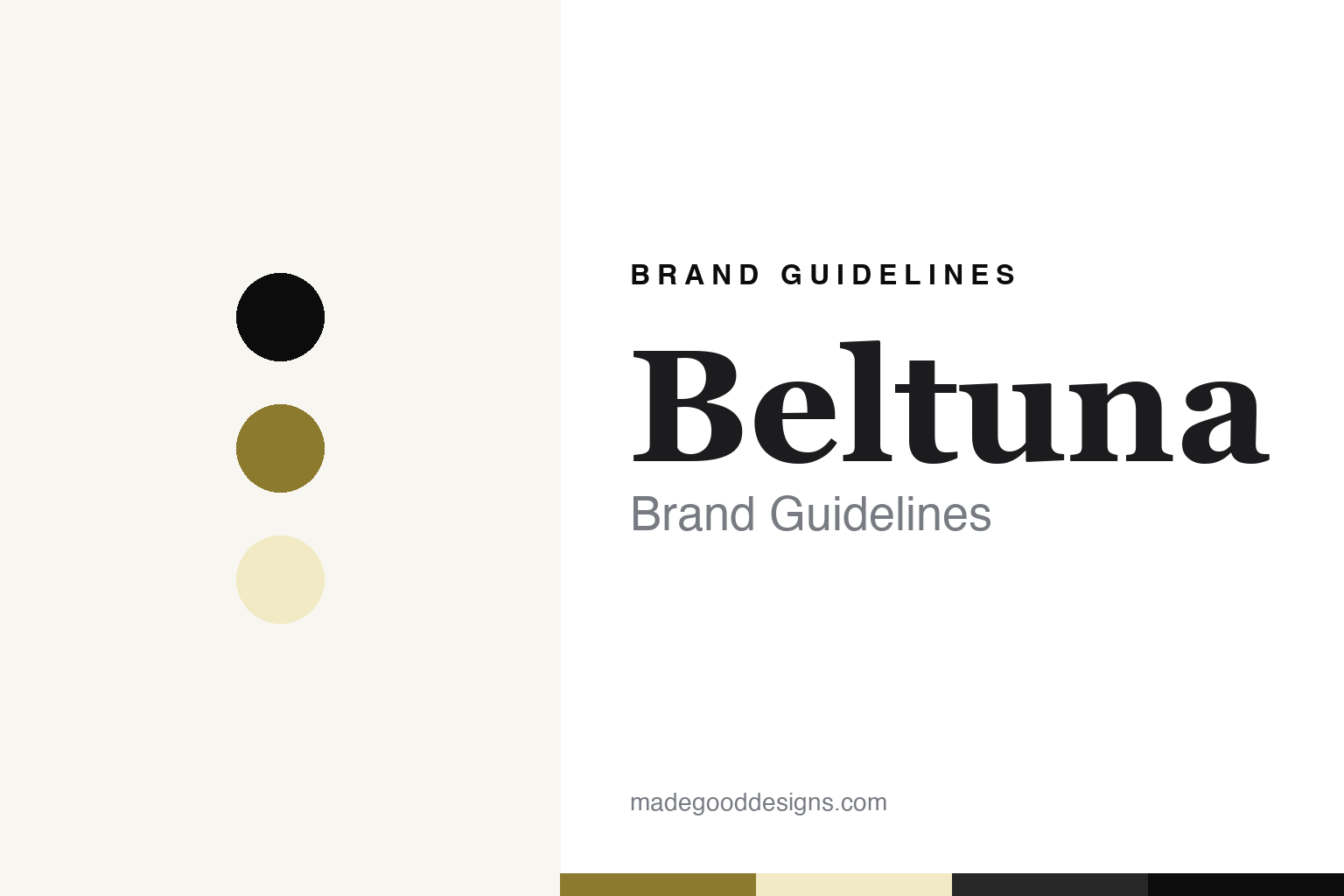
Beltuna Brand Guidelines
Bel plus tune, since 1982.
Aa
Two constants: a Beltuna black and pale gold palette and a Flared serif register. Abstract homage — not a Beltuna product or mark; no instrument, logo or nameplate is reproduced.
Bel plus tune
Beltuna was founded in Castelfidardo in 1982.
Beltuna is one of the younger names in Castelfidardo. Its history page is direct: “The story of Beltuna began in 1982.” It was founded by two local craftsmen, Arnaldo Mengascini and Elio Baldoni, and the name, it says, comes from “‘bel’ (‘beautiful’ in Italian) and ‘tune’” — an Italian–English pun on a beautiful sound. The Italian Wikipedia’s list of accordion makers gives the same date and place.
The company is now run by two generations of the Mengascini family. Its site credits “founder Arnaldo Mengascini,” his wife Annamaria and their four children, Stefania, Francesca, Francesco and Milena. It describes itself as family-run; we did not check the shareholders, and found nothing on Elio Baldoni’s later role.
The legal company is Beltuna Accordions s.r.l., at Via Pio La Torre in Castelfidardo. Its homepage says, in Italian, “Dal 1982 produciamo fisarmoniche artigianali di alta qualità” — since 1982 we have been producing high-quality handcrafted accordions — and its history page that “Beltuna accordions are crafted in the heart of Italy.”
Colour
A father’s patents and a son’s.
Beltuna presents itself as an inventor. Its timeline, which we attribute to the company, lists: 1983, “the first in Castelfidardo” to make varnished wooden accordions without celluloid; 1984, the Europa line, later renamed Prestige; 1990, the Leader line, with what it calls a patented “amplisound” resonance system; 1993, a button keyboard mounted on four pins instead of three; 1996, its debut at the Musikmesse trade fair in Frankfurt; 2002, “GHV” — Gold Handcraft Voice — reeds; 2006, the Spirit line; 2013, Fly, with carbon-fibre parts that it says save “about 1.5 kg”; and 2020, the Grand Convertor, an electromechanical free-bass system that is software-managed but produces acoustic sound.
The patent record backs the inventive streak. Google Patents lists Italian filings assigned to Beltuna Accordions from 1998 onward: a bass mechanism for the Styrian diatonic accordion; a 2005 reed-valve design by Arnaldo Mengascini; a 2010 “Fisarmonica perfezionata” — improved accordion — by Arnaldo Renato Mengascini; and, in 2020, two filings by Francesco Mengascini, including a “Sistema elettro-meccanico per fisarmonica” dated 16 September 2020, which fits the Grand Convertor. We found no record of the 1990 amplisound patent, but Google’s coverage of older Italian filings is thin, so we leave it as Beltuna’s claim.
Its newest instrument goes further. The Matrix, launched in 2022, claims 2,000 right-hand registers, 56 left-hand registers, a 20-hour battery, 3,000 sequence memories and connection to an app — an acoustic accordion with a computer inside. Beltuna says it makes its carbon parts itself: “The production of carbon components is made within Beltuna by its expert artisans.”
Typography
Five chord keys to two thousand registers.
The instrument itself is younger than the town’s industry might suggest. Cyrill Demian and his sons Guido and Karl were granted a Viennese patent for the “Accordion” on 23 May 1829, for a small box with bellows whose five keys each sounded a chord. Beltuna’s Matrix, with its claimed 2,000 right-hand registers and an app, shows how far the box has come in two centuries. The patent described the instrument simply: “Dieses Instrument hat die Gestalt eines kleinen Kästchens mit einem Blasebalge” — this instrument has the shape of a small box with a bellows.
Castelfidardo, a hill town near Ancona in the Marche, calls itself the home of the Italian accordion. Its municipality opened the Museo Internazionale della Fisarmonica on 9 May 1981, and its own description is plain: the town is known around the world for the instrument “grazie all’ingegno di Paolo Soprani che realizzò nel 1863 la prima industria italiana della fisarmonica” — thanks to the ingenuity of Paolo Soprani, who created the first Italian accordion industry in 1863. The scale of that industry has changed. An exhibition by the Ancona chamber of commerce says Castelfidardo, with about 9,000 inhabitants, once “provided employment for about 10,000 workers,” and that “51,000 instruments were produced in 1938 compared to just over 500 in 1944.” In 2012 Il Sole 24 Ore reported that the district had once turned out 240,000 accordions a year, and that by then Castelfidardo and Recanati made “non più di 30mila” — no more than 30,000 — with about twenty firms still passing the trade “di padre in figlio,” from father to son.
Italian law polices origin claims closely. Since 2003 it has been a “falsa indicazione” — a false indication — to stamp “made in Italy” on goods that do not originate in Italy under EU rules, and since 2009 “100% made in Italy” has required design, planning, processing and packaging all to take place in Italy. Il Sole 24 Ore also recalled that, fifty years earlier, accordions from the Marche had been “una delle prime voci dell’export nazionale” — one of Italy’s leading exports. Beltuna, founded in 1982, arrived after that era and made its name by inventing; the patents, from father to son, are its proof. The 2009 decree also added a fine of €10,000 to €250,000 for using a trademark in a way that misleads buyers about a product’s origin.
Aa
A flared serif — capitals with a fan of reeds. (Specimen set in Fraunces, a serif STAND-IN; NOT the Beltuna logo.)
Beltuna
Capitals with a fan of reeds.
Beltuna’s wordmark sets “BELTUNA” in flared serif capitals, with a fan of rays — or reeds — rising from the T, in silver and gold. The website is near-black with a pale gold accent, and its slogan is “EMOTIONS & ACCORDIONS.” Its innovations page says the press of the time called the Europa line a “signature instrument,” and that the phrase became Beltuna’s first slogan.
Beltuna lists about seventy players on its artists page, among them Pino Di Modugno, Marc Berthoumieux, Dorgival Dantas and Markku Lepistö. For a design guide, Beltuna shows a young firm in an old town choosing an international name and a technical story. Its finishes — a “Vintage” line arrived in 2014 — and its carbon parts sit side by side, so the brand can speak to traditional and modern players at once. Compare Bugari, older and more traditional, and Fisitalia, younger still.
For this guide we use near-black and a pale gold with a serif, an unofficial interpretation of the website’s colours. No accordion, wordmark or logo is reproduced.
Explore & save
Keep Beltuna’s identity on hand — save it to a board in the Made Good inspiration library.
Beltuna identity set
Pin the Beltuna black and pale gold palette and the Flared serif register to your own board.