Primare Brand Guidelines
The Danish-designed amplifier maker now based in Malmö.
Aa
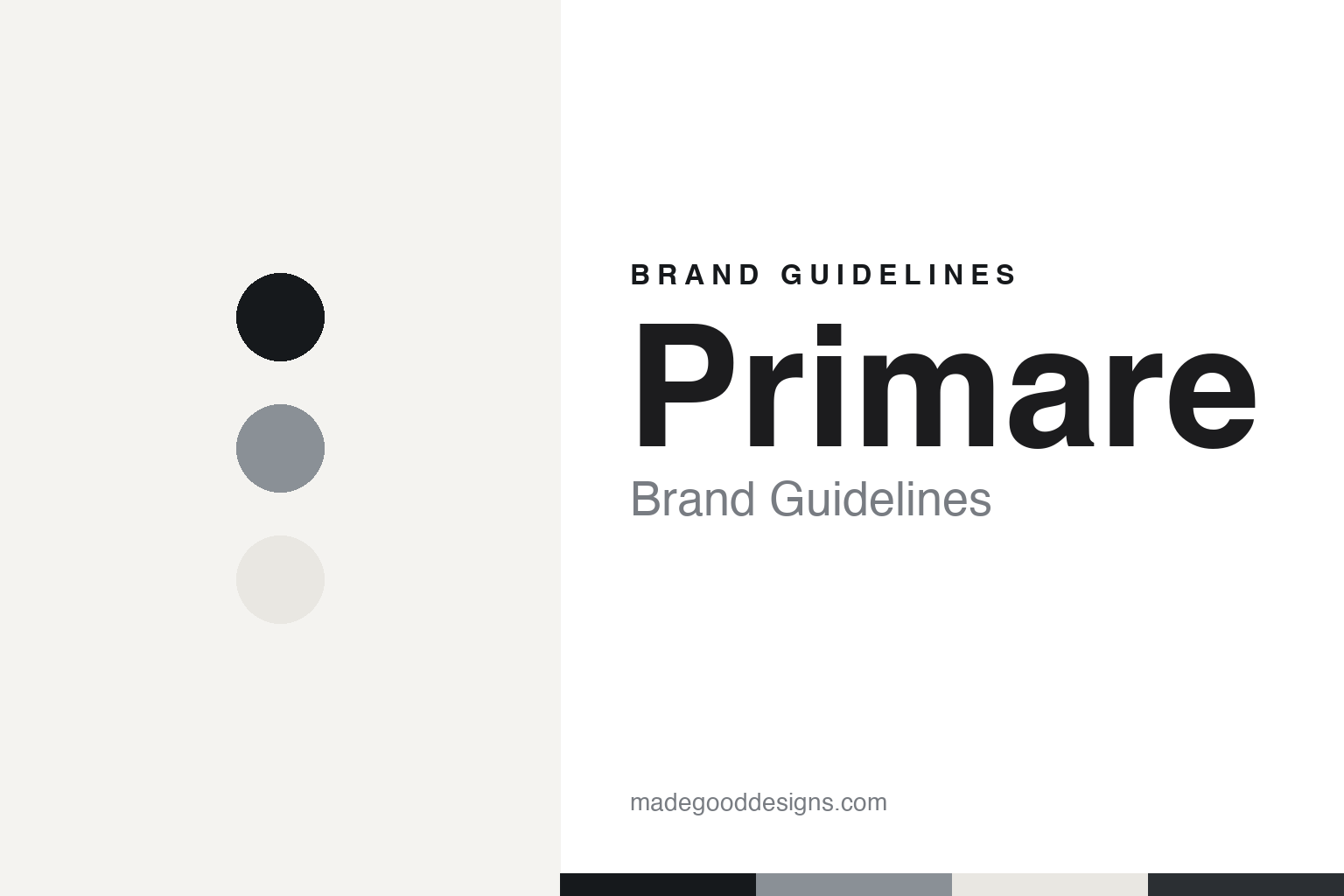
Two constants: a Primare black, graphite and satin grey palette and a geometric sans register. Abstract homage — not a Primare product or mark; no component, logo or nameplate is reproduced.
Primare Systems
A Danish designer, an engineer and a minimalist amplifier.
Primare began with a designer rather than an engineer. The company says it was established as Primare Systems AB in 1985 by the Danish industrial designer Bo Christensen and the engineer Bent Nielsen, with a mission to “design components of exceptional sound quality” that also had an elegant appearance, precise proportions and a user-friendly interface. Hi-Fi News, in a look back at the company’s first system, gives a slightly different start: “Primare Systems of Denmark,” it says, was launched in 1984 by Christensen. We give both dates. The company is now Swedish, but we did not find a dated record of when or why it moved across the Øresund.
Its first products made the point. The 928 series arrived in 1986, and the company describes it as a “minimalist aesthetic” at a time when most amplifiers were crowded with buttons. Hi-Fi News says the 928 System — a preamplifier and two matching mono power amplifiers — cost £8,750, and came in black, with a satin grey version as well; it calls the set one of the finest-sounding pre and power combinations of its era. Primare has said the 928 components went on show at Copenhagen’s museum of industrial art, now Designmuseum Danmark; we have not confirmed that in the museum’s own records.
A different look followed. The 200 series of 1992 replaced black boxes with sculpted, polished stainless steel. The collectors’ site The Vintage Knob describes the 204 CD player, made from 1991 to 1994, as a non-magnetic stainless-steel body with laser-etched lettering, delivered in a steel flight case, and estimates that only about 340 to 350 were built.
Colour
The Xena years and a modular range.
Christensen did not stay. The company says he developed the 300 series of 1994 before leaving; another account puts his departure in 1993, so we say only that he left in the early-to-mid 1990s. The Vintage Knob notes that he also co-founded Bow Technologies, a later audio-electronics venture.
The turning point, by the company’s account, was a 1993 association with Xena, a Swedish audio company. Primare’s distributors describe Xena as linked with the Scandinavian brands Copland and QLN, and say the tie-up brought together Nielsen and Xena’s Lars Pedersen. Pedersen has since been described as Primare’s managing director and owner, in charge since 1996, and the company’s American distributor names him as chief executive and Nielsen as chief designer. We could not find a dated public filing that sets out the ownership in detail, and found no record of a sale to an outside group.
The 30 series of 1998 became, the company says, “the basis for all future designs.” Between 2000 and 2004 Primare moved into home cinema with DVD players and processors. In 2008 it introduced a modular approach with the SPA22, using its own class D amplifier technology, which it calls UFPD; the 30 and 20 series of 2010 followed the same idea, so that cards and boards can be swapped or upgraded. The 60 series and an app called AIR followed in 2014, and in 2017 the company launched Prisma, its streaming and control platform, alongside a second generation of UFPD. Home cinema returned in 2022 with the SPA25 and SP25 processors.
Awards came from the European press association EISA. The CD32 and I32 pair won its European stereo-system award for 2011–2012, the CD35 and I35 Prisma won its stereo-system award for 2019–2020, the A35.8 power amplifier and NP5 Prisma MK2 streamer won in 2022–2023, and the SP25 Prisma processor won for 2024–2025, the company said in August 2024, calling it the third year running for a Primare home-cinema model.
Typography
Nordic hi-fi.
The Nordic loudspeaker trade goes back to the 1920s. In Norway, Vebjørn Tandberg founded Tandbergs Radiofabrikk in Oslo in 1933; it went bankrupt in 1978, English Wikipedia says. In 1950 the Radionette founder Jan Wessel and the Danish engineer Carl Christian Nørgaard Madsen set up Seas, which moved to Moss in 1951, according to Danish Loudspeakers, the 2015 centenary history published for the Danish Sound Innovation Network.
Denmark had several driver makers. The same history traces Peerless to a Copenhagen sales company of 1926, Videbæk Højttalerfabrik — later Vifa — to 1933, and Scan-Speak to 1 February 1970, when Ejvind Skaaning founded it. Vifa-Speak and Peerless combined as Danish Sound Technology in 2000, and in 2005 the group was sold to Tymphany.
Elsewhere, Finland’s Genelec was founded in Iisalmi in 1978 by Ilpo Martikainen and Topi Partanen, English Wikipedia says, and in Sweden Audio Pro says it has made speakers since 1978, while Primare says it was founded in 1985 by the Danish designer Bo Christensen.
The makers in this guide are spread across the region. Hegel is in Oslo and Seas outside Moss, in Norway; Primare gives an address in Limhamn, Malmö, and Audio Pro is based in Helsingborg, both in southern Sweden; Gato Audio is in Herlev, on the edge of Copenhagen; and Argon Audio gives an address in Nørager, in North Jutland. Peerless now belongs to Tymphany, which says it is headquartered in Taiwan.
This guide sets out what can be checked about each brand — who founded it, who owns it, and what it says about where its products are made — and marks clearly what rests only on the company’s own word.
Aa
A geometric sans for a brand built on proportion. (Specimen set in Jost, a sans STAND-IN; NOT the Primare logo.)
Primare
Designed in Sweden, made in China — by its own account.
Today the company gives its address as Limstensgatan 7 in Limhamn, on the western edge of Malmö, and says it has been “designing and producing award-winning hi-fi components” for more than forty years in southern Sweden. On where the products are made, it is unusually direct. Its support pages say that all design work is managed from its offices in Sweden, that manufacturing takes place in facilities in China, and that every unit is given a final quality-control test in Sweden before it is approved for shipping. We give that as the company’s description; we have not seen the factories.
Two names can cause confusion. The English Wikipedia article titled “Bo Christensen” is about a Danish film producer, not Primare’s designer. And AV Luxury Group, which lists Primare among its brands, is the company’s North American distributor, founded in 2022, rather than its owner. The official website is primare.net.
The brand’s visual identity has never been the subject of a published style guide that we could find. What can be traced is a sequence of design decisions: the austere black 928, the polished steel of the 200 series, and the plain, evenly proportioned fronts of the 30 and 35 series that the company still builds on. Primare itself frames those choices in the language of Scandinavian design and the Swedish idea of lagom, or “just enough.”
For a design guide, Primare shows how a brand founded on an industrial designer’s eye can keep his proportions long after he has gone. Compare Hegel, a Norwegian amplifier maker of the same generation, and Gryphon, a Danish one. For this guide we use black, graphite and satin grey with a sans, an unofficial interpretation; no product or logo is reproduced.
Explore & save
Keep Primare’s identity on hand — save it to a board in the Made Good inspiration library.
Primare identity set
Pin the Primare black, graphite and satin grey palette and the geometric sans register to your own board.