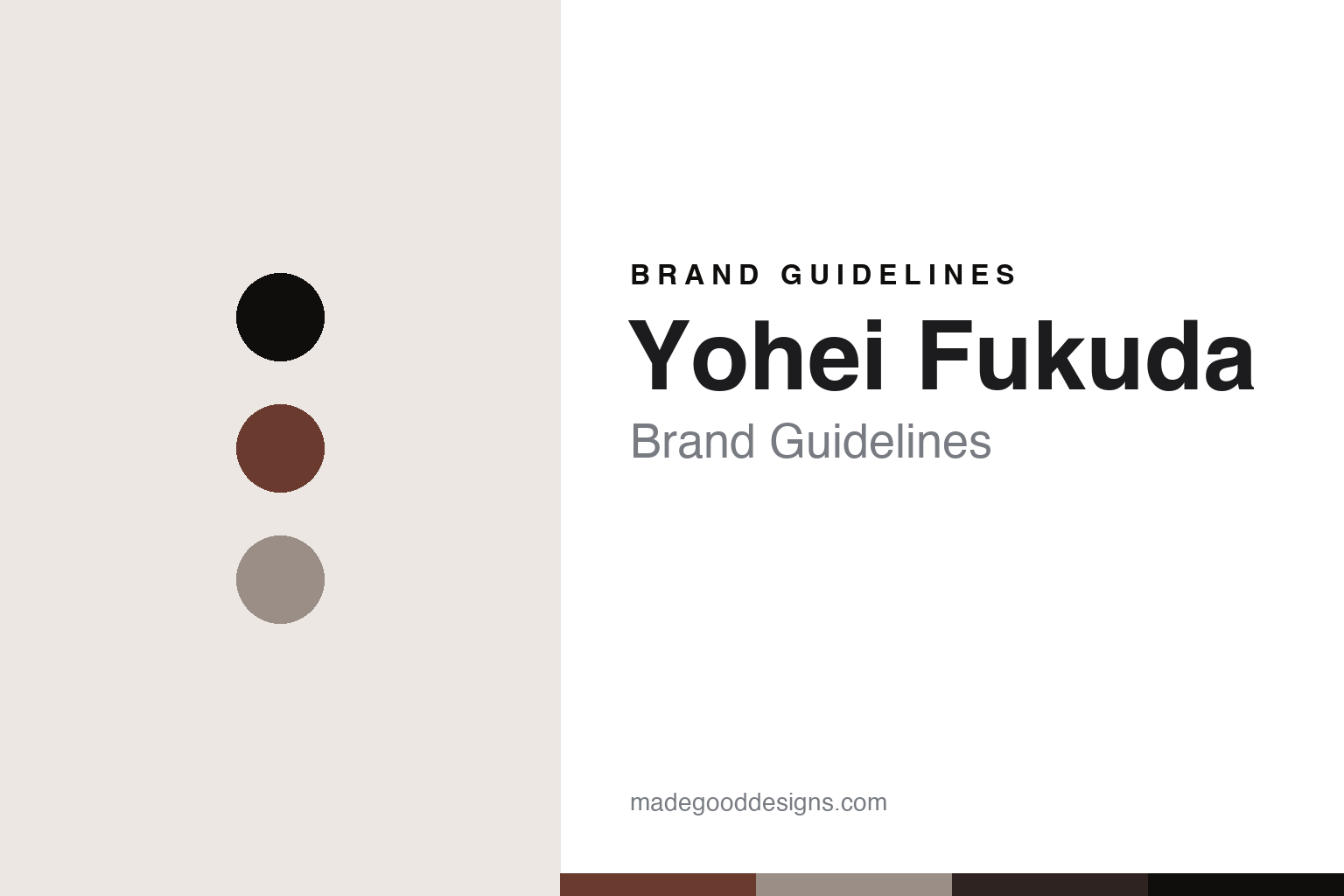
Yohei Fukuda Brand Guidelines
The English craft, made in Tokyo.
Aa
Two constants: a bevel-chestnut palette and a precise-sans register. Abstract homage — not a Yohei Fukuda shoe, last or wordmark.
The English craft, made in Tokyo
Yohei Fukuda is a Tokyo bespoke maker who learned the English craft and became one of the world’s most acclaimed shoemakers.
Yohei Fukuda is a lesson in how a craft crosses the world and comes back finer. From Tokyo he makes bespoke shoes the English way he learned in Northampton — hand-lasted, hand-welted, hand sole-stitched, on a wooden last carved for each client — and he is celebrated above all for his finishing, the sculpted bevelled waist. His answer to the bespoke bench is precision: take the English craft, and refine it to a Japanese standard. A shoe built to one foot, finished past the point most stop.
Its identity is the Tokyo bespoke shoe, refined to the limit. Yohei Fukuda’s hand-welting, its bevelled waist and its tiny, patient output are the work it is known for. A craft, carried east and perfected. A maker who out-finished the tradition he learned.
(Honest notes, so the story stays precise, and about a living maker whose public work only we describe. Yohei Fukuda is based in Tokyo — in Aoyama — not, as is sometimes assumed, in Nara; his shoes are made in Japan. He learned shoemaking in England, studying at Tresham in Northampton and then working for London bespoke firms — including George Cleverley, elsewhere in this round, and Edward Green’s former bespoke department — before founding his own workshop around 2007 to 2008. His bespoke shoes are hand-lasted, hand-welted and hand sole-stitched; he also offers made-to-order and a ready-to-wear line built on the same hand-lasted, hand-welted method but with a machine-stitched sole, its output deliberately capped at roughly two hundred pairs a year. His signature is a finely bevelled waist and a distinctive heel. We report the long lead times and limited output rather than quoting a formal waiting list. His designs, last and marks are his IP, described but never reproduced, and there is no official brand hex — these tones are an unofficial interpretation. This is design commentary and does not promote any product.)
Colour
Yohei Fukuda lives in a bevel-chestnut palette. Click a swatch to copy the hex.
Yohei Fukuda’s identity is precise, restrained and exacting — a bevel chestnut, an ink, a calf grey, an umber, and a chalk. The palette leans bevel chestnut and grey: the register of a finely finished shoe and a quiet workshop. It signals precision and finish over flourish. The honest caveat: with no published brand hex, these values are an original, unofficial interpretation, not first-party colours.
The lesson is a bevel-chestnut palette signals a hand-welted, exactingly-finished identity. Yohei Fukuda’s world is a hand-lasted, hand-finished, Tokyo object. For designers, it is a reminder that a warm chestnut and a soft grey can carry a brand built on finishing — the brown of a fine shoe and the grey of the carved last. Because these tones can fail as small text, keep type dark and let the colour live in the accents, palette and band. The takeaways: learn the craft at its source; refine past the norm; keep output tiny; and treat any single hex as unofficial.
Typography
The register is a precise sans — clean, exact, quiet.
Yohei Fukuda’s identity carries a clean, exact, quiet spirit — a precision maker, not a showman. A precise sans captures the mood: neat, controlled and unshowy, the register of a finishing-obsessed workshop. Set in a bevel-chestnut palette, the precise sans feels clean and exact — exactly the personality the maker carries. It is quiet rather than loud, mirroring a finely finished bespoke shoe. (Yohei Fukuda’s real designs and marks are things we describe but do not reproduce, and the exact typeface is not ours to use.) Because it is not ours to use, the honest description is “a precise-sans spirit,” shown here in a stand-in. The type behaves like the maker: clean, exact and quiet.
Aa
A precise-sans spirit — clean and exact. (Specimen set in Zen Kaku Gothic New, a precise-sans STAND-IN; NOT the Yohei Fukuda wordmark or any shoe design.)
The bespoke bench
Yohei Fukuda stands for a craft learned abroad and perfected.
Yohei Fukuda is a lesson in how a maker refines a borrowed craft to a new standard. A bevel-chestnut palette, a precise sans and a hand-welted bespoke shoe make one thing — a shoe built to one foot and finished to the limit — the whole maker: precise, restrained and exacting. The hand-welting is the craft, and the finishing is the differentiator. The point is a genuinely bespoke object, hand-lasted in Tokyo, by a maker who learned the English tradition and then out-finished it.
Put to work, the identity is finishing as design. A maker in this spirit would go to the source to learn a craft, then refine it past the standard, and keep output small enough to hold that standard. It would let a single detail — the bevelled waist — carry the reputation. A brand learning from it would see that mastering and then exceeding a tradition is a durable identity — that “learned in Northampton, perfected in Tokyo” is a compelling honest arc — and that being precise about training, lineage and location, Tokyo not Nara, is part of the craftsman’s exactness. A brand learning from it would also let limited output speak for itself rather than manufacture scarcity claims. The lesson Yohei Fukuda teaches is that a bespoke craft plus relentless finishing can hold an identity: the hand-welting gives it substance, and the finish gives it distinction. The craft is the personality, and the bespoke shoe is the proof.
For designers and brand-builders, Yohei Fukuda holds the finishing pole in this round about the bespoke bench: learn the craft at its source, and refine it past the standard. The lessons: train where the craft lives; perfect one detail; keep output honest; and never reproduce a protected design. It is also a reminder to stay precise: Yohei Fukuda is a Tokyo bespoke maker, English-trained, whose hand-welted shoes are made in Japan — with the palette here an unofficial interpretation, and only public business facts reported of a living maker. Yohei Fukuda made finishing the identity — proof that refinement can be the difference.
Explore & save
Keep Yohei Fukuda’s identity on hand — save it to a board in the Made Good inspiration library.
Yohei Fukuda identity set
Pin the bevel-chestnut palette and the precise-sans register to your own board.