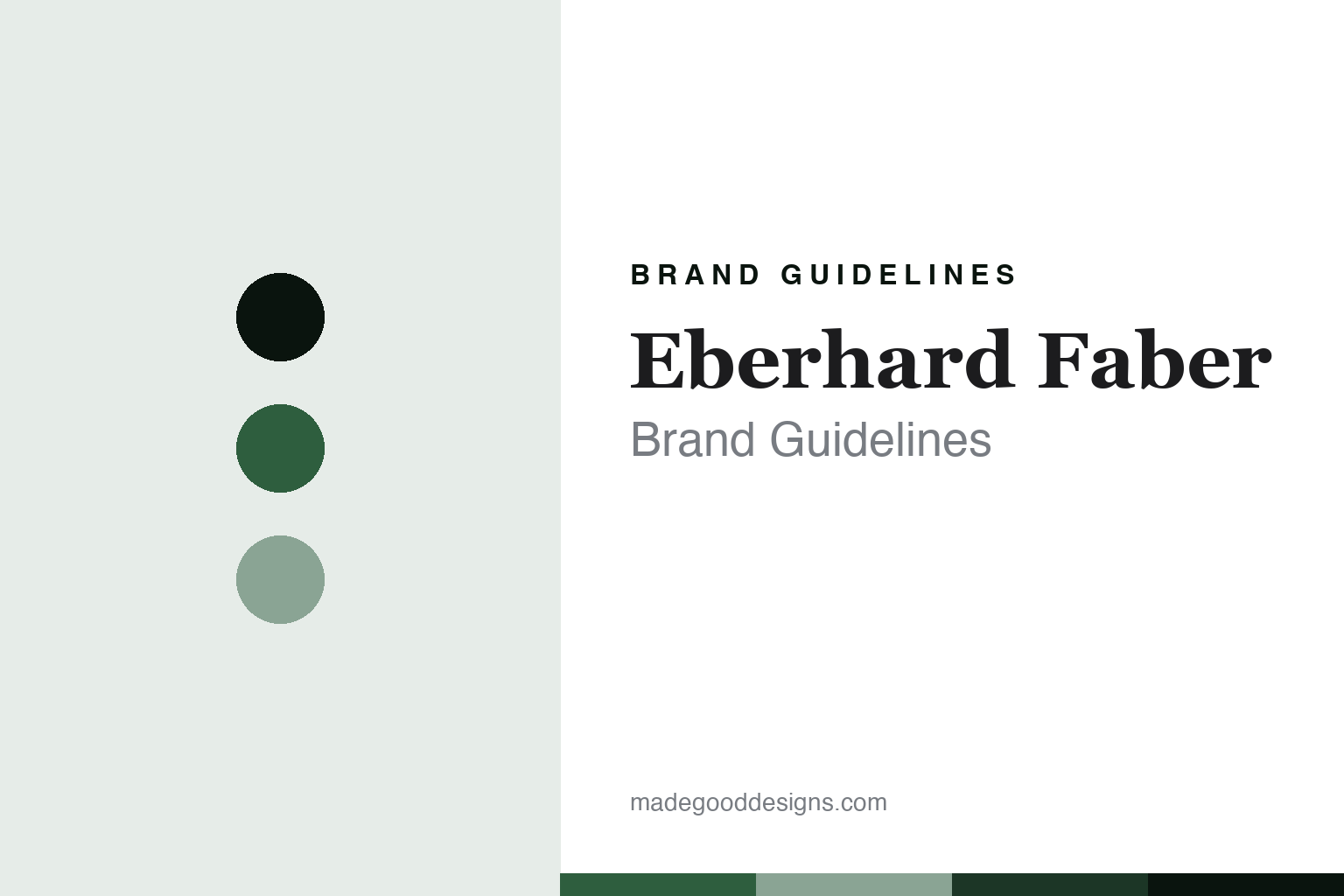
Eberhard Faber Brand Guidelines
The other Faber.
Aa
Two constants: a star-green palette and a heritage-serif register. Abstract homage — not an Eberhard Faber colour, label, barrel or star mark.
The other Faber
Eberhard Faber is the heritage pencil name founded by Lothar von Faber’s brother, famed for graphite — the original Blackwing 602 — and split between two owners.
Eberhard Faber is a lesson in how a family name splits into two pencil houses. It is “the other Faber” — the brand founded by a brother of the man who ran A.W. Faber, the firm that became Faber-Castell — and it built its own pencil business in America and Germany. Its answer to how a pencil is made a legend is graphite: it made the original Blackwing 602, a pencil beloved by writers and composers. A pencil name that shares a family with Faber-Castell but is a separate house.
Its identity is the heritage graphite pencil name. Eberhard Faber’s graphite pencils — above all the original Blackwing 602 — and its erasers are the work it is known for. A name, split between owners. The other branch of the Faber pencil family.
(Honest notes, so the story stays precise, because the family history and the ownership both need care. Eberhard Faber (1822–1879) was the brother of Lothar von Faber, who ran A.W. Faber (later Faber-Castell); Eberhard managed the New York branch and then, in 1861, founded his own pencil factory under his name in New York, later in Greenpoint, Brooklyn. The German company in Neumarkt was a later subsidiary, founded in 1922 by his sons — so the two Fabers were separate companies born of a family split, not one business. Today the name is split between two owners: Faber-Castell reacquired the European brand rights in 2010 (Staedtler had held the European operations from 1978), while the US name passed to Sanford — now Newell — in 1994 and was folded into Paper Mate. One honest point for a coloured-pencil piece: Eberhard Faber’s verified renown is graphite pencils and erasers — it made the original Blackwing 602 in 1934 and the Mongol pencil — not coloured pencils, so we present it as a heritage graphite house rather than a coloured-pencil specialist. Its name, its star mark and its products are their owners’ IP, described but never reproduced, and there is no official brand hex — these tones are an unofficial interpretation. This is design commentary and does not promote any product.)
Colour
Eberhard Faber lives in a star-green palette. Click a swatch to copy the hex.
Eberhard Faber’s identity is heritage, classical and dual — a star green, an ink, a sage, a pine, and a paper. The palette leans star green and sage: the register of an old pencil house and a graphite core. It signals lineage and craft over novelty. The honest caveat: with no published brand hex, these values are an original, unofficial interpretation, not first-party colours — an abstract nod, not the actual star livery.
The lesson is a star-green palette signals a heritage, family-split identity. Eberhard Faber’s world is a heritage, graphite-led, transatlantic object. For designers, it is a reminder that a deep green and a soft sage can carry a brand built on a family name and a famous pencil — the green of an old livery and the grey of graphite. Because these tones can fail as small text, keep type dark and let the colour live in the accents, palette and band. The takeaways: honour the lineage; separate it from Faber-Castell; be honest about the split; and treat any single hex as unofficial.
Typography
The register is a heritage serif — classical, storied, dual.
Eberhard Faber’s identity carries a classical, storied, dual spirit — a two-branch family name, not a single modern brand. A heritage serif captures the mood: traditional, refined and historic, the register of a 19th-century pencil house. Set in a star-green palette, the heritage serif feels classical and storied — exactly the personality the name carries. It is dual rather than singular, mirroring a brand split between two owners. (Eberhard Faber’s real labels, star mark and the Blackwing name are things we describe but do not reproduce, and the exact typeface is not ours to use.) Because it is not ours to use, the honest description is “a heritage-serif spirit,” shown here in a stand-in. The type behaves like the name: classical, storied and dual.
Aa
A heritage-serif spirit — classical and storied. (Specimen set in Cormorant Garamond, a heritage-serif STAND-IN; NOT the Eberhard Faber wordmark, star mark or the Blackwing name.)
The pencil makers, old and new
Eberhard Faber stands for the other branch of a pencil family.
Eberhard Faber is a lesson in how a family name can carry two separate houses. A star-green palette, a heritage serif and a famous graphite pencil make one thing — the other Faber — the whole story: heritage, classical and dual. The family split is the differentiator, and the honest ownership is the meaning. The point is a genuine pencil heritage, distinct from Faber-Castell, that made the original Blackwing 602 and whose name is today split between two corporate owners.
Put to work, the identity is a family lineage, honestly told, as design. A brand story in this spirit would honour a real heritage, be scrupulous about its relationship to a famous relative, and be precise about a complicated ownership. A brand-builder learning from it would see that a genuine lineage is a powerful identity — that “the other Faber, maker of the original Blackwing” is a story worth telling — but only if told accurately: separate companies from a family split, Faber-Castell reacquiring the European brand rights in 2010, the US name going to Newell, the fame resting on graphite rather than coloured pencils. A brand-builder learning from it would also resist the easy conflation with Faber-Castell: shared surname and a 2010 ownership reunification do not make them one company, and saying so plainly is more honest than trading on the confusion. The lesson Eberhard Faber teaches is that a family lineage can hold an identity: the heritage gives it depth, and the precision about the split keeps it credible. The lineage is the personality, and the graphite pencil is the proof.
For designers and brand-builders, Eberhard Faber holds the “old” pole in this round of the pencil makers, old and new, from the transatlantic Faber family: honour the lineage, and separate it from the famous relative. The lessons: carry the heritage; distinguish yourself from Faber-Castell; disclose the split ownership; be honest about what you are famed for; and never reproduce a protected mark. It is also a reminder to stay precise: Eberhard Faber is a heritage pencil name founded by Lothar von Faber’s brother, famed for graphite and split between two owners — with the palette here an unofficial interpretation. Eberhard Faber made the family split the identity — proof that a lineage, precisely told, can be the difference.
Explore & save
Keep Eberhard Faber’s identity on hand — save it to a board in the Made Good inspiration library.
Eberhard Faber identity set
Pin the star-green palette and the heritage-serif register to your own board.