Bollman Hat Co Brand Guidelines
America’s oldest felt works.
Aa
Two constants: a slate-blue palette and a factory-sans register. Abstract homage — not a Bollman hat, label or any owned-brand logo.
America’s felt works
Bollman Hat Company is the employee-owned Pennsylvania hat maker running America’s last start-to-finish felt-hat factory since 1868, and a house of hat brands.
Bollman Hat Company is a lesson in how a factory can be a maker and a brand house at once. From Adamstown, Pennsylvania, Bollman has made wool-felt hats since 1868 — and it also owns and licenses a stable of hat brands. Its answer to how a hat is made a business is both: keep an American felt factory running, and put out hats under many names. A felt works that is also a house of brands.
Its identity is the American felt works. Bollman’s wool-felt hats, its Adamstown factory and its portfolio of hat brands are the work it is known for. A hat, made in Pennsylvania. A maker behind many labels.
(Honest notes, so the story stays precise, because a famous claim needs care. Bollman was founded in 1868 by George Bollman in Adamstown, in Pennsylvania Dutch country, and it runs what is described as America’s last start-to-finish felt-hat factory — but we say “one of America’s oldest,” not flatly “the oldest,” which the company itself does not claim. It is employee-owned, through an ESOP, since 1985, with around three hundred employees and distribution to some seventy-seven countries. It owns brands including Bailey, Betmar, Country Gentleman and Helen Kaminski, and it licenses Kangol globally — it does not own the Kangol trademark, so we say “licenses,” not “owns.” The important, honest point is its 2018 US FTC settlement: Bollman and a subsidiary marketed hats as “American Made Matters” and “Made in USA since 1868” when more than seventy per cent of its hat styles were wholly imported, and ran a “made in USA” certification seal without disclosing its own connection to it. So the honest reading of where its hats are made is: US-made in Adamstown for some lines, imported for most — a distinction the FTC required it to stop blurring. Its owned brands’ names and marks are their IP, described but never reproduced, and there is no official brand hex; these tones are an unofficial interpretation. This is design commentary and does not promote any product.)
Colour
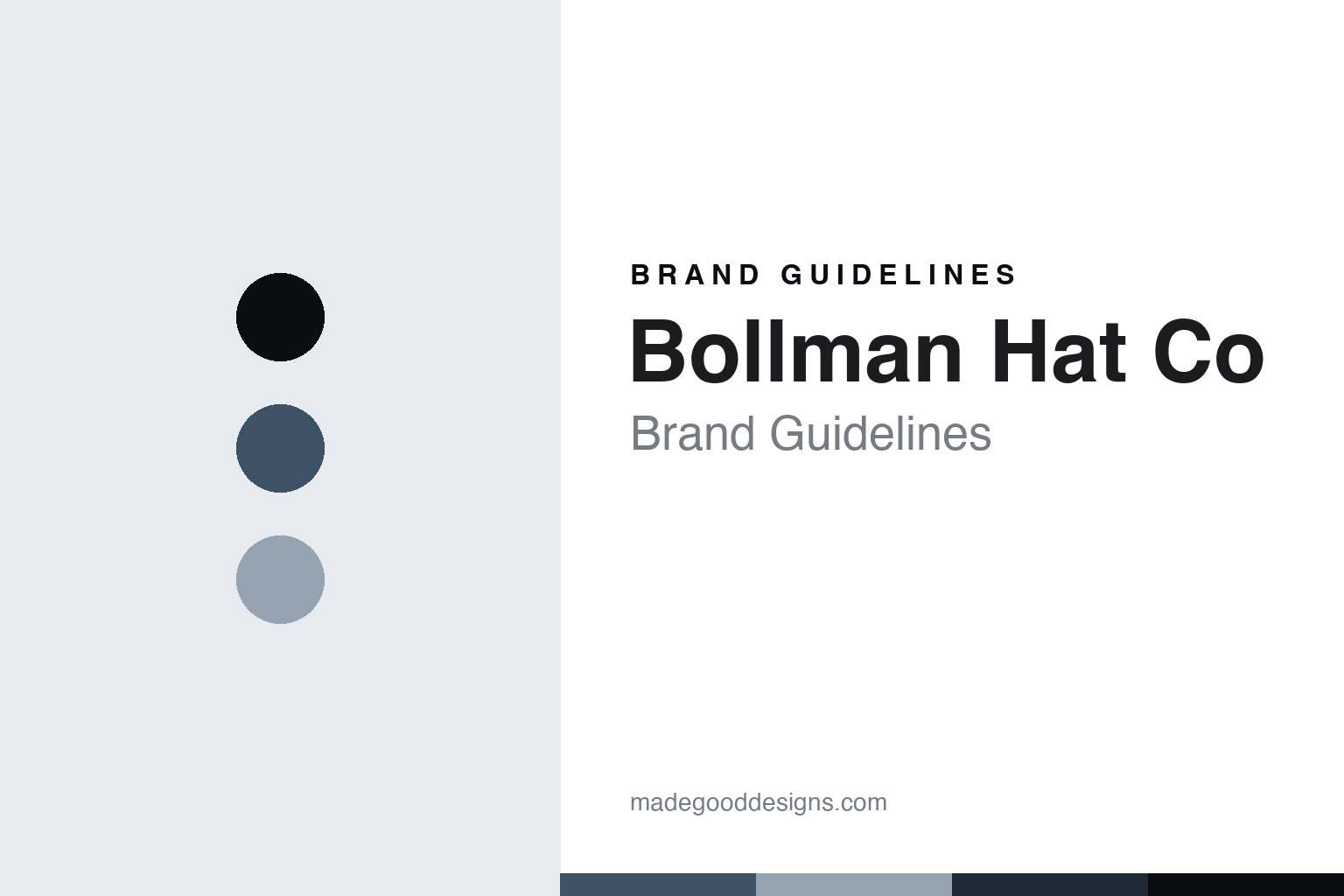
Bollman lives in a slate-blue palette. Click a swatch to copy the hex.
Bollman’s identity is industrial, American and sober — a slate blue, an ink, a grey, a navy, and a paper. The palette leans slate blue and grey: the register of a felt factory and a Pennsylvania works. It signals industry over fashion. The honest caveat: with no published brand hex, these values are an original, unofficial interpretation, not first-party colours.
The lesson is a slate-blue palette signals a felt-factory, maker identity. Bollman’s world is an industrial, felt, American object. For designers, it is a reminder that a slate blue and a soft grey can carry a brand built on a factory — the blue-grey of machinery and the neutral of wool felt. Because these tones can fail as small text, keep type dark and let the colour live in the accents, palette and band. The takeaways: run the factory; hold the brands; be honest about where each is made; and treat any single hex as unofficial.
Typography
The register is a factory sans — plain, industrial, capable.
Bollman’s identity carries a plain, industrial, capable spirit — a felt factory and brand house, not a boutique. A factory sans captures the mood: even, businesslike and unshowy, the register of an American hat works. Set in a slate-blue palette, the factory sans feels plain and capable — exactly the personality Bollman carries. It is industrial rather than decorative, mirroring wool felt. (Bollman’s real marks and its owned brands’ logos are things we describe but do not reproduce, and the exact typeface is not ours to use.) Because it is not ours to use, the honest description is “a factory-sans spirit,” shown here in a stand-in. The type behaves like the works: plain, industrial and capable.
Aa
A factory-sans spirit — plain and capable. (Specimen set in Space Grotesk, a factory-sans STAND-IN; NOT the Bollman wordmark or any owned-brand logo.)
The hat houses that lasted
Bollman stands for the American felt factory that endured.
Bollman is a lesson in how an American felt factory lasts by being a brand house too. A slate-blue palette, a factory sans and a wool-felt hat make one thing — an American felt works — the whole identity: industrial, American and sober. The surviving factory is the differentiator, and the portfolio of brands is the meaning. The point is an 1868 Pennsylvania maker that kept a start-to-finish felt factory running by also owning and licensing the hat brands other people wear.
Put to work, the identity is a factory and a portfolio, honestly told, as design. A maker in this spirit would keep its factory alive, hold a stable of brands, and be candid about the making — some lines US-made in Adamstown, most imported. A brand learning from it would see that a surviving factory plus a brand house is a durable identity — that an American felt works from 1868 is worth keeping — and that being precise, one of America’s oldest not the flat oldest, employee-owned since 1985, licensing rather than owning Kangol, keeps the story honest. A brand learning from it would also take the FTC matter as a lesson: an American factory does not make an all-American range, and the honest “some made here, most imported” is exactly what the regulator required — and what trust requires. The lesson Bollman teaches is that a factory can last as part of a brand house: the works give it substance, and the honesty about origin keeps it credible. The factory is the personality, and the felt hat is the proof.
For designers and brand-builders, Bollman holds the factory pole in this round of the hat houses that lasted, from the United States: keep the works, and label the origin honestly. The lessons: run the factory; hold the brands; distinguish owned from licensed; disclose what is imported; and never reproduce an owned brand’s logo. It is also a reminder to stay precise: Bollman Hat Company is the employee-owned Pennsylvania hat maker running America’s last start-to-finish felt-hat factory since 1868, and a house of hat brands — with the palette here an unofficial interpretation. Bollman made the felt factory the identity — proof that a works and a portfolio, honestly told, can be the difference.
Explore & save
Keep Bollman Hat Co’s identity on hand — save it to a board in the Made Good inspiration library.
Bollman identity set
Pin the slate-blue palette and the factory-sans register to your own board.