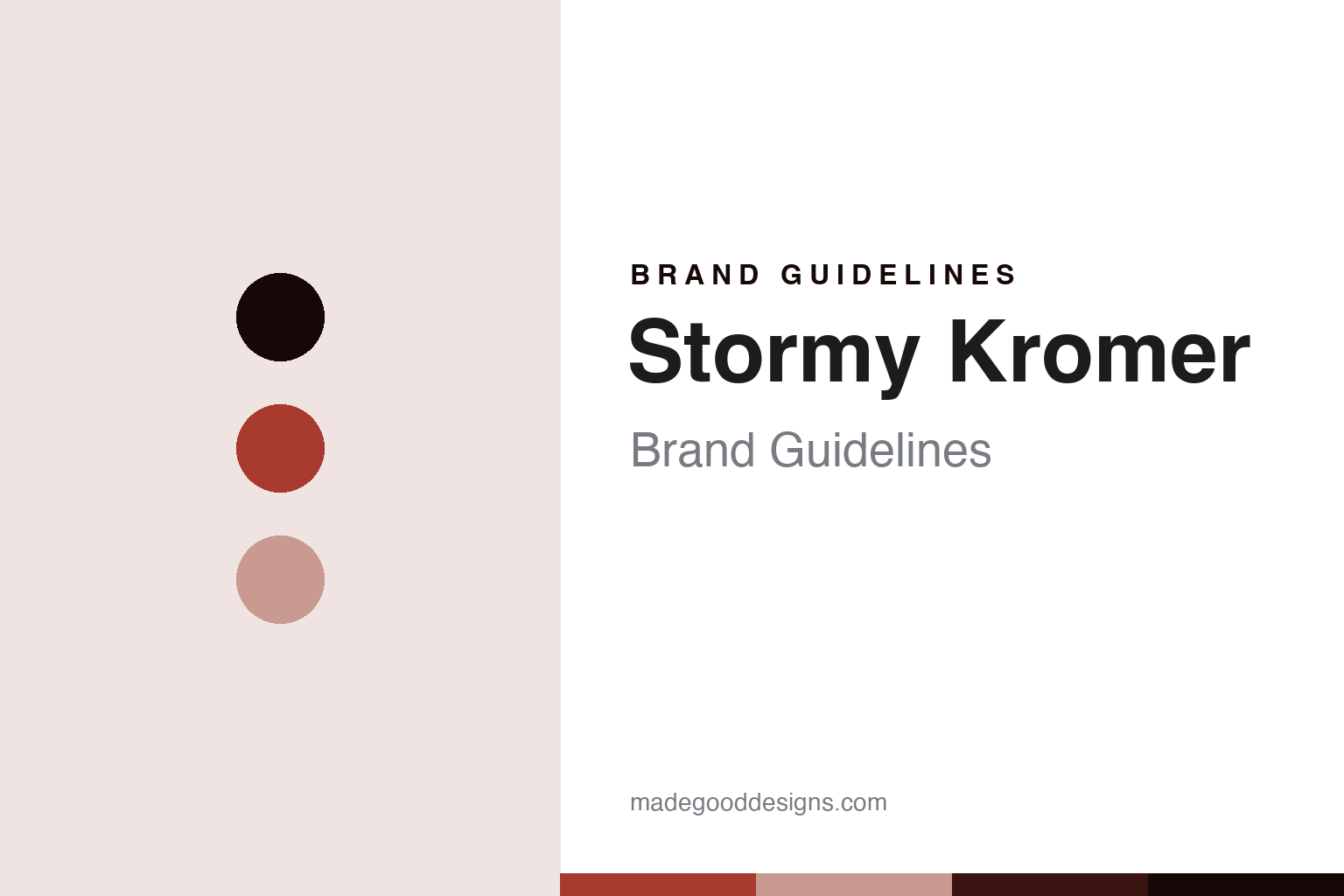
Stormy Kromer Brand Guidelines
The wool earband cap.
Aa
Two constants: a Kromer-red palette and a Northwoods-sans register. Abstract homage — not a Stormy Kromer cap or its earband trade dress.
The American wool cap
Stormy Kromer is the American wool-cap maker whose six-panel earband cap, invented in 1903, is made in the USA in Ironwood, Michigan.
Stormy Kromer is a lesson in how a problem-solving cap becomes an icon. From Ironwood, in Michigan’s Upper Peninsula, Stormy Kromer makes the cap that bears its name — a six-panel wool cap with a pull-down earband — plus wool outerwear. Its answer to how a hat is made an everyday object is invention and warmth: solve a real problem — a cap that stays on in the wind and warms the ears — and make it, genuinely, in the USA. A wool cap born on the railroad.
Its identity is the American wool-cap maker. Stormy Kromer’s original earband cap, made in Michigan, is the work it is known for. A cap, that stays on and keeps you warm. An American maker of a heritage wool cap.
(Honest notes, so the story stays precise, and it is a good story. The cap was invented in 1903 by George “Stormy” Kromer, a semi-professional baseball player and railroad engineer in Wisconsin who kept losing his cap to the wind on the trains; his wife, Ida Kromer, sewed a pull-down band onto a baseball cap, and the Kromer Cap Company was born. George sold the company in 1965. The important modern chapter: in 2001, when production was set to end, Bob Jacquart — of Jacquart Fabric Products (spelled with a “t”), in Ironwood, Michigan — bought the rights and moved making there, as Stormy Kromer Mercantile; it remains owned by the Jacquart family, not, as sometimes stated, a “Grigg” family. The genuinely notable, honest point is that the caps are made in the USA, in Ironwood — a real, sewn-in-Michigan claim, which we scope to the caps rather than every apparel line. Its heritage runs from the railroad to hunting and the Upper Midwest, and its women’s line is named for Ida. Its name is a registered mark and the earband cap is protected trade dress — described but never reproduced — and there is no official brand hex; these tones are an unofficial interpretation. This is design commentary and does not promote any product.)
Colour
Stormy Kromer lives in a Kromer-red palette. Click a swatch to copy the hex.
Stormy Kromer’s identity is rugged, American and warm — a Kromer red, an ink, a rose, a maroon, and a paper. The palette leans Kromer red and rose: the register of a wool cap and the Northwoods. It signals warmth and utility over fashion. The honest caveat: with no published brand hex, these values are an original, unofficial interpretation, not first-party colours.
The lesson is a Kromer-red palette signals a rugged, made-in-Michigan identity. Stormy Kromer’s world is a rugged, wool, American object. For designers, it is a reminder that a warm red and a soft rose can carry a brand built on a wool cap and a place — the red of a plaid cap and the neutral of a workshop. Because these tones can fail as small text, keep type dark and let the colour live in the accents, palette and band. The takeaways: solve a real problem; make it at home; credit the inventors; and treat any single hex as unofficial.
Typography
The register is a Northwoods sans — rugged, plain, honest.
Stormy Kromer’s identity carries a rugged, plain, honest spirit — a working wool-cap maker, not a fashion label. A Northwoods sans captures the mood: even, sturdy and unpretentious, the register of a cold-weather cap. Set in a Kromer-red palette, the Northwoods sans feels rugged and honest — exactly the personality Stormy Kromer carries. It is utility rather than glossy, mirroring a wool earband cap. (Stormy Kromer’s real cap shape and logo are things we describe but do not reproduce, and the exact typeface is not ours to use.) Because it is not ours to use, the honest description is “a Northwoods-sans spirit,” shown here in a stand-in. The type behaves like the house: rugged, plain and honest.
Aa
A Northwoods-sans spirit — rugged and honest. (Specimen set in Work Sans, a Northwoods-sans STAND-IN; NOT the Stormy Kromer wordmark or cap shape.)
The cap makers
Stormy Kromer stands for the wool cap made at home.
Stormy Kromer is a lesson in how an invention and a place can be an identity. A Kromer-red palette, a Northwoods sans and a wool earband cap make one thing — a cap that solves a real problem, made in the USA — the whole identity: rugged, American and warm. The earband cap is the differentiator, and the Michigan making is the meaning. The point is a cap invented on the railroad in 1903, revived in Ironwood, and still genuinely sewn in Michigan.
Put to work, the identity is invention and place, honestly told, as design. A maker in this spirit would build on a real invention, make it at home, and credit its origins — a cap from George and Ida Kromer, a revival by the Jacquart family in Ironwood. A brand learning from it would see that a genuine invention and a real made-here claim are a durable identity — that a cap sewn in Michigan carries a truth a factory-abroad cap cannot — and that being precise, invented 1903, revived 2001 in Ironwood, owned by the Jacquart family, made in the USA, keeps the story honest. A brand learning from it would also value the rare authenticity: an actual made-in-USA cap, scoped honestly to the caps rather than every line, is exactly the kind of claim that earns trust. The lesson Stormy Kromer teaches is that invention and place can hold an identity: the cap gives it purpose, and the honest made-here claim keeps it credible. The wool cap is the personality, and the earband is the proof.
For designers and brand-builders, Stormy Kromer holds the made-in-USA pole in this round of the cap makers, from the United States: solve a real problem, and make it where you say. The lessons: build on a real invention; make it at home; credit the inventors and the reviver; scope a made-here claim honestly; and never reproduce a protected trade dress. It is also a reminder to stay precise: Stormy Kromer is the American wool-cap maker whose six-panel earband cap, invented in 1903, is made in the USA in Ironwood, Michigan — with the palette here an unofficial interpretation. Stormy Kromer made the wool cap the identity — proof that invention and place can be the difference.
Explore & save
Keep Stormy Kromer’s identity on hand — save it to a board in the Made Good inspiration library.
Stormy Kromer identity set
Pin the Kromer-red palette and the Northwoods-sans register to your own board.