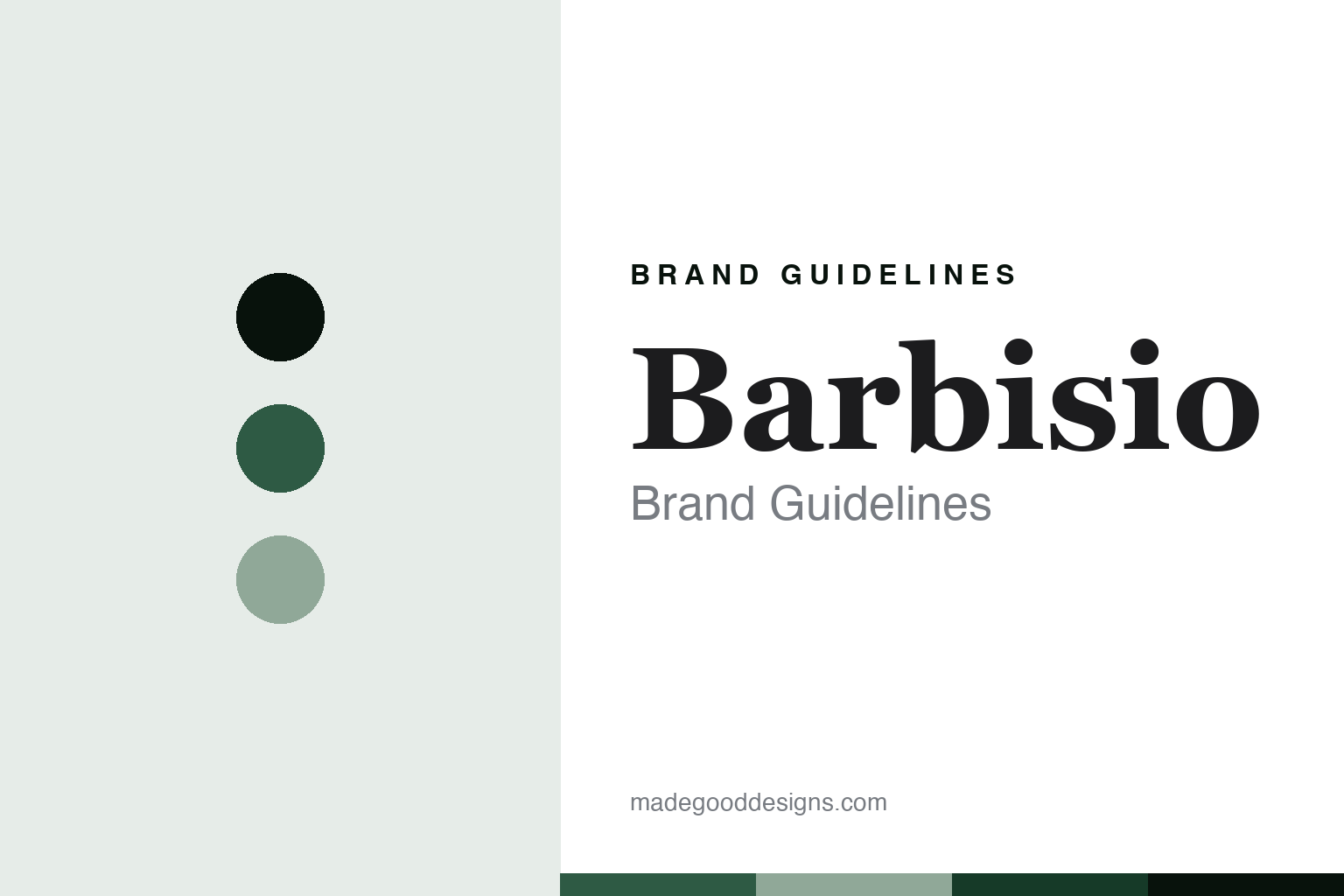
Barbisio Brand Guidelines
The felt name that lasted.
Aa
Two constants: a forest-green palette and a Biella-serif register. Abstract homage — not a Barbisio hat, label or hatband.
The Biella felt house
Barbisio is the historic Biella felt-hat name founded in 1862, whose original factory closed in 1981 and which is made today at its birthplace under the Zegna group.
Barbisio is a lesson in how a name can survive its own factory. Founded in 1862 in Sagliano Micca, in the Biella hatting district of Piedmont, Barbisio was one of the great Italian fur-felt hat makers — lightweight fedoras from the same region and tradition as Borsalino. Its answer to how a hat is made is Biella felt: work fur felt into a fine, light hat, in the Italian felt heartland. A historic felt name, still made where it was born.
Its identity is the Biella felt house. Barbisio’s fur-felt fedoras, and its place in Italian hat history, are the work it is known for. A hat, made in Biella. A name that outlasted its original company.
(Honest notes, so the story stays precise, because the company and the name are not the same. Barbisio was founded in 1862 in Sagliano Micca — we do not name an individual founder, which we could not verify, and note the brand itself often dates its craft to 1897, the cooperative that became its present maker. Its original factory closed in 1981; the Barbisio name was then carried on by a neighbouring maker, Cappellificio Cervo, from 1982, and since 2018 it has sat within the Ermenegildo Zegna group — so we describe it as a historic name produced today by Cappellificio Cervo, part of the Zegna group, not as the original 19th-century company trading unbroken. The genuinely strong point is that it is still made in Sagliano Micca, at its birthplace in the Biella district. On its history, it is fair to place Barbisio in the same tier as Borsalino among Italy’s leading felt-hat makers, which we frame as a comparison rather than a documented rivalry. Its name and marks are its IP, described but never reproduced, and there is no official brand hex — these tones are an unofficial interpretation. This is design commentary and does not promote any product.)
Colour
Barbisio lives in a forest-green palette. Click a swatch to copy the hex.
Barbisio’s identity is heritage, Italian and sober — a forest green, an ink, a sage, a pine, and a paper. The palette leans forest green and sage: the register of the Biella felt district and a historic hat name. It signals heritage over fashion. The honest caveat: with no published brand hex, these values are an original, unofficial interpretation, not first-party colours.
The lesson is a forest-green palette signals a Biella, felt-heritage identity. Barbisio’s world is a heritage, felt, Italian object. For designers, it is a reminder that a deep green and a soft sage can carry a name built on a district and a material — the green of the Piedmont hills and the grey-green of felt. Because these tones can fail as small text, keep type dark and let the colour live in the accents, palette and band. The takeaways: work the felt; keep it in Biella; separate the name from the original company; and treat any single hex as unofficial.
Typography
The register is a Biella serif — heritage, refined, Italian.
Barbisio’s identity carries a heritage, refined, Italian spirit — a historic felt name, not a new label. A Biella serif captures the mood: traditional, elegant and storied, the register of a Piedmont hat house. Set in a forest-green palette, the Biella serif feels heritage and refined — exactly the personality Barbisio carries. It is Italian rather than generic, mirroring a fine fur-felt fedora. (Barbisio’s real labels and marks are things we describe but do not reproduce, and the exact typeface is not ours to use.) Because it is not ours to use, the honest description is “a Biella-serif spirit,” shown here in a stand-in. The type behaves like the name: heritage, refined and Italian.
Aa
A Biella-serif spirit — heritage and refined. (Specimen set in Playfair Display, a Biella-serif STAND-IN; NOT the Barbisio wordmark or any label.)
The hat houses that lasted
Barbisio stands for the name a neighbour kept alive.
Barbisio is a lesson in how a heritage name is kept alive by another maker. A forest-green palette, a Biella serif and a fur-felt fedora make one thing — a historic Italian felt name — the whole identity: heritage, Italian and sober. The rescue is the differentiator, and the birthplace is the meaning. The point is an 1862 name whose own factory closed, and which a neighbouring hatmaker carried on, still making it in the same Biella town — now under the Zegna group.
Put to work, the identity is a rescued name, honestly told, as design. A brand in this spirit would carry a real heritage, keep the making in its home district, and be candid about the arc — a founding in 1862, an original factory closed in 1981, a name continued by a neighbour and now owned by a luxury group. A brand learning from it would see that a heritage name can be a durable identity even when its original company is gone — that a felt hat still made in Sagliano Micca has an authenticity a relaunch elsewhere would lack — and that being precise, founded 1862, factory closed 1981, made today by Cappellificio Cervo under Zegna, keeps the story honest. A brand learning from it would also value the “made where it was born” fact: keeping the craft in the same town is exactly what lets a rescued name mean something. The lesson Barbisio teaches is that a name can last when a neighbour keeps it: the birthplace gives it authenticity, and the honest arc keeps it credible. The name is the personality, and the felt hat is the proof.
For designers and brand-builders, Barbisio holds the rescued-name pole in this round of the hat houses that lasted, from Italy: keep the craft at home, and tell the rescue honestly. The lessons: work the felt; keep it in the district; separate the name from the original company; name the current owner; and never reproduce a protected label. It is also a reminder to stay precise: Barbisio is the historic Biella felt-hat name founded in 1862, whose original factory closed in 1981 and which is made today at its birthplace under the Zegna group — with the palette here an unofficial interpretation. Barbisio made the rescued name the identity — proof that a name a neighbour keeps can be the difference.
Explore & save
Keep Barbisio’s identity on hand — save it to a board in the Made Good inspiration library.
Barbisio identity set
Pin the forest-green palette and the Biella-serif register to your own board.