Carnoustie Golf Links Brand Guidelines
The Angus links of three crows, a burn and eight Opens.
Aa
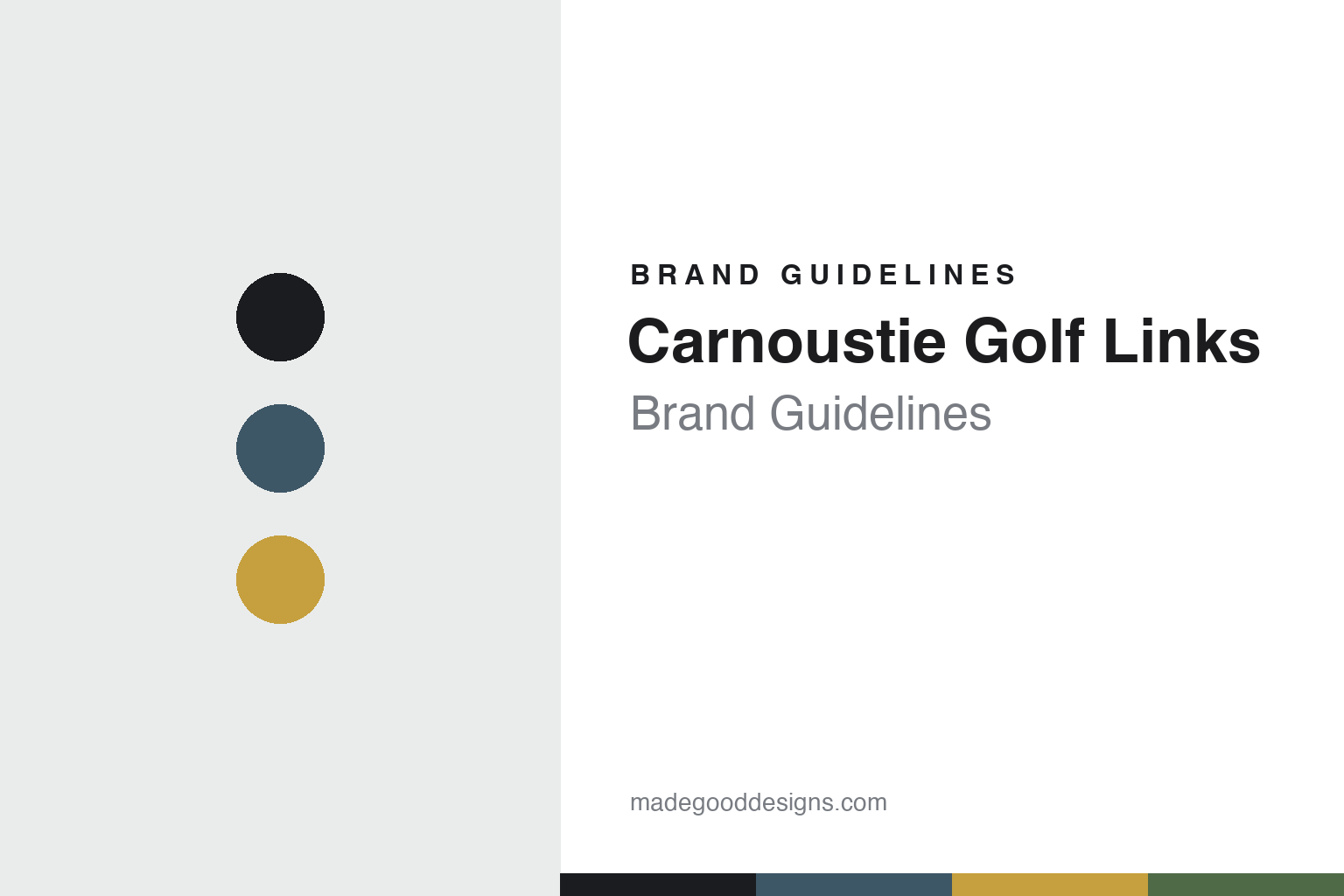
Two constants: a crow black, burn blue and whin gold palette and a civic serif register. Abstract homage — not a Carnoustie Golf Links product or mark; no crest, logo or scorecard is reproduced.
Links by the Barry Burn
Golf on the Angus coast since the 16th century.
Carnoustie Golf Links is the public golf links at Carnoustie, on the Angus coast of Scotland, east of Dundee. It has three main courses — the Championship Course, the Burnside Course and the Buddon Links — and, according to English Wikipedia, a free five-hole short course called The Nestie. Golf here goes back a long way: the links’ heritage page cites parish records of 1560 that mention “gowff,” and says that by 1839 the Carnoustie Golf Club had been formed.
The courses took shape in stages. English Wikipedia, citing The World Atlas of Golf and James W. Finegan’s 2010 book on Scottish golf, says the original ten-hole course, crossing and recrossing the Barry Burn, was laid out by Allan Robertson, assisted by Old Tom Morris, and opened in 1842. The coastal railway from Dundee to Arbroath, opened in 1838, had brought golfers from as far as Edinburgh. Morris extended the course to 18 holes in 1867, and James Braid reworked it in 1926, ahead of the course’s Open Championship debut in 1931. The links’ own heritage page gives the same sequence of Robertson, Morris and Braid.
Public ownership dates from 1890. Wikipedia says the 14th Earl of Dalhousie, who owned the land, sold the links to the local authority that year, with the money raised by public fundraising because the council had no funds of its own; Golf Business News wrote in March 2025 that the links had been in public ownership since 1890. Today the landowner is Angus Council. Its consultation papers say that since 1980 the courses have been managed on its behalf by the Carnoustie Golf Links Management Committee, incorporated in 2011 as CGLMC Ltd, which has since become a charitable company limited by guarantee.
Colour
Three crows and a tree.
The links’ emblem has civic roots. According to its heritage page, when Carnoustie became a burgh in 1899 local officials adopted a crest showing three crows flying over a leafy tree. The tree is now taken to be the Dibble Tree in the town centre, which the page says is more than 200 years old and around which the town is said to have been built. That crest, the page says, has been adapted over the years and remains the official Carnoustie Golf Links logo.
The crows come from a local legend that the page retells: that the town’s name derives from “Craw’s Nestie,” after crows that colonised the woods on Buddon Ness. It also gives a likelier origin in two Scandinavian words meaning rock and bay. The links run a junior programme called the Carnoustie Craws, and an amateur trophy launched in 1927 as the Carnoustie Corporation Trophy was renamed the Craw’s Nest Tassie, a tassie being an old Scots word for a drinking cup, the heritage page says.
The Championship Course carries its own vocabulary. Wikipedia’s list of hole names includes Hogan’s Alley at the sixth, formerly called Long, Spectacles at the 14th and Barry Burn at the 16th, with the 18th simply called Home. The tagline used across the links’ website is “Golf’s Greatest Test,”, and its restaurant is called The Rookery.
The other courses have their own character. The links credit the Buddon Links to Peter Alliss and Dave Thomas, on land that was partly the old ladies’ course, and say it has since been revised to a par of 68; the Burnside is also played to a par of 68. Behind the 18th green of the Championship Course stands the Carnoustie Golf Hotel, built before the 1999 Open, according to Wikipedia citing Finegan. Angus Council owns the land beneath it and has leased it to a private company, its papers say. The links also run an indoor performance centre with simulator bays, where golfers can play the opening hole of the Championship Course indoors.
Typography
Links, courses and resorts.
Golf links, courses and resorts present themselves through place before anything else. A venue’s name is usually its town, its bay or its estate, and its crest, flag or wordmark tends to borrow from the land around it: a bridge, a tree, a stretch of coast, a stone building. In June 2025, for example, St Andrews Links introduced a separate icon for each of its courses, drawn from local history, while keeping its older Links Crest as the corporate mark of the trust that runs them, Golf Business News reported.
The identity then travels across a set of familiar objects. Scorecards and yardage books carry the course name and its hole-by-hole layout; tee markers, direction signs and pin flags repeat the mark out on the ground; and clubhouse shops put it on polo shirts, caps, headcovers and towels. Clubhouses and hotels give a venue its architecture, and the names of the course architects, as the venues and their histories credit them, often become part of the story a resort tells about each course.
Ownership shapes how these places speak. Some links are public land run by a trust or a council committee; others belong to a resort company, a family business or a larger group with hotels elsewhere. Several have changed hands more than once, and a few run courses under lease rather than outright ownership. This guide describes each owner plainly, by its business role and the dates its sources give.
History pages and championship lists are a large part of how these venues publish themselves: the year a course opened, the architects who shaped or revised it, and the championships it has hosted, given as dated facts. This guide follows that record. It does not rank courses, compare them, or quote green fees, room rates or membership prices, and the colours shown with each guide are an unofficial interpretation rather than a venue’s own palette.
Aa
A civic serif for a links whose logo began as a burgh crest. (Specimen set in Crimson Pro, a serif STAND-IN; NOT the Carnoustie Golf Links logo.)
Carnoustie Golf Links
An Open venue under new management.
Carnoustie has hosted The Open eight times — in 1931, 1937, 1953, 1968, 1975, 1999, 2007 and 2018 — according to Wikipedia and the links. Tommy Armour won in 1931 and Francesco Molinari in 2018. The Championship Course has also staged the Women’s British Open in 2011 and 2021, the Senior Open in 2010, 2016 and 2024 by Wikipedia’s count, and the Amateur Championship in 1947, 1966, 1971 and 1992. It is one of three courses used for the autumn Alfred Dunhill Links Championship, with the Old Course at St Andrews and Kingsbarns. Wikipedia says the course was substantially modified before the 1999 Open, with all its bunkers rebuilt and new tees added, while keeping the routing used since 1926.
Management changed in 2025. In August 2023, Angus Council’s papers say, investment partners of the management committee bought the Carnoustie Golf Hotel; their holding company is Carnoustie Golf Heritage and Hospitality Group Limited (CGHH). In March 2025 Golf Business News reported that Angus Council had handed the running of the three courses to CGHH, under a short-term arrangement running to 2033, and that the management committee had sold its intellectual property, including the “Carnoustie Golf Links” trademark, to the company, with its assets and staff transferring. The report said the courses and the hotel were now under the same management control. The council’s papers state that ownership of the courses and the land stays with Angus Council and that the committee continues as a charity.
For a design guide, Carnoustie Golf Links shows how a public links can carry a town crest — three crows and a tree — into a championship identity. Compare St Andrews Links, another public links on The Open’s rota, and Gleneagles, a Perthshire resort whose courses are credited to James Braid. For this guide we use a crow black, a burn blue and a whin gold with a serif, an unofficial interpretation; no product or logo is reproduced.
Explore & save
Keep Carnoustie Golf Links’s identity on hand — save it to a board in the Made Good inspiration library.
Carnoustie Golf Links identity set
Pin the Carnoustie Golf Links crow black, burn blue and whin gold palette and the civic serif register to your own board.
Source & notes
Frequently Asked Questions
What font can I use to match the Carnoustie Golf Links look?
This guide describes Carnoustie Golf Links’ type as “A civic serif for a links whose logo began as a burgh crest”. Its type specimen is set in Crimson Pro from Google Fonts as a stand-in; Crimson Pro is not Carnoustie Golf Links’ own lettering.
What colours are in the Carnoustie Golf Links palette?
This guide’s Carnoustie Golf Links palette is Crow black #1B1C1F, Burn blue #3E5767, Whin gold #C6A03E, Links green #4F6A47 and Sea haar #E8EBE6. The tones are the guide’s own unofficial interpretation, not official Carnoustie Golf Links hex codes.
When did Carnoustie Golf Links open?
Carnoustie Golf Links opened in 1842 (ten holes), in Carnoustie, Angus, Scotland.
Who owns Carnoustie Golf Links?
Carnoustie Golf Links today: Council-owned; run by CGHH since 2025.