Gleneagles Brand Guidelines
A railway company’s country palace, built around its golf courses.
Aa
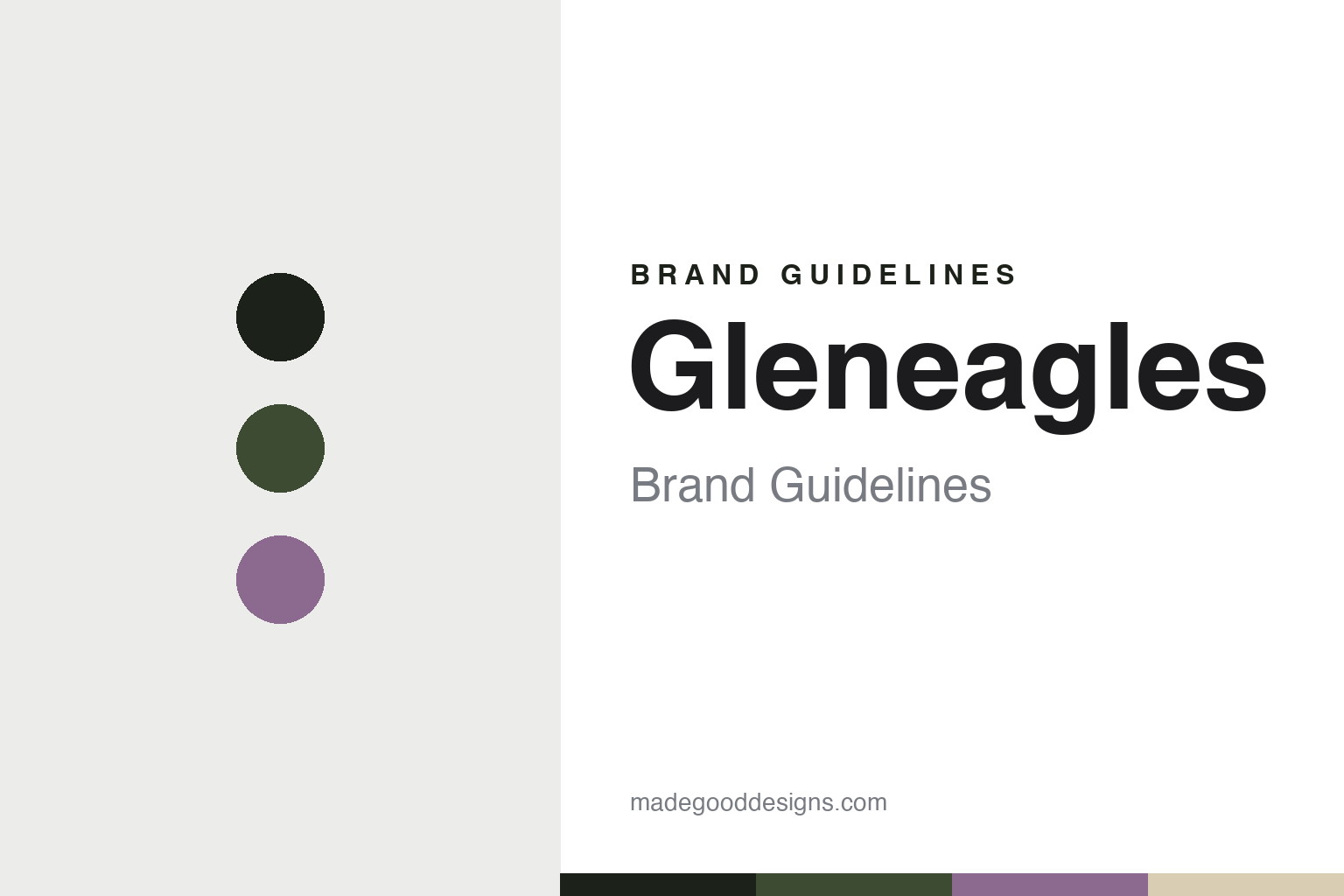
Two constants: an Ochil moss, heather and Strathearn stone palette and a classic serif register. Abstract homage — not a Gleneagles asset; no eagle mark, crest or building image is reproduced.
A railway palace
A general manager’s holiday idea in Strathearn.
Gleneagles is a hotel and golf resort near Auchterarder in Perthshire, Scotland, and it began as a railway project. Golf Business News, writing in July 2015, said the hotel was conceived by Donald Matheson, then general manager of the Caledonian Railway, while he was on holiday nearby in 1910; impressed by the countryside, he pictured a palace-style hotel surrounded by golf courses. The hotel’s own history page says a company, Gleneagles Ltd, was formed in 1913 to build and run the hotel and its courses, and that work stopped after the First World War broke out in August 1914 and did not resume until 1922.
The golf came first. The hotel says Matheson engaged James Braid, the five-time Open champion, with his assistant Cecil Key Hutchison, to lay out two courses in the grounds, and that the King’s Course and the Queen’s Course opened on 1 May 1919, five years before the building was finished. They were shaped by hand, with horse and cart, the hotel says.
By the time the hotel opened, the railway had changed. The Caledonian Railway became part of the London, Midland and Scottish Railway (LMS) in 1923, and the hotel says the LMS took over Gleneagles Ltd fully before the opening. English Wikipedia records that the Caledonian also built the nearby Gleneagles station and that the hotel had its own branch line. The hotel opened on Saturday 7 June 1924; the bandleader Henry Hall and his band played at the opening gala ball, which was broadcast on BBC radio, according to both the hotel and English Wikipedia.
During the Second World War the hotel closed to guests and was used as a hospital, the hotel and English Wikipedia say; the hotel dates its reopening to 1947.
Colour
From British Transport Hotels to Ennismore.
Ownership followed the railways for almost six decades. English Wikipedia says the hotel passed from the LMS to the British Transport Commission in 1948 and to British Transport Hotels in 1963; Golf Business News dated its arrival in British Transport Hotels to 1948. It became a Category B listed building in 1980. In 1981 it was sold into the private sector: English Wikipedia names the buyer as Gleneagles Hotels plc, and Golf Business News described a consortium of Scottish businessmen that also bought two Edinburgh hotels. Since 1982 the hotel has opened all year round, English Wikipedia says.
A drinks company followed. In 1984 the Perth distiller Arthur Bell & Sons bought Gleneagles; Bell’s came under Guinness in 1985, and Guinness became part of Diageo in 1997. In July 2015 Diageo sold the hotel to Ennismore, the London hospitality company founded by Sharan Pasricha, for an undisclosed sum, Golf Business News reported at the time, adding that Ennismore had said it would keep the existing management. In November 2026 the same publication described Ennismore as a London-based lifestyle hospitality company and noted that it had merged with Accor in 2021, with the resort run through the joint-venture company.
The courses grew around the original two. The Monarch’s Course, designed by Jack Nicklaus, opened in 1993 and was later renamed the PGA Centenary Course. A nine-hole par-three layout, the PGA National Academy Course, is known informally as the Wee Course; the Gleneagles Golf Academy, opened in 1994, was renamed the PGA National Academy for Scotland in 2010, English Wikipedia says. In November 2026 Golf Business News, citing The Courier, reported that Gleneagles had bought the neighbouring estate holding gWest, an 18-hole course designed by David McLay Kidd and completed in 2009 that never officially opened for public play.
Championships are part of the record. English Wikipedia lists the Curtis Cup on the King’s Course in 1936, the Women’s British Open in 1957 and the Scottish Open from 1987 to 1994. The PGA Centenary Course hosted the Ryder Cup in September 2014 and the Solheim Cup in 2019, and the resort also held the European Golf Team Championships in 2018 and the Senior Open in 2022 and 2026, according to English Wikipedia.
Typography
Links, courses and their keepers.
Golf links, courses and resorts present themselves through place before anything else. A venue’s name is usually its town, its bay or its estate, and its crest, flag or wordmark tends to borrow from the land around it: a bridge, a tree, a stretch of coast, a stone building. In June 2025, for example, St Andrews Links introduced a separate icon for each of its courses, drawn from local history, while keeping its older Links Crest as the corporate mark of the trust that runs them, Golf Business News reported.
The identity then travels across a set of familiar objects. Scorecards and yardage books carry the course name and its hole-by-hole layout; tee markers, direction signs and pin flags repeat the mark out on the ground; and clubhouse shops put it on polo shirts, caps, headcovers and towels. Clubhouses and hotels give a venue its architecture, and the names of the course architects, as the venues and their histories credit them, often become part of the story a resort tells about each course.
Ownership shapes how these places speak. Some links are public land run by a trust or a council committee; others belong to a resort company, a family business or a larger group with hotels elsewhere. Several have changed hands more than once, and a few run courses under lease rather than outright ownership. This guide describes each owner plainly, by its business role and the dates its sources give.
History pages and championship lists are a large part of how these venues publish themselves: the year a course opened, the architects who shaped or revised it, and the championships it has hosted, given as dated facts. This guide follows that record. It does not rank courses, compare them, or quote green fees, room rates or membership prices, and the colours shown with each guide are an unofficial interpretation rather than a venue’s own palette.
Aa
A classic serif — for a hotel whose name is set like a country house. (Specimen set in Cormorant Garamond, a serif STAND-IN; NOT the Gleneagles logo.)
Gleneagles
An eagle, a glen and a country-house tone.
Gleneagles presents itself as a country estate with many pursuits rather than only a golf venue. Its history page dates a shooting school to 1985 and an equestrian centre to 1988, both now run under the Gleneagles name, and lists the British School of Falconry, which English Wikipedia says has been based there since 1992. Later additions named by the hotel include the Braid House wing, named after the courses’ architect; the Gleneagles Arena, an events space and tennis centre opened in 2015; and Ochil House, a private events wing launched in 2018. In 2016, the hotel says, a six-year renovation began that added new bars and restaurants and redesigned the bedrooms and suites.
The name now travels beyond Perthshire. The hotel runs Gleneagles Townhouse on St Andrew Square in Edinburgh, which its website describes as a city outpost of the hotel, with 33 guest rooms, a restaurant, a rooftop bar and a members’ club in a former Bank of Scotland building. In 2017 it also launched Gleneagles & Co, a range of foods, homeware and leather goods made with Scottish and British makers, the hotel says.
The visual identity leans on an eagle. In its announcement of a ten-piece clothing collection made with the Los Angeles golf-apparel brand Malbon Golf, the hotel described each garment as carrying an insignia that combines what it calls its eagle design with Malbon’s golf-ball logo, in neutrals, moss greens and navy blues chosen to suit the Perthshire setting.
For a design guide, Gleneagles shows how a railway hotel built its identity on a landscape and a set of named courses, and how that name can stretch to a city hotel and a shop range. Compare St Andrews Links, the Fife links managed by a trust, and Carnoustie Golf Links, another Scottish championship venue. For this guide we use an Ochil moss, a heather and a Strathearn stone with a serif, an unofficial interpretation; no product or logo is reproduced.
Explore & save
Keep Gleneagles’s identity on hand — save it to a board in the Made Good inspiration library.
Gleneagles identity set
Pin the Gleneagles Ochil moss, heather and Strathearn stone palette and the classic serif register to your own board.
Source & notes
Frequently Asked Questions
What font can I use to match the Gleneagles look?
This guide describes Gleneagles’ type as “A classic serif — for a hotel whose name is set like a country house”. Its type specimen is set in Cormorant Garamond from Google Fonts as a stand-in; Cormorant Garamond is not Gleneagles’ own lettering.
What colours are in the Gleneagles palette?
This guide’s Gleneagles palette is Ochil moss #3E4B33, Glen ink #1C2119, Heather #8C6A8F, Strathearn stone #D9CDB4 and Linen #F6F2EA. The tones are the guide’s own unofficial interpretation, not official Gleneagles hex codes.
When did Gleneagles open?
Gleneagles opened on 7 June 1924 (courses 1 May 1919), in Auchterarder, Perthshire.
Who owns Gleneagles?
Gleneagles is owned by Ennismore (since 2015). This guide dates Gleneagles to 7 June 1924 (courses 1 May 1919), in Auchterarder, Perthshire.