Antigua Sailing Week Brand Guidelines
The English Harbour regatta begun by island hoteliers.
Aa
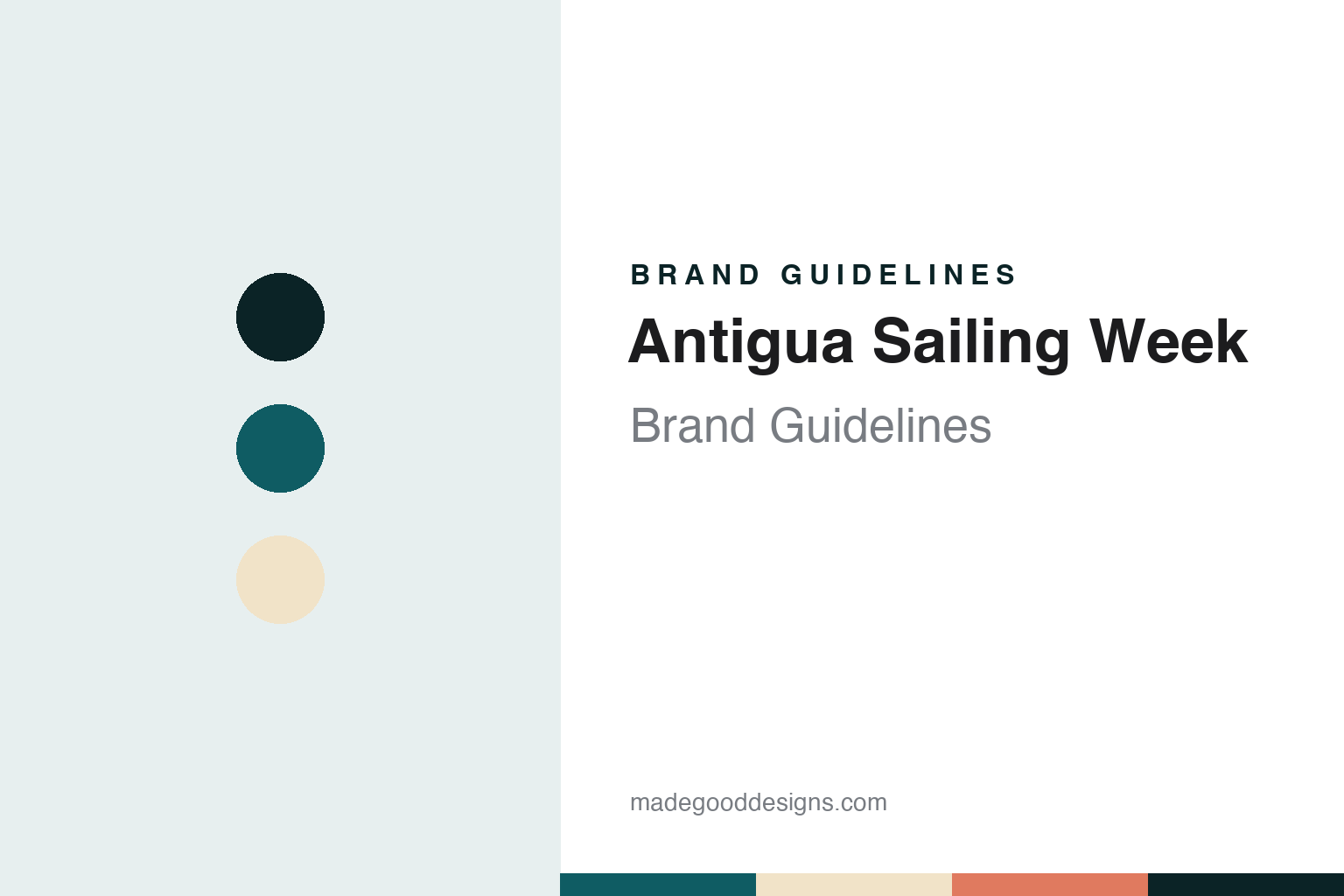
Two constants: an Antigua Sailing Week teal, coral and sand palette and an Open sans register. Abstract homage — not an Antigua Sailing Week asset or mark; no logo, trophy or flag is reproduced.
A hoteliers’ regatta
Friends, hotels and a longer season.
Antigua Sailing Week is a regatta sailed from English Harbour, on the south coast of Antigua. Its own history page says it began in 1968, when a group of friends, several of them hoteliers, set up a regatta to lengthen the island’s winter season by persuading visitors to stay a little longer or to come for the event itself. The Antigua Hotel Association sponsored that first edition, held from 8 to 15 June 1968 with boats from the United States, Canada and the Caribbean, the organiser says. English Wikipedia, citing The Rough Guide to Antigua and Barbuda of 2002, gives the founding year as 1967, so the two sources differ by a year.
The first programme was broad. The organiser lists a three-day “Lord Nelson Regatta” for yachts of up to 135 feet, power boat races, deep-sea fishing, Sunfish dinghy contests and a two-day race for Antigua’s working fishing boats, freshly painted for the occasion. Invitations went out through travel agents under the slogan “Island for All Seasons.” The week opened on 8 June 1968 with the finish of a race from Guadeloupe to English Harbour and closed with a Lord Nelson Costume Ball in Nelson’s Dockyard on 15 June.
The event was repeated in 1969, from 31 May to 7 June, and its dates later settled on a start on the last Sunday in April, according to its history page. Over time the hotels became less involved, the workboat races dropped out and dinghy racing moved to separate events. The Guadeloupe race survives as the Guadeloupe to Antigua Race, and the costume ball became the Lord Nelson’s Ball at the Admiral’s Inn before giving way to an open awards party in the Dockyard, behind the Copper and Lumber Store.
Colour
Splits, spin-offs and a new format.
Antigua Sailing Week has repeatedly passed parts of its fleet to new events. In the early years most entries were classic designs; as faster racing boats came to outnumber them, the classic class split off in 1988 to form the Antigua Classic Yacht Regatta, the organiser says. In 2009, it adds, members of the then race-management team joined the Royal Ocean Racing Club to start the RORC Caribbean 600, an offshore race.
Fleet sizes have moved with the Caribbean calendar. The organiser says the week once drew more than 250 yachts and has since settled at a little over 100 a year, as maxis and superyachts gained events of their own and the European and North American seasons began earlier. English Wikipedia, citing guidebooks published between 2002 and 2005, describes an average of about 100 yachts with 150 to 200 in its busiest years, and says the closing prize-giving has been presided over by the Governor-General. The event’s tagline became “where sailing comes first.”
The largest change came in 2026. In July 2025 the Antigua and Barbuda Ministry of Tourism announced a new event, the Antigua Racing Cup, for course racing, alongside a reworked Antigua Sailing Week, Cruising World reported, quoting race manager Jaime Torres as saying the week would return to “its cruising roots.” Scuttlebutt Sailing News reported in June 2026 that Antigua had hosted 56 editions of the week before the two were run as separate, back-to-back events that April. The organiser’s comparison page set the Racing Cup for 9–12 April 2026, off the south-east coast with CSA and IRC classes and one-design racing in RS Elites and Dragons, and the 57th Antigua Sailing Week for 22–26 April 2026: point-to-point legs round the island with overnight stops at Nonsuch Bay, Little Jumby Bay and Ffryes Beach, scored under a simplified CSA rating and open to cruising boats and bareboats.
The organiser’s report of 28 April 2026 names Alison Sly-Adams as president of Antigua Sailing Week and says the Lord Nelson Trophy, its top overall prize, went to the First 47.7 Kali, skippered by Chuck Bayer of Michigan, which took CSA Class 1. The report credits more than 50 volunteers, and the final prize-giving was held in Nelson’s Dockyard, a UNESCO World Heritage Site.
Typography
How races and regattas present themselves.
Offshore races and regattas are run by organisers rather than manufacturers, so their identities live on posters, start lines, race villages, maps and broadcasts more than on products. Some organisers are clubs, some are private companies and some are semi-public bodies tied to a host town or region. A design guide for any of them starts with a plain question: who runs the event, and who owns the name.
Race names carry a lot of history. Many events have changed their names as title sponsors came and went, and an organiser’s pages on history and past editions usually list each edition under the name it raced under at the time. A wordmark often has to sit beside a sponsor’s name, a host town and a year, and partner logos are usually set in tiers below it, from title partner down to official suppliers.
Boat classes shape the look as well. Sources name classes such as IMOCA, Class40, the Mini 6.50 and the F50 one-design catamaran, and each event sets out which classes it admits. Sails, hulls and wings carry team names and partner marks, and course maps and tracking graphics let viewers follow a long race day by day.
The rest of the identity sits on land: the race village where boats are moored before the start, the signage on pontoons, the official merchandise and the trophy, which some organisers unveil publicly. The guides in this group describe what their sources show about those elements, name organisers, clubs and companies plainly, and treat editions and dates as the main facts.
Aa
An open sans for a harbour regatta. (Specimen set in Archivo, a sans STAND-IN; NOT the Antigua Sailing Week logo.)
Antigua Sailing Week
A hotel association’s mark on a dockyard stage.
The name and logo belong to the island’s hotel trade. Footer text on the regatta’s website says the Antigua Sailing Week logo is a registered trademark of the Antigua Barbuda Hotels & Tourism Association, describes the event as wholly owned by that association since 1968, and names Caribbean Sailing Events Inc. as its appointed representative, whose written permission is needed to use the mark. The ownership line ties the event back to the hotel association that sponsored its first edition.
The setting carries much of the identity. Welcome parties and prize-givings have centred on English Harbour and Nelson’s Dockyard, with Falmouth Harbour alongside; the organiser’s 2026 report places the final prize-giving within sight of the Fort Berkeley gunpowder magazine and the limestone Pillars of Hercules. Each 2026 leg ended at a different shoreside party, from a beach rendezvous hosted by the Falmouth Ocean Club to a festival at Ffryes Beach, and the organiser named Sunsail Moorings as its official bareboat provider for the year.
The week’s trophies give it a vocabulary of its own: the Lord Nelson Trophy for the overall winner, a Governor General’s Cup for the multihull class winner in 2026, a Caribbean Sailing Association Travellers Trophy for regular competitors on the regional circuit and a youth trophy linked to the Youth to Keel programme, according to the organiser’s 2026 report.
For a design guide, Antigua Sailing Week shows how a regatta can rest its identity on a harbour and a place in the calendar while its format changes around them. Compare Cowes Week, another regatta built around a harbour town, and Les Voiles de Saint-Tropez. For this guide we use a deep harbour teal, coral and warm sand with a sans, an unofficial interpretation; no product or logo is reproduced.
Explore & save
Keep Antigua Sailing Week’s identity on hand — save it to a board in the Made Good inspiration library.
Antigua Sailing Week identity set
Pin the Antigua Sailing Week teal, coral and sand palette and the Open sans register to your own board.
Source & notes
Frequently Asked Questions
What font can I use to match the Antigua Sailing Week look?
This guide describes Antigua Sailing Week’s type as “An open sans for a harbour regatta”. Its type specimen is set in Archivo from Google Fonts as a stand-in; Archivo is not Antigua Sailing Week’s own lettering.
What colours are in the Antigua Sailing Week palette?
This guide’s Antigua Sailing Week palette is Harbour teal #0F5C63, Ink #0B2326, Coral #E07A5F, Warm sand #F1E3C8 and Paper #FAF7F1. The tones are the guide’s own unofficial interpretation, not official Antigua Sailing Week hex codes.
When was Antigua Sailing Week founded?
Antigua Sailing Week was founded in 1968 (organiser); 1967 (Wikipedia), in English Harbour, Antigua.
Who owns Antigua Sailing Week?
Antigua Sailing Week is owned by Antigua Barbuda Hotels and Tourism Association.