St Andrews Links Brand Guidelines
The Fife links where a charitable trust runs the Old Course and its sister courses.
Aa
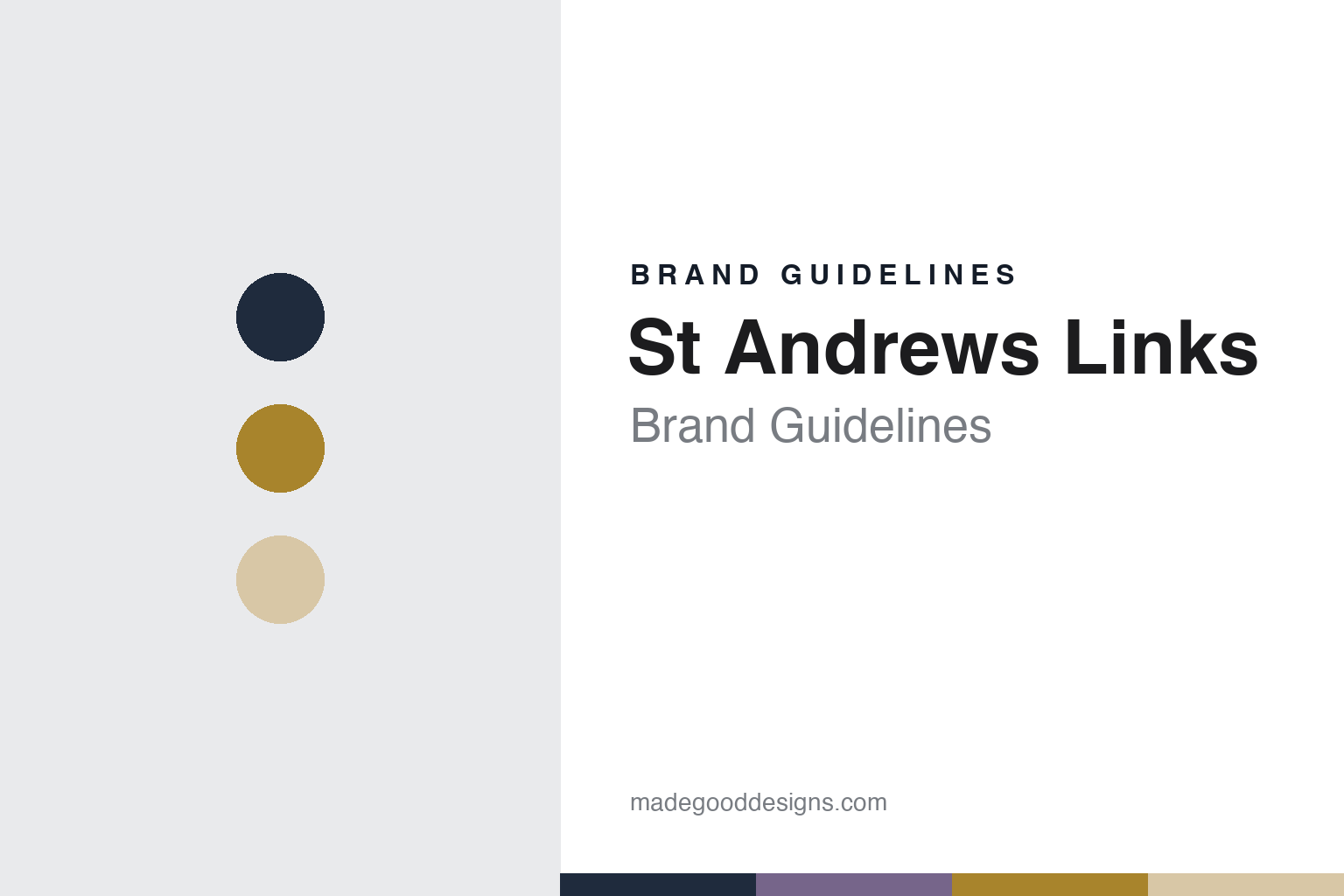
Two constants: a navy, heather, gorse and sandstone palette and an inscription serif register. Abstract homage — not a St Andrews Links asset; no crest, logo, course icon or tartan is reproduced.
Common ground
A town’s links, held in trust.
St Andrews Links is the group of public golf courses at St Andrews, on the Fife coast of Scotland, where golf has been played since the 15th century, according to English Wikipedia, which notes the town’s nickname, the “home of golf.” The courses are owned by Fife Council and operated by the St Andrews Links Trust, a charity. Six of them lie together on the links north of the town: the Old, the New, the Jubilee, the Eden, the Strathtyrum and the nine-hole Balgove. The Castle Course sits about a mile to the south-east, and the Craigtoun Course a few miles to the south-west.
The public right to play is old. English Wikipedia traces the history of the links to 1552, when Archbishop John Hamilton was granted a charter to keep a rabbit warren on the land; the charter refers to the public ownership of the links and the right of the townspeople to play golf and other games, a right later confirmed in local and royal charters. Golf and rabbit farming were at odds for years: after the links ran into debt in 1797, the town council allowed rabbits to be farmed there, and the dispute lasted until 1821, when James Cheape of the neighbouring Strathtyrum estate bought the land.
A later James Cheape sold the links to the Royal and Ancient Golf Club of St Andrews in the 1890s — English Wikipedia gives 1893 in one article and 1892 in another, adding that the club passed the land to the town a year later. The St Andrews Links Act 1894 then gave the burgh commissioners power to acquire the links as a public park and recreation ground. The St Andrews Links Order Confirmation Act 1974 created the trust that runs them today.
The Trust is a separate body from the Royal and Ancient Golf Club, founded in 1754, whose clubhouse stands beside the first tee of the Old Course, and from the R&A, which was spun out of that club in 2004 to take over its role in the rules of golf. Several other clubs are based at the links, including St Andrews Golf Club, founded in 1843, the New Golf Club, founded in 1902, and the St Regulus Ladies Golf Club, founded in 1914; their members have favoured access to the courses, while visitors may also play.
Colour
Eight courses and their names.
The Old Course was known simply as the golfing grounds of St Andrews until the New Course opened in 1895, English Wikipedia says. Its 18-hole length dates from 1764, when the course was cut from 22 holes to 18, and Old Tom Morris, who designed its first and 18th holes, separated the first green from the 17th around 1863, leaving the layout of seven double greens that golfers play today. The Old Course has hosted The Open 30 times since 1873, most recently in 2022, and the Women’s Open in 2007, 2013 and 2024.
The other courses each have their own date and designer, as English Wikipedia records them. The New Course was commissioned by the Royal and Ancient club and laid out by Old Tom Morris. The Jubilee was named after Queen Victoria’s Diamond Jubilee of 1897; it opened with 12 holes and grew to 18 in 1905. The Eden, designed by Harry Colt, opened in 1914 and was altered by Donald Steel in 1989; its name comes from the Eden estuary beside it. The Balgove, named after the farm on which it was built, opened in 1972, and the Strathtyrum opened in July 1993 on land the Trust bought from the Strathtyrum estate in 1986. The Castle Course, on a cliff top east of the town, opened in June 2008 to a design by David McLay Kidd.
The newest addition came by lease. In December 2025 Golf Business News reported that the Trust had agreed with the Old Course Hotel to take over a long-term lease of The Duke’s Course from 5 January 2026. The course, a heathland layout with tree-lined fairways, was renamed The Craigtoun Course after nearby Craigtoun Country Park, with a new logo showing the trees around it. The magazine noted that the change brought it into line with the Strathtyrum, Eden, Balgove and Castle courses, all named after local places or landmarks. The hotel’s general manager told the magazine that the course had been under Kohler’s leadership for 25 years.
The Trust also runs the buildings around the courses. It built the St Andrews Links Clubhouse by the first holes of the New and Jubilee in 1995, and from 1998 redeveloped Pilmour Cottage, a 19th-century villa, into its headquarters and the Eden Clubhouse, English Wikipedia says; neither clubhouse belongs to a club, and both are open to all. Its website also lists the Castle and Craigtoun clubhouses and the Tom Morris Bar & Grill.
Typography
Design and documentation.
Golf links, courses and resorts present themselves through place before anything else. A venue’s name is usually its town, its bay or its estate, and its crest, flag or wordmark tends to borrow from the land around it: a bridge, a tree, a stretch of coast, a stone building. In June 2025, for example, St Andrews Links introduced a separate icon for each of its courses, drawn from local history, while keeping its older Links Crest as the corporate mark of the trust that runs them, Golf Business News reported.
The identity then travels across a set of familiar objects. Scorecards and yardage books carry the course name and its hole-by-hole layout; tee markers, direction signs and pin flags repeat the mark out on the ground; and clubhouse shops put it on polo shirts, caps, headcovers and towels. Clubhouses and hotels give a venue its architecture, and the names of the course architects, as the venues and their histories credit them, often become part of the story a resort tells about each course.
Ownership shapes how these places speak. Some links are public land run by a trust or a council committee; others belong to a resort company, a family business or a larger group with hotels elsewhere. Several have changed hands more than once, and a few run courses under lease rather than outright ownership. This guide describes each owner plainly, by its business role and the dates its sources give.
History pages and championship lists are a large part of how these venues publish themselves: the year a course opened, the architects who shaped or revised it, and the championships it has hosted, given as dated facts. This guide follows that record. It does not rank courses, compare them, or quote green fees, room rates or membership prices, and the colours shown with each guide are an unofficial interpretation rather than a venue’s own palette.
Aa
An inscription serif — lettering that, the Trust says, follows carved stone. (Specimen set in Cinzel, a serif STAND-IN; NOT the St Andrews Links logo.)
St Andrews Links
Three cuts for three bridges.
In June 2025 St Andrews Links introduced an updated identity for the links and its courses, Golf Business News reported. The Trust described every element as drawn from the place. The new St Andrews Links wordmark has three cuts in its letters to stand for the bridges golfers use to cross the Swilcan Burn, the stream that runs through the links. Its lettering takes its lead from the carved text on the Martyrs’ Monument, behind the 18th green of the Old Course, and on the old march stones that mark the historic routing of the original course.
Each course was given its own icon. The Old Course icon shows the Swilcan Bridge on the 18th fairway; the New Course is marked by Old Tom Morris’s flat cap; and the Jubilee by a queen chess piece, a nod to Queen Victoria’s Jubilee. The colour palette, the Trust said, takes its cue from the heather and gorse on the courses, the North Sea and the stone buildings of the town. The older Links Crest, which also appears on the Old Course starter’s hut, stays on as the corporate mark of the Trust itself. The new marks began to appear on merchandise and across the Trust’s digital channels as the rollout began.
A textile followed. In July 2026 the Trust launched a registered Home of Golf tartan, made by The Isle Mill, part of the Macnaughton Group, Golf Business News reported. Its colours, as the Trust described them, are a navy base with a sand shade taken from the sandstone of the Swilcan Bridge and the town, a soft lilac from the heather and evening skies, and a sea blue for the surrounding water and the burn. The first range covered polo shirts, caps, headcovers, a throw and a teddy bear, sold online and at a new Home of Golf Hub on Market Street, which the Trust described as its first permanent community, information and retail presence in the centre of the town. The site’s footer notes that St Andrews Links, the Home of Golf and The Old Course are registered trademarks.
For a design guide, St Andrews Links shows how a public venue can build a brand from its own ground: a stream, a bridge, a monument’s lettering and a few local colours, with an older crest kept for the institution behind it. Compare Carnoustie Golf Links, a links that English Wikipedia places within 45 minutes’ drive of St Andrews, and Kohler, whose Old Course Hotel ran The Duke’s Course before the lease. For this guide we use a North Sea navy, heather, gorse gold and sandstone with a serif, an unofficial interpretation; no product or logo is reproduced.
Explore & save
Keep St Andrews Links’s identity on hand — save it to a board in the Made Good inspiration library.
St Andrews Links identity set
Pin the St Andrews Links navy, heather, gorse and sandstone palette and the inscription serif register to your own board.
Source & notes
Frequently Asked Questions
What font can I use to match the St Andrews Links look?
This guide describes St Andrews Links’ type as “An inscription serif — lettering that, the Trust says, follows carved stone”. Its type specimen is set in Cinzel from Google Fonts as a stand-in; Cinzel is not St Andrews Links’ own lettering.
What colours are in the St Andrews Links palette?
This guide’s St Andrews Links palette is North Sea navy #1F2B3D, Heather #76658A, Gorse gold #A8842C, Sandstone #D8C7A6 and Paper #F6F3EC. The tones are the guide’s own unofficial interpretation, not official St Andrews Links hex codes.
Who owns St Andrews Links?
St Andrews Links today: Courses owned by Fife Council, run by the Trust.