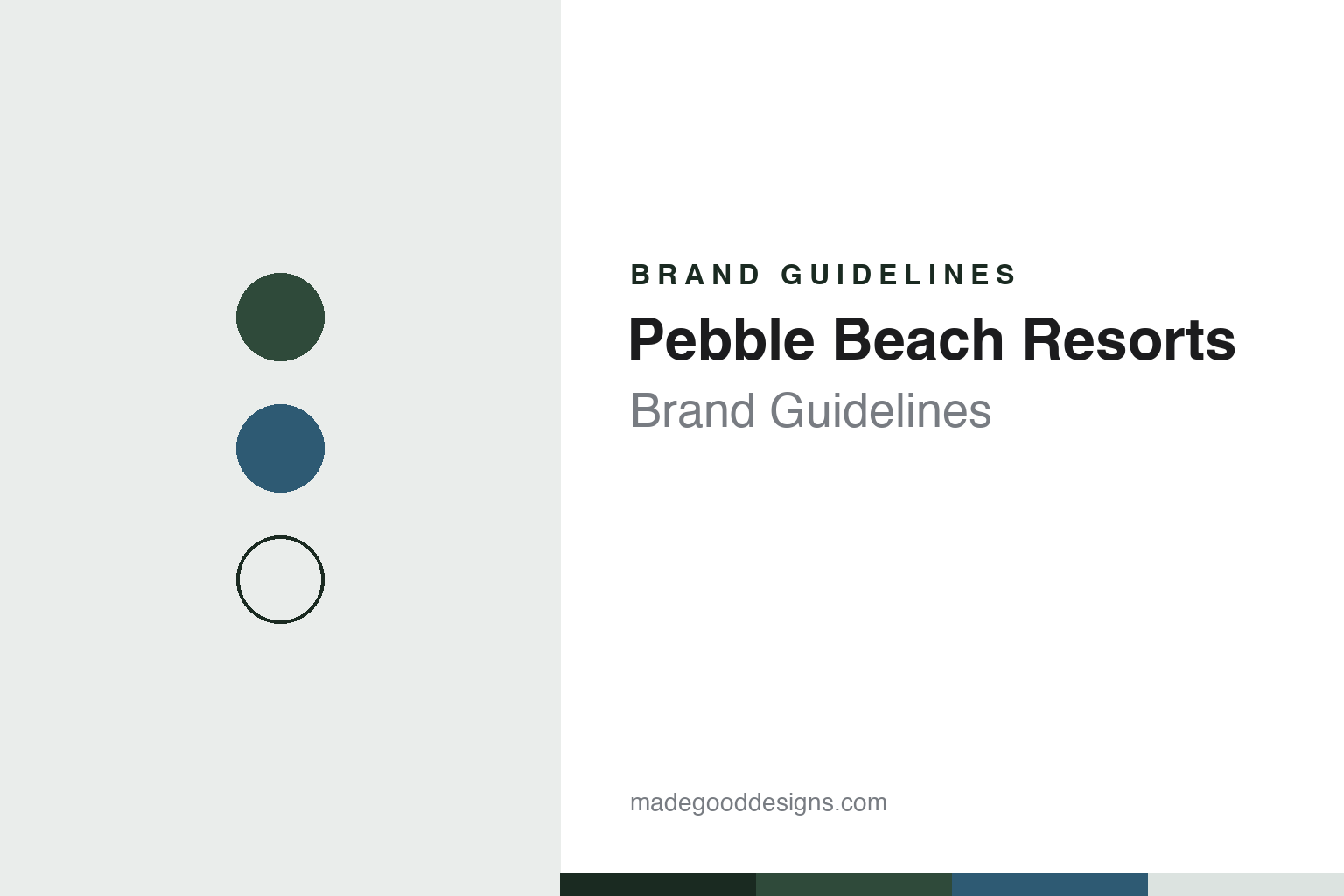
Pebble Beach Resorts Brand Guidelines
The Monterey Peninsula resort whose sign is a single cypress tree.
Aa
Two constants: a cypress green, bay blue and granite palette and a coastal serif register. Abstract homage — not a Pebble Beach asset; no Lone Cypress mark, logo or photograph is reproduced.
Del Monte Properties
A railway estate turned resort.
Pebble Beach Resorts is the name under which Pebble Beach Company presents its hotels and golf courses on the Monterey Peninsula in California. Its golf courses and hotels sit inside Pebble Beach, an unincorporated community in Monterey County reached by the 17-Mile Drive, the scenic road that the Pacific Improvement Company had laid out by 1892 for guests of its Hotel Del Monte, according to English Wikipedia. The Pacific Improvement Company was the property arm of the four Central Pacific Railroad founders, and it bought the land in 1880.
The resort began with a lodge. In 1908 the architect Lewis P. Hobart was hired to design the Pebble Beach Lodge, a rustic log inn completed by 1909 halfway along the drive. Samuel Finley Brown Morse, hired in the 1910s to manage the Pacific Improvement Company, persuaded it in 1916 to build a golf course at the edge of Pebble Beach and Stillwater Cove. The log lodge burned in December 1917 while the course was under construction, and a new Del Monte Lodge replaced it, designed by Hobart with Clarence Tantau, English Wikipedia says.
In 1919, the San Francisco Chronicle wrote in its 2019 centennial timeline, Morse formed the Del Monte Properties Company and bought the 18,000-acre Del Monte holdings, including the Hotel Del Monte, the Del Monte Lodge — now The Lodge at Pebble Beach — and two golf courses. The new lodge and Pebble Beach Golf Links opened that year; English Wikipedia dates the course’s opening to 22 February 1919.
Ownership changed several times after Morse. Del Monte Properties was reincorporated as the Pebble Beach Corporation on 30 March 1977, when the lodge took its present name. In 1979 20th Century Fox bought the business and reorganised it as Pebble Beach Company, the Chronicle reported. English Wikipedia says that when the studio was sold in 1985, the businessman Marvin Davis kept Pebble Beach, and in 1990 sold it to a Japanese buyer, who placed it under a holding company called the Lone Cypress Company. In March 1992 the Japanese golf course operator Taiheiyo Club took it over, and in July 1999 a group of American investors bought Pebble Beach Company, the Chronicle reported. An April 2025 announcement named David Stivers as the company’s chief executive.
Colour
Neville, Grant and the courses that followed.
Pebble Beach Golf Links was designed by two amateur golfers, Jack Neville and Douglas Grant, who worked at no cost, the San Francisco Chronicle reported. English Wikipedia says Neville aimed to put as many holes as possible along the rocky coastline, using a figure-of-eight routing. Robert Hunter and H. Chandler Egan revised the course in 1927 and 1928 ahead of the 1929 U.S. Amateur, consulting Alister MacKenzie, and in January 1999 a new fifth hole by Jack Nicklaus opened on land beside Stillwater Cove.
The course’s championship record is long. It has hosted the U.S. Open six times — in 1972, 1982, 1992, 2000, 2010 and 2019 — and the 1972 event was the first U.S. Open held on a public course, according to the Chronicle; Jack Nicklaus won that year, and Tom Watson won in 1982. It hosted the PGA Championship in 1977 and its first women’s major, the U.S. Women’s Open, in July 2023. Since January 1947 it has been a host course of the professional-amateur event founded as the Bing Crosby National Pro-Am, which took on a title sponsor in 1986 and is now the AT&T Pebble Beach Pro-Am on the PGA Tour.
Pebble Beach Company owns other courses in the community. Spyglass Hill, designed by Robert Trent Jones Sr., opened on 11 March 1966. It was first called Pebble Beach Pines Golf Club, and Morse renamed it after a place in Treasure Island, the 1883 novel by Robert Louis Stevenson, who had spent time in the Monterey area in 1879; its holes carry names from the book, such as Treasure Island for the first and Blind Pew for the fourth, English Wikipedia says. The Links at Spanish Bay, designed by Robert Trent Jones Jr., Tom Watson and Sandy Tatum, opened in 1987 in a style modelled on a British links; English Wikipedia says it closed for renovation in March 2026. The company also owns the short Peter Hay course and the Del Monte Golf Course in Monterey.
The resort’s hotels are The Lodge at Pebble Beach and The Inn at Spanish Bay, whose development Marvin Davis completed, according to the Chronicle. The Lodge also hosted the first Pebble Beach Concours d’Elegance, the classic-car show, in 1950.
Typography
Design and documentation.
Golf links, courses and resorts present themselves through place before anything else. A venue’s name is usually its town, its bay or its estate, and its crest, flag or wordmark tends to borrow from the land around it: a bridge, a tree, a stretch of coast, a stone building. In June 2025, for example, St Andrews Links introduced a separate icon for each of its courses, drawn from local history, while keeping its older Links Crest as the corporate mark of the trust that runs them, Golf Business News reported.
The identity then travels across a set of familiar objects. Scorecards and yardage books carry the course name and its hole-by-hole layout; tee markers, direction signs and pin flags repeat the mark out on the ground; and clubhouse shops put it on polo shirts, caps, headcovers and towels. Clubhouses and hotels give a venue its architecture, and the names of the course architects, as the venues and their histories credit them, often become part of the story a resort tells about each course.
Ownership shapes how these places speak. Some links are public land run by a trust or a council committee; others belong to a resort company, a family business or a larger group with hotels elsewhere. Several have changed hands more than once, and a few run courses under lease rather than outright ownership. This guide describes each owner plainly, by its business role and the dates its sources give.
History pages and championship lists are a large part of how these venues publish themselves: the year a course opened, the architects who shaped or revised it, and the championships it has hosted, given as dated facts. This guide follows that record. It does not rank courses, compare them, or quote green fees, room rates or membership prices, and the colours shown with each guide are an unofficial interpretation rather than a venue’s own palette.
Aa
A coastal serif — a resort that signs itself with a tree. (Specimen set in Cormorant Garamond, a serif STAND-IN; NOT the Pebble Beach logo.)
Pebble Beach
“It’s our signature.”
The resort’s emblem is a tree. The Lone Cypress is a Monterey cypress standing on a granite headland above Carmel Bay, off the 17-Mile Drive between Cypress Point and Pebble Beach Golf Links. English Wikipedia says paintings and photographs of it date back to the 1880s; a stone retaining wall was built around its base in 1941, cables were added in 1948, and the tree was fenced off from the public in 1969. It lost a limb in a storm on 16 February 2019, which changed its outline.
The company treats the tree as its mark. In January 1999 the Monterey County Weekly reported that Pebble Beach Company owns the tree and the land around it, that images of it had appeared on company documents since 1919, and that the company registered it as a trademark in May 1990. A company spokesman told the paper, “It’s our signature.” A sign by the stairs down to the tree said that photographs or artworks of it for commercial or promotional use needed the company’s written permission, while personal snapshots were welcome, the paper reported.
The tree also anchors the resort’s championship branding. In April 2025 Pebble Beach Resorts and the USGA unveiled a logo for the course’s seventh U.S. Open, according to their announcement, combining the Lone Cypress — which the resort called a symbol of Pebble Beach since its founding in 1919 — with seven stars, one for each U.S. Open at the course, in red, white, blue and silver.
For a design guide, Pebble Beach shows how a resort can rest its whole identity on a single feature of its landscape, and guard it closely. Compare Pinehurst, another American resort that has hosted the U.S. Open, and PGA Tour, whose AT&T Pebble Beach Pro-Am is played on its courses each year. For this guide we use a cypress green, Carmel Bay blue and granite with a serif, an unofficial interpretation; no product or logo is reproduced.
Explore & save
Keep Pebble Beach Resorts’s identity on hand — save it to a board in the Made Good inspiration library.
Pebble Beach identity set
Pin the Pebble Beach cypress green, Carmel Bay blue and granite palette and the coastal serif register to your own board.
Source & notes
Frequently Asked Questions
What font can I use to match the Pebble Beach Resorts look?
This guide describes Pebble Beach Resorts’ type as “A coastal serif — a resort that signs itself with a tree”. Its type specimen is set in Cormorant Garamond from Google Fonts as a stand-in; Cormorant Garamond is not Pebble Beach Resorts’ own lettering.
What colours are in the Pebble Beach Resorts palette?
This guide’s Pebble Beach Resorts palette is Cypress green #2F4A3A, Carmel Bay blue #2E5A73, Granite #86857E, Sea mist #DCE3E0 and Paper #F7F6F2. The tones are the guide’s own unofficial interpretation, not official Pebble Beach Resorts hex codes.
When did Pebble Beach Resorts open?
Pebble Beach Resorts opened in 1919 (golf links and lodge), in Pebble Beach, California.
Who owns Pebble Beach Resorts?
Pebble Beach Resorts is owned by Pebble Beach Company (investor group since 1999).