PGA Tour Brand Guidelines
The tour players’ division that became a brand of its own.
Aa
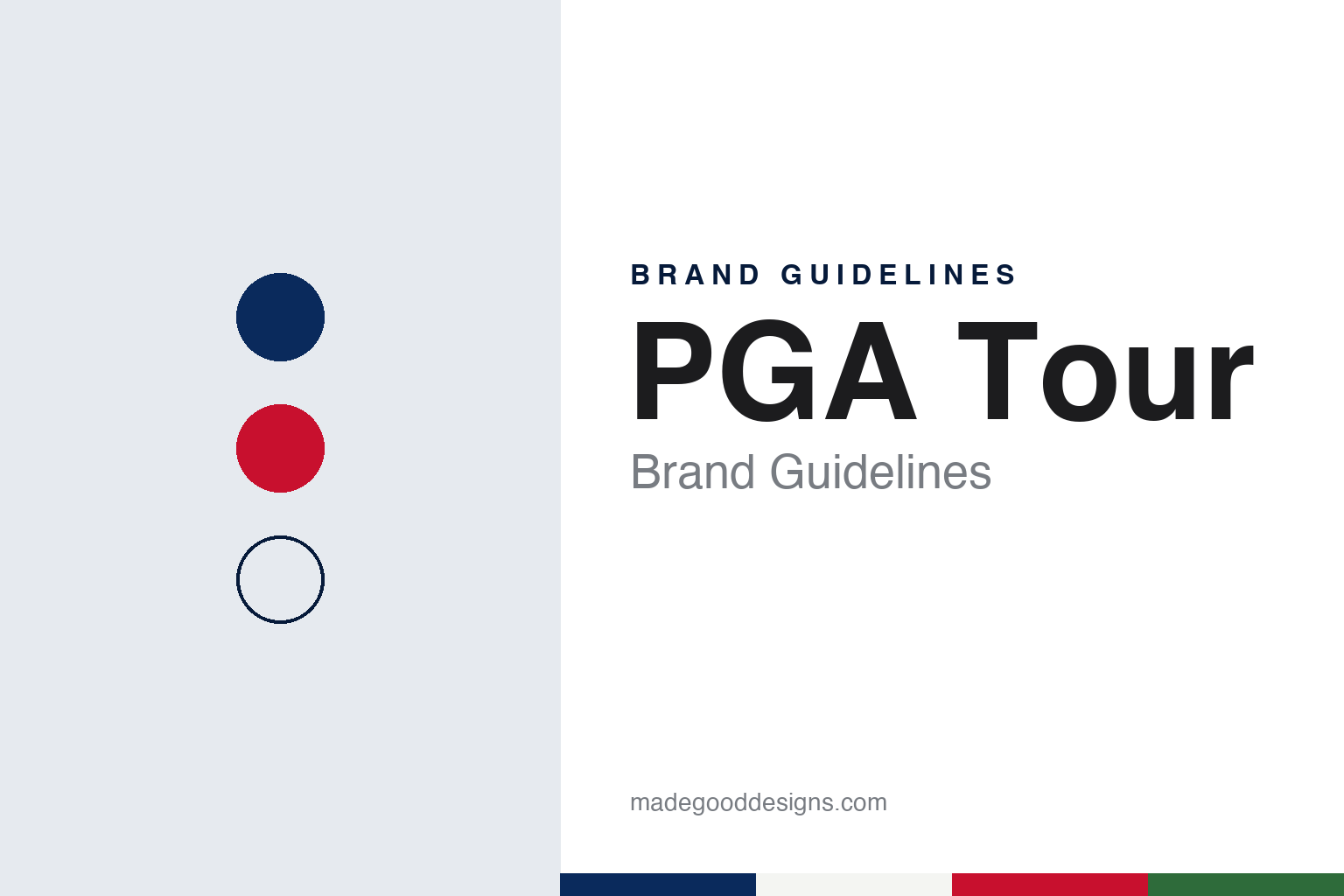
Two constants: a tour navy, flag red and ball white palette and a capitalised tour sans register. Abstract homage — not a PGA Tour asset; no logo, silhouette or trophy is reproduced.
Tournament Players Division
Touring professionals separate from the club professionals’ association.
The PGA Tour began as part of another organisation. Tournament golf in the United States had been run by the Professional Golfers’ Association of America, a body whose core members are club professionals, and by the late 1960s the touring players and the association disagreed about how the growing income from televised golf should be used, English Wikipedia says.
Wikipedia dates the break to 1968. Following the PGA Championship that July, it says, tour players formed their own body in August, American Professional Golfers, Inc., headquartered in New York City, and in December 1968 the PGA of America spun the tour off into a separate organisation for tour players: the Tournament Players Division. Golf News Net, in an explainer by its founder Ryan Ballengee, dates the split to 1969 and credits Arnold Palmer, Jack Nicklaus and others with engineering it; it describes the new division as affiliated with the PGA of America but operating separately, with the association’s PGA Championship still recognised by the touring professionals.
The division hired an administrator rather than a player to lead it. Joseph Dey, who had recently retired as executive director of the United States Golf Association, was chosen as commissioner in January 1969, Wikipedia says, on a five-year contract. He was succeeded in early 1974 by the tour player Deane Beman, who held the job for two decades; Golf News Net also gives 1974 for Beman’s arrival.
Later commissioners came from inside the organisation. Wikipedia records that Tim Finchem took over in June 1994 and was succeeded on 1 January 2017 by Jay Monahan.
The split explains a confusion that persists in the brand: two organisations share the letters PGA. The PGA of America, which runs the PGA Championship, is a separate body from the PGA Tour, which runs the week-to-week tour events, as Golf News Net sets out.
Colour
From a division name to a capitalised wordmark and a swinging golfer.
The name came with Beman’s era. The Tournament Players Division adopted the name “PGA Tour” in 1975, according to Wikipedia, and Golf News Net likewise describes the division being renamed the PGA Tour under Beman. The organisation’s officials style it in capitals, PGA TOUR, Wikipedia notes.
The name was not fixed at once. In late August 1981, after a marketing dispute with the PGA of America, the tour officially changed its name to the TPA Tour, for Tournament Players Association, Wikipedia says; the issues were resolved within seven months, and in March 1982 it went back to “PGA Tour.”
The logo arrived in the same years. Golf News Net reported in March 2024 that the PGA Tour logo “has been the same for decades, going back to 1982,” when it was unveiled to coincide with the Players Championship’s move to TPC Sawgrass. The golf writer Geoff Shackelford, writing on his website on 21 January 2021, marked the logo as turning 40, and published a photograph of Deane Beman with mock-ups of possible PGA Tour logos, pointing readers to PGATour.com stories by Laury Livsey on the mark’s origins and the alternatives that were considered.
The mark combines the PGA TOUR wordmark with the silhouette of a golfer. According to Golf News Net, the figure is not a particular player: it is a generic male golfer in the follow-through position of the swing. Fans have long guessed at Palmer, Nicklaus, Ben Hogan or Byron Nelson, the site says, but the silhouette is none of them — unlike the NBA’s logo, whose figure the site identifies with Jerry West. Ballengee added that the logo “and its font” were not expected to change in deference to any particular player.
Under the same brand the organisation runs several tours: the PGA Tour itself, PGA Tour Champions for players aged 50 and over, the Korn Ferry Tour for players working toward PGA Tour status, and PGA Tour Americas, Wikipedia says.
Typography
Design and documentation.
A sports league or promotion rarely sells a single object. What it builds is a system of marks that has to work everywhere the competition appears: on a television graphic in the corner of a screen, on a ticket, on a replica shirt, on a mat or a pitch, and on a social feed viewed on a phone. That spread of uses tends to push league and promotion logos towards simple silhouettes, a small set of colours and lettering that can survive being shrunk, stitched or animated.
Broadcast packages are a large part of that identity. Score bugs, lower thirds, opening titles and replay wipes repeat the same colours and type across every event, so viewers learn the look of a competition before they know its history. Organisations can refresh these packages on their own schedule, separate from the main logo.
Physical objects carry the brand too. Jerseys, championship belts, trophies, medals and rings are made to be photographed, and their shapes, materials and engraving often echo the primary mark. Studying a league’s identity means looking past the logo file to the graphics, kit and prizes that surround it.
Aa
A capitalised sans, in the spirit of the PGA TOUR wordmark. (Specimen set in Libre Franklin, a sans STAND-IN; NOT the PGA Tour logo.)
PGA Tour
A nonprofit in Ponte Vedra Beach with a for-profit arm.
The organisation’s home is in north-east Florida. Golf News Net says Beman moved the PGA Tour’s headquarters from suburban Washington, D.C., to Ponte Vedra Beach, where TPC Sawgrass now stands, and Wikipedia describes the PGA Tour as a nonprofit organisation headquartered there, a suburb south-east of Jacksonville. Under Beman, the same Golf News Net explainer says, the tour and its tournaments were structured to run as nonprofit organisations.
Its signature events carry the brand into broadcast graphics and trophies. Wikipedia lists The Players Championship, hosted at TPC Sawgrass; the FedEx Cup, whose finale is the Tour Championship at East Lake Golf Club; and the biennial Presidents Cup among the events the PGA Tour runs. Other events that appear on the schedule are run by other organisations, including the PGA of America’s championship.
Since 2023 the organisation’s commercial structure has changed. On 6 June 2023, CNN reported, the PGA Tour, the DP World Tour and Saudi Arabia’s Public Investment Fund announced an agreement to combine the PIF’s golf businesses, including LIV Golf, with the two tours’ commercial businesses and rights in a new, collectively owned, for-profit entity. Wikipedia records that in January 2024 the tour agreed an investment from Strategic Sports Group, a consortium of team owners led by Fenway Sports Group, into its for-profit arm, PGA Tour Enterprises, while the PGA Tour as a sanctioning body remained a nonprofit.
For a design guide, PGA Tour shows how a sports organisation can rest its identity on an anonymous figure in motion and a capitalised name. Compare MLB, whose batter silhouette dates from 1969, and the NBA, whose Logoman sits inside a rectangle. For this guide we use tour navy, flag red and ball white with a sans, an unofficial interpretation; no product or logo is reproduced.
Explore & save
Keep PGA Tour’s identity on hand — save it to a board in the Made Good inspiration library.
PGA Tour identity set
Pin the PGA Tour navy, flag red and ball white palette and the capitalised tour sans register to your own board.