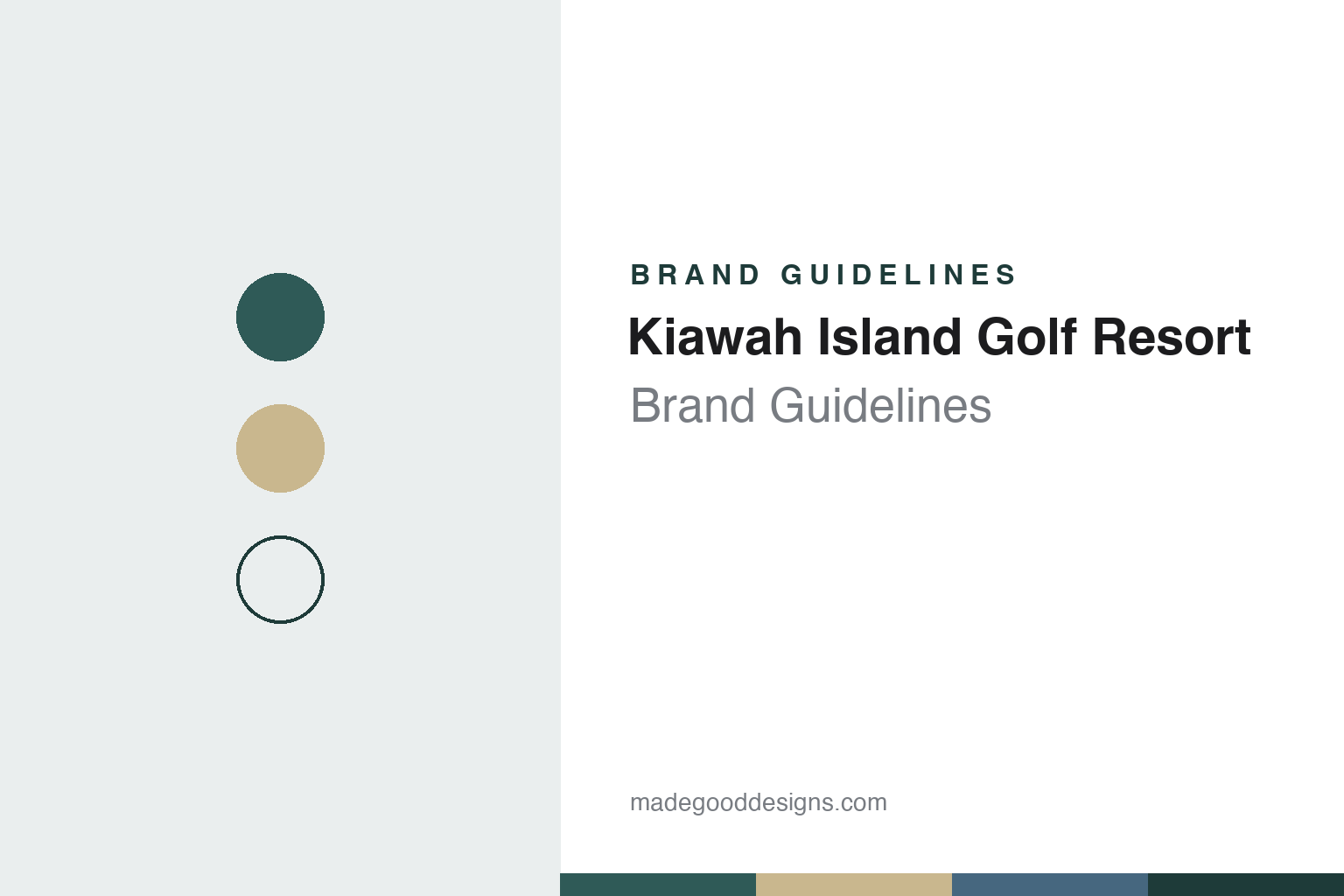
Kiawah Island Golf Resort Brand Guidelines
A sea-island resort where the courses meet the Atlantic.
Aa
Two constants: a marsh green, dune sand and Atlantic blue palette and a Lowcountry serif register. Abstract homage — not a Kiawah Island Golf Resort mark; no logo, flag or scorecard is reproduced.
A Sea Island
Timber, a master plan and an inn on the beach.
Kiawah Island is a barrier island on the Atlantic coast of South Carolina, about 25 miles southwest of Charleston. English Wikipedia says it takes its name from the Kiawah people, and that before the resort it was farmed and later logged; in 1950 it was bought for timber by C. C. Royal, whose family built the first beach homes there in the 1950s.
The resort grew out of a sale in 1974, when the Royal family sold the island to the Kuwait Investment Company. Legends Magazine, the Kiawah Island Club’s magazine, set out the island’s history in a March 2024 timeline: the new owner worked with the Sea Pines Company of Hilton Head on an environmental inventory and a master plan, and Sea Pines took over management of the island in 1975. In May 1976, the magazine says, Kiawah Island Golf Resort officially opened with the Kiawah Island Inn on a beachside bluff, along with a tennis complex and shops; English Wikipedia instead gives May 1974 as the resort’s opening, the year of the sale. A golf course, Marsh Point, opened in 1976 as well.
Ownership then changed several times. In 1988 the island was bought by Kiawah Resort Associates, a development group, and the town of Kiawah Island was incorporated the same year. Hurricane Hugo struck the Charleston area on 21 September 1989, and in 1990 Kiawah Resort Associates sold the resort assets to Landmark Land Co., according to Legends Magazine. In 1993, the magazine says, the resort properties were sold at an auction held in a Dallas hotel ballroom to Virginia Investment Trust, the company of the Virginia businessman Bill Goodwin; English Wikipedia also gives 1993 for the sale to William H. Goodwin.
The island’s private club is a separate business. The Kiawah Island Club was founded in 1993 and owns two members-only courses, the River Course and Cassique; in 2013 South Street Partners acquired Kiawah Partners, the island’s master developer, which included the club, Legends Magazine says. Those courses are not part of the resort.
Colour
The Ocean Course and four others.
The resort runs five courses. The Ocean Course, at the eastern end of the island, opened in 1991; it was designed by Pete Dye for that year’s Ryder Cup matches, and English Wikipedia credits it to Pete and Alice Dye. GOLF.com reported in May 2021 that Alice Dye was responsible for raising the course so that the ocean could be seen from the holes, which in turn left them more exposed to the wind. The Ocean Course clubhouse, in a cottage style, was designed by Robert A. M. Stern and opened in 2007, Kiawah Island Real Estate said in an August 2024 history of golf on the island.
The other four courses span four decades. Turtle Point, by Jack Nicklaus, opened in 1981 and was renovated under Nicklaus in 2016; it hosted the 1990 PGA Cup, Wikipedia says. Osprey Point, by Tom Fazio, opened in 1988 and was renovated by Fazio in 2014. Oak Point, on Johns Island, was originally designed by Clyde Johnston and has since been regrassed with paspalum. Cougar Point, which opened in 1976 as Marsh Point, reopened in 2017 after a ten-month renovation with Gary Player Design, according to the same August 2024 history.
The Ocean Course has carried the resort’s championship record. It hosted the 1991 Ryder Cup, which GOLF.com recalls as the “War at the Shore” and which the United States won; the 2007 Senior PGA Championship; and the PGA Championship in 2012, won by Rory McIlroy, and again in 2021, won by Phil Mickelson. Wikipedia notes that this made it the fourth course to host all three of those PGA of America championships. The course also appeared on screen: GOLF.com reported that it was one of several used to film scenes for The Legend of Bagger Vance, released in 2000.
Beside the golf sits the hotel. The Sanctuary, a 255-room oceanfront hotel and spa, opened in 2004, Legends Magazine says, and the resort also rents villas and private homes and offers tennis, nature programmes and an activity centre called The Treehouse, according to its website.
Typography
Links, courses and resorts.
Golf links, courses and resorts present themselves through place before anything else. A venue’s name is usually its town, its bay or its estate, and its crest, flag or wordmark tends to borrow from the land around it: a bridge, a tree, a stretch of coast, a stone building. In June 2025, for example, St Andrews Links introduced a separate icon for each of its courses, drawn from local history, while keeping its older Links Crest as the corporate mark of the trust that runs them, Golf Business News reported.
The identity then travels across a set of familiar objects. Scorecards and yardage books carry the course name and its hole-by-hole layout; tee markers, direction signs and pin flags repeat the mark out on the ground; and clubhouse shops put it on polo shirts, caps, headcovers and towels. Clubhouses and hotels give a venue its architecture, and the names of the course architects, as the venues and their histories credit them, often become part of the story a resort tells about each course.
Ownership shapes how these places speak. Some links are public land run by a trust or a council committee; others belong to a resort company, a family business or a larger group with hotels elsewhere. Several have changed hands more than once, and a few run courses under lease rather than outright ownership. This guide describes each owner plainly, by its business role and the dates its sources give.
History pages and championship lists are a large part of how these venues publish themselves: the year a course opened, the architects who shaped or revised it, and the championships it has hosted, given as dated facts. This guide follows that record. It does not rank courses, compare them, or quote green fees, room rates or membership prices, and the colours shown with each guide are an unofficial interpretation rather than a venue’s own palette.
Aa
A Lowcountry serif for a sea-island resort. (Specimen set in Playfair Display, a serif STAND-IN; NOT the Kiawah Island Golf Resort logo.)
Kiawah Island Golf Resort
A resort named for its island.
The resort takes its name from the island. On its website the five courses, The Sanctuary, the villas and the spa all sit under the one Kiawah Island Golf Resort name, and the island is described through its ten miles of beach, its river, lagoons, marshland and maritime forest. Four of the five course names end in “Point,” and the fifth is simply the Ocean Course.
Its website lists two sister properties: The Jefferson Hotel in Richmond, Virginia, and The Sea Pines Resort on Hilton Head Island, South Carolina. Visitors should not confuse the resort with Kiawah Island Real Estate or the Kiawah Island Club, which operate on the same island under separate ownership and use their own websites.
For a designer, the material is the South Carolina coast: salt marsh, maritime forest, a wide beach and a clubhouse in a cottage style. The Ocean Course gives the resort its most recognisable images, from the 1991 Ryder Cup to the two PGA Championships, and its clubhouse is credited to a named architect, Robert A. M. Stern, so the course and the building can both be credited in print.
For a design guide, Kiawah Island Golf Resort shows how a resort can tie its identity to one course while keeping several others under the same name. Compare TPC Sawgrass and Whistling Straits, two more courses credited to Pete Dye. For this guide we use marsh green, dune sand and Atlantic blue with a serif, an unofficial interpretation; no product or logo is reproduced.
Explore & save
Keep Kiawah Island Golf Resort’s identity on hand — save it to a board in the Made Good inspiration library.
Kiawah Island Golf Resort identity set
Pin the Kiawah Island Golf Resort marsh green, dune sand and Atlantic blue palette and the Lowcountry serif register to your own board.
Source & notes
Frequently Asked Questions
What font can I use to match the Kiawah Island Golf Resort look?
This guide describes Kiawah Island Golf Resort’s type as “A Lowcountry serif for a sea-island resort”. Its type specimen is set in Playfair Display from Google Fonts as a stand-in; Playfair Display is not Kiawah Island Golf Resort’s own lettering.
What colours are in the Kiawah Island Golf Resort palette?
This guide’s Kiawah Island Golf Resort palette is Marsh green #2F5A57, Dune sand #C9B78E, Atlantic blue #46677F, Live-oak shade #1E3B39 and Shell white #F6F4EE. The tones are the guide’s own unofficial interpretation, not official Kiawah Island Golf Resort hex codes.
When did Kiawah Island Golf Resort open?
Kiawah Island Golf Resort opened in 1976 (Kiawah Island Inn) (Kiawah Island, South Carolina, United States).