Tokyo Marathon Brand Guidelines
The Shinjuku to Tokyo Station race that joined the city’s older marathons into one.
Aa
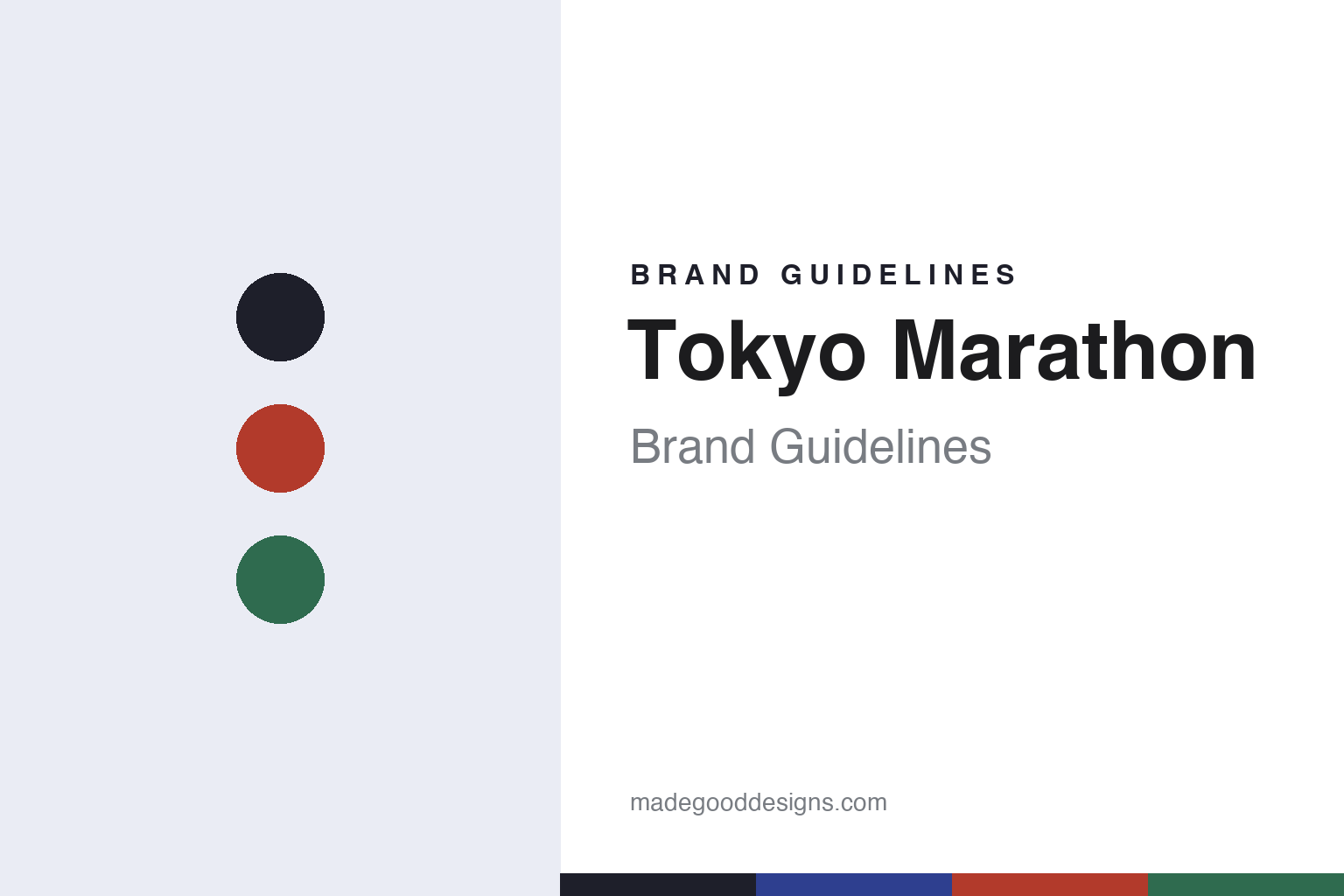
Two constants: a sumi ink, indigo, vermilion and pine green palette and a clean Japanese gothic register. Abstract homage — not a Tokyo Marathon asset; no logo, key visual or bib design is reproduced.
Tokyo Marathon 2007
Several city races folded into one.
The Tokyo Marathon is younger than most big-city marathons. Its first edition, officially Tokyo Marathon 2007, was held on 18 February 2007; Japanese Wikipedia notes that each edition’s official name ends with its year. The new race took the place of several events held in central Tokyo: the men’s Tokyo International Marathon, the Tokyo International Women’s Marathon, the Tokyo City Half Marathon and the Tokyo City Road Race, a 10 km event for citizen runners and athletes with disabilities, according to Japanese Wikipedia. English Wikipedia adds that from 1981 the city had hosted both the Tokyo International Marathon and the Tokyo–New York Friendship International Marathon, which alternated years from 1982.
The idea of a mass race on central roads had been building for some years. Japanese Wikipedia says a citizen-run event, the Tokyo Yume-Mai Marathon, had been held since 2001 on pavements, with runners stopping at traffic lights, and that the new race was prepared by the Tokyo Metropolitan Government with the Japan Association of Athletics Federations (JAAF), modelled on the large citizen races of New York, London, Boston, Berlin and Chicago. The first edition doubled as a selection race for the 2007 World Championships in Athletics in Osaka and had a field of 30,000, with 25,000 in the marathon and 5,000 in a 10 km race, English Wikipedia says.
The date has moved more than once. Japanese Wikipedia says the first two editions were held on the third Sunday of February, the 2009 race on 22 March, and the editions from 2010 to 2018 on the fourth Sunday of February; since 2019 the race has been held on the first Sunday of March. In 2020 only the elite and elite wheelchair races were held, and the edition officially called Tokyo Marathon 2021 was run on 6 March 2022, with no separate 2022 race.
Colour
A foundation, co-organisers and partners.
Since the 2011 edition the race has been organised by the Tokyo Marathon Foundation, a general incorporated foundation set up on 30 June 2010 to take over from the organising committee of the Tokyo Metropolitan Government and JAAF, according to Japanese Wikipedia; those two bodies became co-organisers. The organiser’s race information lists further co-organisers including The Yomiuri Shimbun, Nippon Television Network, the Sankei Shimbun and The Tokyo Shimbun, with the Tokyo Athletics Association as managing organisation. Japanese Wikipedia says the foundation has also organised the Tokyo Legacy Half since 2022.
The race’s presenting partner is Tokyo Metro, the organiser says, and its list of official partners includes ASICS Japan, Seiko Group and Mastercard. Japanese Wikipedia names Seiko as official timer and records earlier partners such as BMW Japan, which supplied official cars from 2011 to 2020. Television has been shared too: the same source says Fuji Television and Nippon Television took turns to broadcast the race until 2024, and that Nippon Television has carried it alone since 2025.
The race’s standing grew in steps. Japanese Wikipedia says it received a Gold Label in 2010 under the world governing body’s road-race label scheme, joined the World Marathon Majors from the 2013 edition and has held Platinum Label status since 2020. In a preview dated 27 February 2026, Japan Running News wrote that the Tokyo race opened that year’s Abbott World Marathon Majors and that Nippon TV’s international broadcast would go out on affiliates in 115 countries.
Demand is measured in applications. English Wikipedia gives 309,824 applicants for the 2015 race and 331,211 for 2019. The organiser said its 19th edition, on 1 March 2026, welcomed 38,773 runners, and its results page lists 37,567 finishers; Brigid Kosgei of Kenya set a women’s course record of 2:14:29 that day, the organiser reported.
Typography
Races and their names.
Running races and mass-participation events present themselves through a small, repeated set of things: a race name, a logo, a bib, a medal and a course map. Organisers publish these each year, and many of them change from edition to edition while the course and the landmark at the finish stay the same. Free weekly events work with a different kit: a printed personal barcode and a numbered finish token take the place of a bib, and shirts in set colours mark milestones instead of medals.
Title sponsors are a large part of that picture. A city marathon can carry a carmaker’s, a bank’s or an insurer’s name for a decade or more and then change it, so the race name on the bib, the medal ribbon and the finish banner shifts with each new contract. Start pens, finish arches, finisher shirts and medals are the places where the sponsor’s colours meet the event’s own marks.
Behind the events sit organisations of different kinds: sports clubs and the companies they set up to run their races, foundations, charities and commercial series owners. This guide describes each one plainly, by legal form and dated role, and names title sponsors as dated facts rather than as endorsements. Participant and finisher counts appear only as a dated source gives them.
Much of what these events publish about themselves is history: first editions, course changes, past names and lists of editions. Each guide below sets out what can be checked about one event, who organises it and how its name and visual language have changed, and keeps records to a single attributed fact.
Aa
A clean gothic sans for a city race. (Specimen set in Zen Kaku Gothic New, a sans STAND-IN; NOT the Tokyo Marathon logo.)
The Day We Unite
Multicoloured lines and a move to Tokyo Station.
The course gives the race its outline. It starts outside the Tokyo Metropolitan Government Building in Shinjuku. Until 2016 the marathon finished at Tokyo Big Sight in Ariake; from 2017 the finish moved to Tokyo Station on Gyoko-dori, and Japanese Wikipedia quotes race director Tadaaki Hayano as saying the new finish was chosen as a place fit to be the face of Tokyo. The organiser’s current course runs through Suidobashi, Kanda, Nihombashi, Asakusa Kaminarimon Gate, Ryogoku, Ginza and Hibiya, and it says the course is certified by JAAF, AIMS and World Athletics. Japanese Wikipedia describes silver confetti released over the start, and bib collection at the Tokyo Marathon EXPO in the days before the race, with no collection on race day.
The organiser explains its mark in its own words. It says the Tokyo Marathon logo, updated in 2016, uses multicoloured lines to stand for the different values and aims of the people who take part, and that the lines cross and weave together to show that race day is “The Day We Unite.” The key visual it published for its 2027 edition, which it numbers as the 20th, was created by the Tokyo graphic designer Takahiro Yasuda, a member of the creative association CEKAI, and is built around dots that represent individual participants.
The name is guarded closely. Japanese Wikipedia says “Tokyo Marathon” is a registered trademark held by the foundation, and the organiser says the foundation owns the rights to the race’s name, logos, photographs and other designs, which only the organiser and approved partners may use.
For a design guide, the Tokyo Marathon shows how a young race can gather older events into one name, give it a foundation to look after it, and build an identity from lines that stand for its runners. Compare ASICS, whose Japanese arm is listed among the race’s official partners, and Chicago Marathon, a fellow World Marathon Majors race. For this guide we use sumi ink, indigo, vermilion and pine green with a sans, an unofficial interpretation; no product or logo is reproduced.
Explore & save
Keep Tokyo Marathon’s identity on hand — save it to a board in the Made Good inspiration library.
Tokyo Marathon identity set
Pin the Tokyo Marathon sumi ink, indigo, vermilion and pine green palette and the clean Japanese gothic register to your own board.
Source & notes
Frequently Asked Questions
What font can I use to match the Tokyo Marathon look?
This guide describes Tokyo Marathon’s type as “A clean gothic sans for a city race”. Its type specimen is set in Zen Kaku Gothic New from Google Fonts as a stand-in; Zen Kaku Gothic New is not Tokyo Marathon’s own lettering.
What colours are in the Tokyo Marathon palette?
This guide’s Tokyo Marathon palette is Sumi ink #1E1F2A, Indigo #2E3F8F, Vermilion #B23A2B, Pine green #2F6B4F and Washi #F6F4EF. The tones are the guide’s own unofficial interpretation, not official Tokyo Marathon hex codes.