Great North Run Brand Guidelines
The half marathon that crosses the Tyne Bridge to the sea.
Aa
Two constants: a bridge green, sea blue and sandstone palette and an industrial grotesque register. Abstract homage — not a Great North Run asset; no logo, medal or bib is reproduced.
Tyneside, 1981
A local fun run that became a fixture of the September calendar.
The Great North Run was first staged on 28 June 1981, when 12,000 runners took part, English Wikipedia says. In its first year it was advertised as a local fun run. The race was devised by Brendan Foster, the former Olympic 10,000-metre bronze medallist and BBC television commentator, who, according to English Wikipedia, took the idea from the Round the Bays race in New Zealand, which he ran in 1979.
Foster came to the event as an athlete turned businessman. Athletics Weekly, in a profile published on 2 September 2014, says he began organising major athletics meetings while still competing, rose to vice-president of marketing (worldwide) at Nike International, and later set up his own company, Nova International, a sports marketing agency specialising in mass-participation events for television, of which he was chairman and managing director. The magazine describes the Great North Run as his “brainchild.”
The race grew steadily. English Wikipedia gives 47,000 participants in 2003 and an announced field of 54,000 in 2011. Athletics Weekly says that in 2013 a record 56,000 entrants were accepted from more than 122,000 applicants, and that the event’s millionth finisher was due to cross the line in South Shields on 7 September 2014. English Wikipedia records that milestone at the 2014 race. In 2026 around 63,000 runners took on the half marathon, the Chronicle in Newcastle reported on 23 September 2026.
The calendar moved too. Eight of the first nine races were held in June, English Wikipedia says; since 1990 the run has been held in the autumn, usually in September and occasionally in October. In 1992 the race incorporated the first IAAF World Half Marathon Championships. The 2020 edition was cancelled. Junior and mini races are held on the Saturday before the main race on the Newcastle Quayside.
Colour
Over the Tyne Bridge to the seafront.
The route is the event’s most recognisable image. English Wikipedia describes a start on the A167 in Newcastle upon Tyne, just north of the central motorway and on the edge of both the city centre and the Town Moor. Runners head east and south along the motorway section, round the eastern side of the city centre, and cross the Tyne Bridge into Gateshead.
From Gateshead the course runs east along the A184, the Felling Bypass, then turns north-east along Leam Lane towards South Shields, reaching the southern side of Jarrow and continuing along John Reid Road through Harton and Marsden. The last mile runs along the seafront road to the finish line in South Shields, on the North Sea coast; Athletics Weekly describes the whole route as a 13.1-mile journey from Newcastle to South Shields. English Wikipedia notes that all roads on the course close several hours before the start, and that buses carrying runners’ belongings travel along the closed roads ahead of the field.
That geography gives the race a clear set of visual cues: a city start, a river crossing, the towns of the south bank of the Tyne and a finish beside the sea. The event has also attached cultural work to the run. For the twenty-fifth edition in 2005, English Wikipedia says, the anniversary events included the launch of the Great North Run Cultural Programme at the Sage Gateshead.
Entry runs through a ballot. The Chronicle reported in September 2026 that the ballot for the 2027 race had closed and that results were sent to entrants the same day, with a second ballot in January for those who missed out.
Typography
How races present themselves.
Running races and mass-participation events present themselves through a small, repeated set of things: a race name, a logo, a bib, a medal and a course map. Organisers publish these each year, and many of them change from edition to edition while the course and the landmark at the finish stay the same. Free weekly events work with a different kit: a printed personal barcode and a numbered finish token take the place of a bib, and shirts in set colours mark milestones instead of medals.
Title sponsors are a large part of that picture. A city marathon can carry a carmaker’s, a bank’s or an insurer’s name for a decade or more and then change it, so the race name on the bib, the medal ribbon and the finish banner shifts with each new contract. Start pens, finish arches, finisher shirts and medals are the places where the sponsor’s colours meet the event’s own marks.
Behind the events sit organisations of different kinds: sports clubs and the companies they set up to run their races, foundations, charities and commercial series owners. This guide describes each one plainly, by legal form and dated role, and names title sponsors as dated facts rather than as endorsements. Participant and finisher counts appear only as a dated source gives them.
Much of what these events publish about themselves is history: first editions, course changes, past names and lists of editions. Each guide below sets out what can be checked about one event, who organises it and how its name and visual language have changed, and keeps records to a single attributed fact.
Aa
An industrial grotesque — the register of bridges, quaysides and race numbers. (Specimen set in Archivo, a sans STAND-IN; NOT the Great North Run logo.)
Great North Run
A Gateshead company and a run of sponsors.
The race is organised by The Great Run Company, which also stages the wider Great Run series of road races that Foster built after the Great North Run, English Wikipedia says. The company is registered in Gateshead. Companies House records show that the company was incorporated in 1997, traded under the name Nova International Limited from 1998, and took the name The Great Run Company Limited in January 2025. Its listed parent, with a holding of 75 per cent or more, is Nova Holding Limited.
Title sponsors have changed several times, and each change has altered the name on bibs, medals and signage. English Wikipedia says Bupa was title partner of the Great North Run from the early 1990s until 2014. In 2015 Morrisons announced a sponsorship of the Great Run series; in November 2015 the Great Run Company said it was looking for a new title sponsor, and the 2016 Great North Run was staged without one. Simplyhealth became lead sponsor for 2017. In 2023 AJ Bell became lead sponsor of the Great Run series, English Wikipedia says, and the Chronicle used the name AJ Bell Great North Run in its September 2026 report on the 2027 ballot.
Foster’s role has been that of founder and businessman. Athletics Weekly credits him with growing Nova International around events made for television, and English Wikipedia says he went on to build a series of other Great Run road races on the model of the Great North Run.
For a design guide, the Great North Run shows how a road race can turn a route into an identity: a river crossing on the Tyne Bridge, a city-to-sea direction of travel, and a name that has carried a series of sponsors since the early 1990s. Compare the London Marathon brand guide and the Paris Marathon brand guide. For this guide we use a bridge green, a North Sea blue and a sandstone on sea mist with a grotesque sans, an unofficial interpretation; no product or logo is reproduced.
Explore & save
Keep Great North Run’s identity on hand — save it to a board in the Made Good inspiration library.
Great North Run identity set
Pin the Great North Run bridge green, sea blue and sandstone palette and the industrial grotesque register to your own board.
Source & notes
Frequently Asked Questions
What font can I use to match the Great North Run look?
This guide describes Great North Run’s type as “An industrial grotesque — the register of bridges, quaysides and race numbers”. Its type specimen is set in Archivo from Google Fonts as a stand-in; Archivo is not Great North Run’s own lettering.
What colours are in the Great North Run palette?
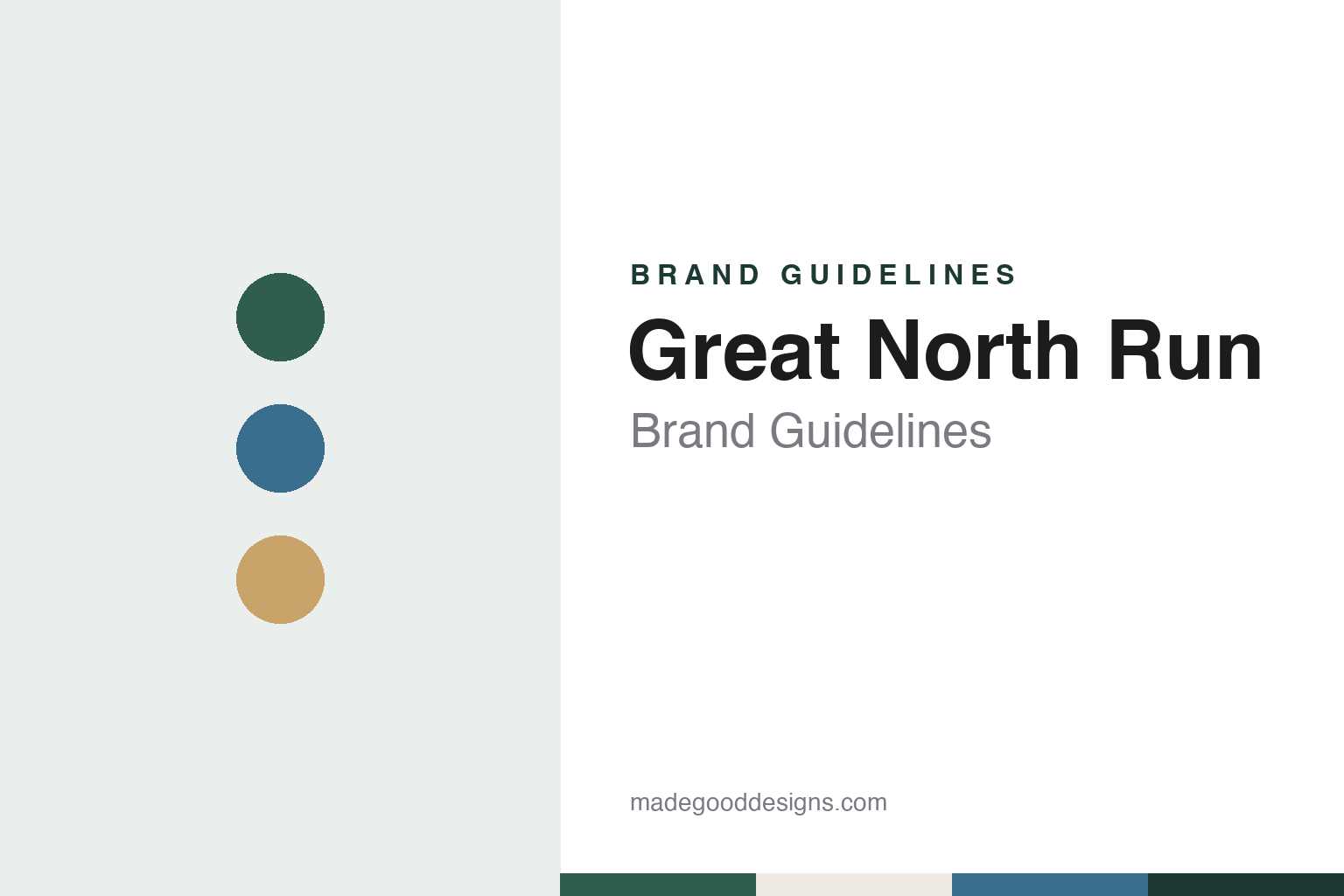
This guide’s Great North Run palette is Bridge green #2F5D50, Quayside ink #1C3A33, North Sea blue #3A6E8F, Sandstone #C9A46A and Sea mist #EFEBE3. The tones are the guide’s own unofficial interpretation, not official Great North Run hex codes.