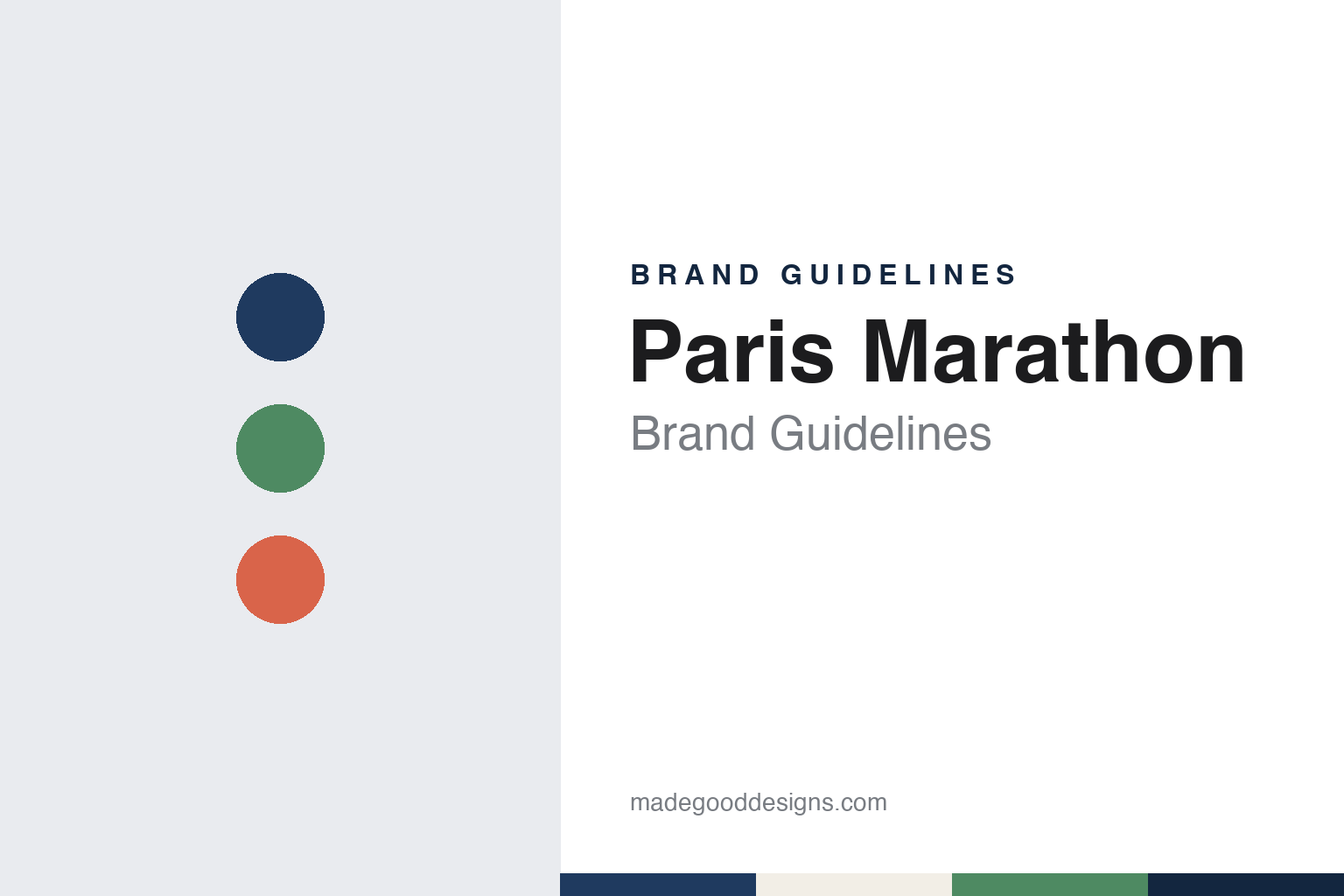
Paris Marathon Brand Guidelines
The city marathon that runs from the Champs-Élysées to Avenue Foch.
Aa
Two constants: a navy, green and coral palette and a condensed street sans register. Abstract homage — not a Paris Marathon asset; no logo, medal or bib is reproduced.
Bois de Boulogne, 1976
A small race in a park, then a tour of the city.
Paris has staged marathon-style races since the nineteenth century. English Wikipedia describes a Tour de Paris Marathon in 1896, run over about 40 kilometres from Paris to Conflans-Sainte-Honorine by way of Versailles, with 191 participants. French Wikipedia dates that start to 19 July 1896 at the Porte Maillot, a few days after the marathon at the Athens Olympic Games, and records an edition in 1918 in which Marie-Louise Ledru took part, which it describes as the first official participation by a woman in a marathon.
The event that carries the name today is younger. French Wikipedia dates the real start of the Marathon de Paris as an organised race to 18 September 1976. Long-distance road running was not yet a mass pastime, it notes, and only 126 athletes took part, running the full 42.195 kilometres inside the Bois de Boulogne. English Wikipedia also gives 1976 as the start of the present race.
The course soon moved into the streets. In 1979, according to French Wikipedia, the route passed every arrondissement town hall in Paris and finished on the square in front of Notre-Dame. The race has been held every year since then, and it grew quickly: French Wikipedia says it passed 10,000 finishers in 1984 and more than 40,000 in 2015. The race is normally held on a Sunday in April, English Wikipedia says. The 2020 edition was cancelled after two postponements, and the 2021 race was held in the autumn, on 17 October.
Growth has continued in recent years. French Wikipedia gives 54,175 finishers from 55,922 participants in 2024, 56,950 starters in 2025 and 57,464 finishers in 2026. French Wikipedia also says it is the only French race holding the Elite label in the World Athletics Label Road Races scheme.
Colour
From the Champs-Élysées to Avenue Foch.
The course is the race’s strongest visual asset, and the organisers have long presented it as a tour of the city. English Wikipedia describes the start on the Avenue des Champs-Élysées, a downhill run to circle the Place de la Concorde and a turn onto the Rue de Rivoli, past the Louvre and around the Place de la Bastille, then south-east to the Bois de Vincennes. A long loop of the park brings runners back into central Paris, with the halfway point on the Rue de Charenton.
The second half follows the Seine. French Wikipedia says that since 2005 the whole course has stayed on the right bank and inside the administrative limits of Paris, running along the riverside quays, through a series of tunnels and past the Pont de Bir-Hakeim with its view of the Eiffel Tower, before entering the Bois de Boulogne by the Porte d’Auteuil. The finish is on the Avenue Foch. French Wikipedia adds that runners regard the course as demanding because of its many small climbs.
One detail on the road is itself a piece of graphic design. French Wikipedia says the city has for about twenty years painted a guide line along the full 42.195 kilometres, an idea it traces to the Melbourne marathon of 1956. For the 2024 edition the line was a green band that took 300 cans of spray paint. Called the “ligne directrice,” it does not mark the shortest distance but the ideal racing line, always set for the next corner. In 2024, when the Seine was high, the organisers moved one stretch between kilometres 25 and 28 from the lower quays to the upper quays, a variant French Wikipedia says had been approved years earlier.
The race also has a long-standing mark. French Wikipedia says the visual identity of the Marathon de Paris stayed the same for many years, built around a logo that uses the Eiffel Tower to stand for the letter A in both “Marathon” and “Paris.” In September 2026 the incoming organiser presented a new visual identity and slogan for the race, Marathons.com reported.
Typography
How races present themselves.
Running races and mass-participation events present themselves through a small, repeated set of things: a race name, a logo, a bib, a medal and a course map. Organisers publish these each year, and many of them change from edition to edition while the course and the landmark at the finish stay the same. Free weekly events work with a different kit: a printed personal barcode and a numbered finish token take the place of a bib, and shirts in set colours mark milestones instead of medals.
Title sponsors are a large part of that picture. A city marathon can carry a carmaker’s, a bank’s or an insurer’s name for a decade or more and then change it, so the race name on the bib, the medal ribbon and the finish banner shifts with each new contract. Start pens, finish arches, finisher shirts and medals are the places where the sponsor’s colours meet the event’s own marks.
Behind the events sit organisations of different kinds: sports clubs and the companies they set up to run their races, foundations, charities and commercial series owners. This guide describes each one plainly, by legal form and dated role, and names title sponsors as dated facts rather than as endorsements. Participant and finisher counts appear only as a dated source gives them.
Much of what these events publish about themselves is history: first editions, course changes, past names and lists of editions. Each guide below sets out what can be checked about one event, who organises it and how its name and visual language have changed, and keeps records to a single attributed fact.
Aa
A condensed street sans — the register of route signs and race numbers. (Specimen set in Barlow Condensed, a sans STAND-IN; NOT the Paris Marathon logo.)
Paris Marathon
A city-owned race and its organisers.
The race belongs to the city and is run under a concession. A Marathons.com report of 10 September 2026 says Amaury Sport Organisation (ASO), the sports-events company that owns the newspaper L’Équipe, organised the Paris Marathon and the Paris Half Marathon from 1998. French Wikipedia names the organising body in that period as Paris Athlétisme Compétition – Club Marathon, part of ASO, and English Wikipedia also gives ASO as organiser.
Sponsorship has shaped the name. French Wikipedia says the race officially became the Schneider Electric Marathon de Paris from 2013, after ASO and Schneider Electric, a multinational based in France, signed a title partnership. Marathons.com says the Japanese sportswear maker ASICS has been an official partner of the race since 2009.
The concession then changed hands. On 20 May 2026 the Council of Paris approved the award of the marathon and half marathon for the 2027 to 2030 editions to the Cadence group, the trail-running site u-Trail reported the next day. It names the group’s members as Keneo, Havas Events and Avena Event; French Wikipedia also lists OSE, the organiser of the Eco-Trail de Paris, which it associates with Avena Event. Marathons.com calls the group Cadence Running United. At a press conference on 8 September 2026, the same report says, the new organiser named ASICS as title partner for 2027, with Schneider Electric remaining a major partner, and moved entry for the 2027 race to a lottery. ASO organised the 2026 edition.
For a design guide, the Paris Marathon shows how a city race can borrow its graphic language from the city itself: a monument folded into the lettering, a painted green line on the asphalt, a start and finish framed by the grand avenues, and a name that has carried a title partner since 2013. Compare the ASICS brand guide and the Berlin Marathon brand guide. For this guide we use a boulevard navy, a guide-line green and an awning coral on limestone with a condensed sans, an unofficial interpretation; no product or logo is reproduced.
Explore & save
Keep Paris Marathon’s identity on hand — save it to a board in the Made Good inspiration library.
Paris Marathon identity set
Pin the Paris Marathon navy, green and coral palette and the condensed street sans register to your own board.
Source & notes
Frequently Asked Questions
What font can I use to match the Paris Marathon look?
This guide describes Paris Marathon’s type as “A condensed street sans — the register of route signs and race numbers”. Its type specimen is set in Barlow Condensed from Google Fonts as a stand-in; Barlow Condensed is not Paris Marathon’s own lettering.
What colours are in the Paris Marathon palette?
This guide’s Paris Marathon palette is Boulevard navy #1F3A5F, Night ink #13263F, Guide-line green #4E8A62, Awning coral #D9644A and Limestone #F2EEE6. The tones are the guide’s own unofficial interpretation, not official Paris Marathon hex codes.