Berlin Marathon Brand Guidelines
A city loop that starts and finishes at the Brandenburg Gate.
Aa
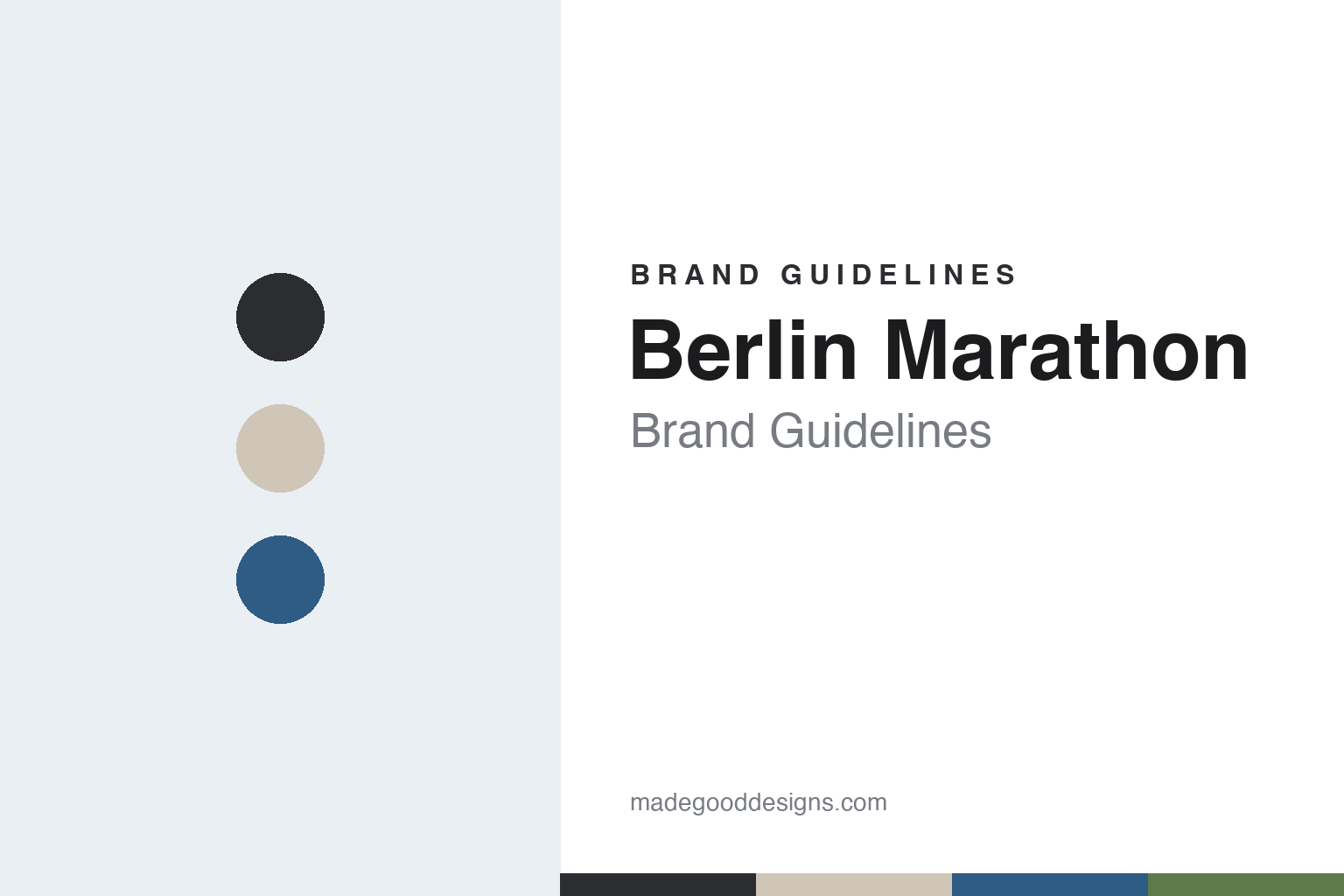
Two constants: an asphalt, sandstone and Spree blue palette and a condensed sans register. Abstract homage — not a Berlin Marathon asset; no logo, medal or bib is reproduced.
Berliner Volksmarathon
A club race in the forest that moved into the city.
The Berlin Marathon was first held in October 1974 as the 1. Berliner Volksmarathon, a people’s marathon organised by the sports club SC Charlottenburg. German Wikipedia credits the idea to Horst Milde, whose group had organised the club’s cross-country race on the Teufelsberg since 1964, and records that 244 of 286 registered runners finished. The course started by the Mommsenstadion and ran out and back through the Grunewald forest along the AVUS road.
The race moved into the city in 1981, starting on the lawn in front of the Reichstag building and finishing on the Kurfürstendamm, German Wikipedia says; wheelchair racers took part from that year. With the city divided, the course was limited to West Berlin until 1990. On 30 September 1990, days before German reunification, the field ran through the Brandenburg Gate for the first time, and the entry limit of 25,000 was reached. A schools mini-marathon over the last 4.2195 km of the course was added in 1989, electronic chip timing in 1994, an inline-skating marathon in 1997 and a handbike race in 2004.
The event also grew as a spectacle. From 1987, when the start moved to the Straße des 17. Juni, the organisers placed more than 30 bands along the route, and in 1990 the race was the first marathon shown live on German television, with a live broadcast in Japan as well, German Wikipedia says. The skating marathon passed 7,000 finishers in 2002 and from 2003 moved to the evening before the main race; English Wikipedia gives 5,081 skaters in the 2019 edition. In 1977 the German marathon championship was folded into the event, starting an hour after the public field.
In 2003 the finish moved from the Kurfürstendamm to the Brandenburg Gate, with Unter den Linden as the finishing straight, and the start was placed on the Straße des 17. Juni in front of the Gate, German Wikipedia records; with start and finish side by side, runners’ kit bags no longer had to be carried across the city. In 2004 Mark Milde, who had recruited the elite fields since 1999, succeeded Horst Milde as race director. The race joined the World Marathon Majors series when it was founded in 2006, alongside Boston, London, Chicago and New York; Runner’s World Germany refers to the series in 2026 as the Abbott World Marathon Majors. The 2020 edition was cancelled after the Berlin Senate banned large events that year.
Colour
One course, many names.
Today the event is organised by SCC EVENTS GmbH on behalf of SC Charlottenburg, German Wikipedia says, and runs over a weekend: skaters and a children’s race on Saturday, and on Sunday the marathon itself, with wheelchair and handbike races. The course is a single loop through Charlottenburg, Tiergarten, Moabit, Mitte, Friedrichshain, Kreuzberg, Neukölln, Schöneberg and Zehlendorf, starting and finishing near the Brandenburg Gate, according to English Wikipedia.
The name on the medal and the bib has changed with its sponsors. English Wikipedia lists the race as plain Berlin Marathon from 1974 to 1989; the Yanase Berlin Marathon in 1990; the Canon Berlin Marathon in 1991 and 1992; plain Berlin Marathon again from 1993 to 1997; the Alberto Berlin Marathon in 1998 and 1999; the real,- Berlin Marathon from 2000 to 2010; and the BMW Berlin Marathon from 2011 to 2026. German Wikipedia notes that the carmaker took over from the retail chain Real in 2011.
On 1 October 2026 SCC EVENTS announced Generali Deutschland as the next title sponsor, Runner’s World Germany reported the following day, naming the edition of 26 September 2027 as the first to be held as the GENERALI BERLIN-MARATHON and ending BMW’s 16 years in the role. The magazine noted that the announcement was staged in red, a colour unusual for the event, and that the insurer had been a running partner in Berlin since 2017 and title sponsor of the Berlin half marathon since 2019. Its GENERALI 5K, held the day before the marathon, finishes at the same line and drew more than 13,000 runners in 2026, the magazine said.
Typography
Races, sponsors and series.
Running races and mass-participation events present themselves through a small, repeated set of things: a race name, a logo, a bib, a medal and a course map. Organisers publish these each year, and many of them change from edition to edition while the course and the landmark at the finish stay the same. Free weekly events work with a different kit: a printed personal barcode and a numbered finish token take the place of a bib, and shirts in set colours mark milestones instead of medals.
Title sponsors are a large part of that picture. A city marathon can carry a carmaker’s, a bank’s or an insurer’s name for a decade or more and then change it, so the race name on the bib, the medal ribbon and the finish banner shifts with each new contract. Start pens, finish arches, finisher shirts and medals are the places where the sponsor’s colours meet the event’s own marks.
Behind the events sit organisations of different kinds: sports clubs and the companies they set up to run their races, foundations, charities and commercial series owners. This guide describes each one plainly, by legal form and dated role, and names title sponsors as dated facts rather than as endorsements. Participant and finisher counts appear only as a dated source gives them.
Much of what these events publish about themselves is history: first editions, course changes, past names and lists of editions. Each guide below sets out what can be checked about one event, who organises it and how its name and visual language have changed, and keeps records to a single attributed fact.
Aa
A condensed sans for start-line and bib lettering. (Specimen set in Barlow Condensed, a sans STAND-IN; NOT the Berlin Marathon logo.)
Berlin Marathon
A landmark finish that outlasts its sponsors.
Scale is part of the identity. German Wikipedia, citing the Berliner Morgenpost, gives 58,212 registered runners from 161 nations for the 50th-anniversary edition on 29 September 2024, and English Wikipedia gives 54,062 finishers that year. Runner’s World Germany put total participation across the 2026 weekend’s events at more than 86,000, from 162 nations, with television pictures shown in well over 100 countries. The anniversary edition added an opening ceremony, concerts and a pop-up exhibition on the Pariser Platz telling the race’s history, German Wikipedia says, along with a 5 km run the day before.
The course is flat, and the men’s course record is 2:01:09, set by Eliud Kipchoge in 2022, according to English and German Wikipedia. In design terms, the Brandenburg Gate finish, the Straße des 17. Juni start and the loop through the city’s districts form a fixed set of images that stay the same while the sponsor’s name, and the colour that comes with it, changes.
For a design guide, the Berlin Marathon shows how a city race keeps one name and one landmark while its title partner changes around it. Compare BMW, its title sponsor from 2011 to 2026, and Chicago Marathon, another race in the same series. For this guide we use an asphalt grey, a sandstone and a Spree blue with a condensed sans, an unofficial interpretation; no product or logo is reproduced.
Explore & save
Keep Berlin Marathon’s identity on hand — save it to a board in the Made Good inspiration library.
Berlin Marathon identity set
Pin the Berlin Marathon asphalt, sandstone and Spree blue palette and the condensed sans register to your own board.
Source & notes
Frequently Asked Questions
What font can I use to match the Berlin Marathon look?
This guide describes Berlin Marathon’s type as “A condensed sans for start-line and bib lettering”. Its type specimen is set in Barlow Condensed from Google Fonts as a stand-in; Barlow Condensed is not Berlin Marathon’s own lettering.
What colours are in the Berlin Marathon palette?
This guide’s Berlin Marathon palette is Asphalt #2B2D31, Gate sandstone #CFC6B8, Spree blue #2F5C85, Linden green #5E7A4A and Paper #F7F6F3. The tones are the guide’s own unofficial interpretation, not official Berlin Marathon hex codes.