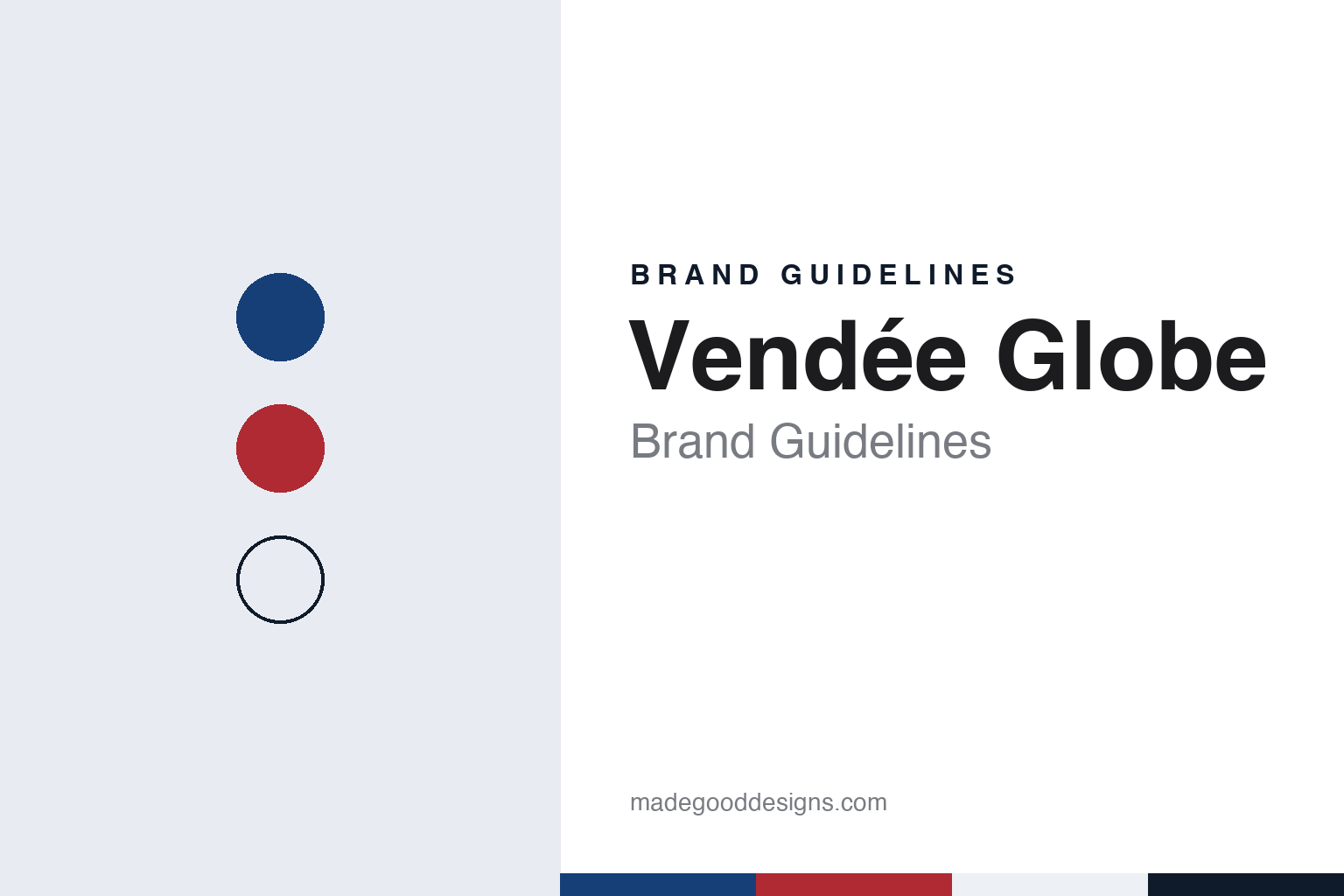
Vendée Globe Brand Guidelines
The solo non-stop race from Les Sables-d’Olonne since 1989.
Aa
Two constants: an ocean blue and start red palette and a condensed capitals register. Abstract homage — not a Vendée Globe asset or mark; no poster, boat, logo or map is reproduced.
The Globe Challenge
A Paris press conference and a start in Vendée.
The Vendée Globe is a solo, non-stop, unassisted race around the world that starts and finishes at Les Sables-d’Olonne on France’s Atlantic coast. It was created by the French sailor Philippe Jeantot, who, English Wikipedia says, had twice won the larger class of the BOC Challenge, a solo round-the-world race sailed in stages, in 1982–83 and 1986–87. French Wikipedia says that Jeantot announced his race at a press conference in Paris on 28 January 1988, under the name Globe Challenge, with a start set for 26 November 1989, and that he set up a company, Philippe Jeantot Organisation, in April 1988 to run it.
The name came partly from the sponsors. According to French Wikipedia, most of the first budget came from the Vendée département, the town of Les Sables-d’Olonne, the bank Crédit Agricole and the Vendée food company Fleury Michon, and at their request the race became the Vendée Globe Challenge. Later editions used the name Vendée Globe Les Sables-d’Olonne before the shorter form took over. The first race started on 26 November 1989 with thirteen skippers, and English Wikipedia names Titouan Lamazou as its winner.
The second race followed in 1992–93, and the event has been held every four years since: in 1996, 2000, 2004, 2008, 2012, 2016, 2020 and 2024. The Localtis news service of the Banque des Territoires noted in January 2025 that the 2024–25 race was only the tenth edition because of that four-year rhythm, which it compared with the Olympic Games.
Colour
A course, a class and a semi-public organiser.
The course is simple to describe. Skippers leave Les Sables-d’Olonne, sail south through the Atlantic and then east around Antarctica, leaving the Cape of Good Hope, Cape Leeuwin and Cape Horn to port, before returning to the same port. French Wikipedia notes that boats are moored at Port Olona before the start and head out along the channel between La Chaume and Les Sables to a start line laid in the bay, a scene the 2020 race poster also pointed to.
The boats are monohulls with a maximum length of 60 feet. French Wikipedia says extra rules were added from 1991 that defined the IMOCA 60-foot class, which also races in other ocean events such as the Route du Rhum; English Wikipedia adds that Open 50 boats were also allowed before 2004.
The organiser changed after the first decade. French Wikipedia says that Jeantot’s organising company, Sail Com, was placed in liquidation at the end of 2002. Since 2004 the race has been run by SAEM Vendée, a semi-public company created by the département. Localtis reported in January 2025 that the département holds 56 per cent of its shares, the town of Les Sables-d’Olonne 16 per cent and the Pays de la Loire region 12 per cent, with about thirty private Vendée companies holding the rest, and that the head of the département, Alain Leboeuf, has chaired it since 2021. The organiser’s site lists the company at La Roche-sur-Yon, the departmental capital.
The tenth edition started on 10 November 2024. The organiser’s figures give forty skippers at the start, and Localtis counted eleven nationalities among them, against nine four years earlier. Localtis reported that Charlie Dalin crossed the finish line at Les Sables-d’Olonne on the morning of 14 January 2025 to win.
Typography
How offshore races and regattas present themselves.
Offshore races and regattas are run by organisers rather than manufacturers, so their identities live on posters, start lines, race villages, maps and broadcasts more than on products. Some organisers are clubs, some are private companies and some are semi-public bodies tied to a host town or region. A design guide for any of them starts with a plain question: who runs the event, and who owns the name.
Race names carry a lot of history. Many events have changed their names as title sponsors came and went, and an organiser’s pages on history and past editions usually list each edition under the name it raced under at the time. A wordmark often has to sit beside a sponsor’s name, a host town and a year, and partner logos are usually set in tiers below it, from title partner down to official suppliers.
Boat classes shape the look as well. Sources name classes such as IMOCA, Class40, the Mini 6.50 and the F50 one-design catamaran, and each event sets out which classes it admits. Sails, hulls and wings carry team names and partner marks, and course maps and tracking graphics let viewers follow a long race day by day.
The rest of the identity sits on land: the race village where boats are moored before the start, the signage on pontoons, the official merchandise and the trophy, which some organisers unveil publicly. The guides in this group describe what their sources show about those elements, name organisers, clubs and companies plainly, and treat editions and dates as the main facts.
Aa
Condensed capitals for a name that sits beside sponsors, towns and years. (Specimen set in Barlow Condensed, a sans STAND-IN; NOT the Vendée Globe logo.)
Blue, red and a globe
A logo that has carried its partners from the start.
The first logo set the pattern. French Wikipedia describes it as a panel sponsored by the radio station Europe 1, in white capital letters on a blue ground around a world map showing the course, with the words Vendée Globe 89/90, solo, non-stop challenge and “Les Sables → Les Sables”.
The partners moved into the logo over time. French Wikipedia says that from the fifth edition, when SAEM Vendée took over, the mention of Les Sables-d’Olonne was reduced in the visual and a band along the foot of the logo named the three main partners: the Vendée département, the town and the Vendée food company Sodebo. The Pays de la Loire region’s visual appeared in the logo on the notice of race for 2020–21 and was gone again for the 2024–25 edition. The organiser’s site sets its partners out in tiers, from title partner and major partner down to official suppliers.
Posters carry the same codes. In December 2019 the organisers unveiled the visual for the 2020 race, designed by the agencies Désigne and Pulp; the announcement, carried by the Australian site Mysailing, said it kept the race’s main themes of the oceans, the race’s colours of red and blue and the solo skipper at the bow, and added the foils of the newer boats. It named the département as title partner, Sodebo as major partner and the town and the region as official partners, and pointed spectators to the boats leaving down the channel at Les Sables. French Wikipedia adds that in 2024 the race adopted a sound identity for its broadcasts, audiovisual content and key moments, and the organiser lists a graphic identity post in its own team.
For a design guide, the Vendée Globe shows how a race can keep one simple idea, a solo loop from one harbour, while partners and editions change around it. Compare Route du Rhum, another French solo race open to IMOCA boats, and Transat Jacques Vabre, a double-handed race from Le Havre. For this guide we use an ocean blue and a start red with a condensed sans, an unofficial interpretation; no product or logo is reproduced.
Explore & save
Keep Vendée Globe’s identity on hand — save it to a board in the Made Good inspiration library.
Vendée Globe identity set
Pin the Vendée Globe ocean blue and start red palette and the condensed capitals register to your own board.
Source & notes
Frequently Asked Questions
What font can I use to match the Vendée Globe look?
This guide describes Vendée Globe’s type as “Condensed capitals for a name that sits beside sponsors, towns and years”. Its type specimen is set in Barlow Condensed from Google Fonts as a stand-in; Barlow Condensed is not Vendée Globe’s own lettering.
What colours are in the Vendée Globe palette?
This guide’s Vendée Globe palette is Ocean blue #163F78, Start red #B02A33, Foam #EDF1F5, Ink #0F1A2A and Paper #F9FAFB. The tones are the guide’s own unofficial interpretation, not official Vendée Globe hex codes.
Who founded Vendée Globe?
Vendée Globe was founded by Philippe Jeantot (1988 announcement).