Route du Rhum Brand Guidelines
The solo race from a Breton port to Caribbean rum country, every four years since 1978.
Aa
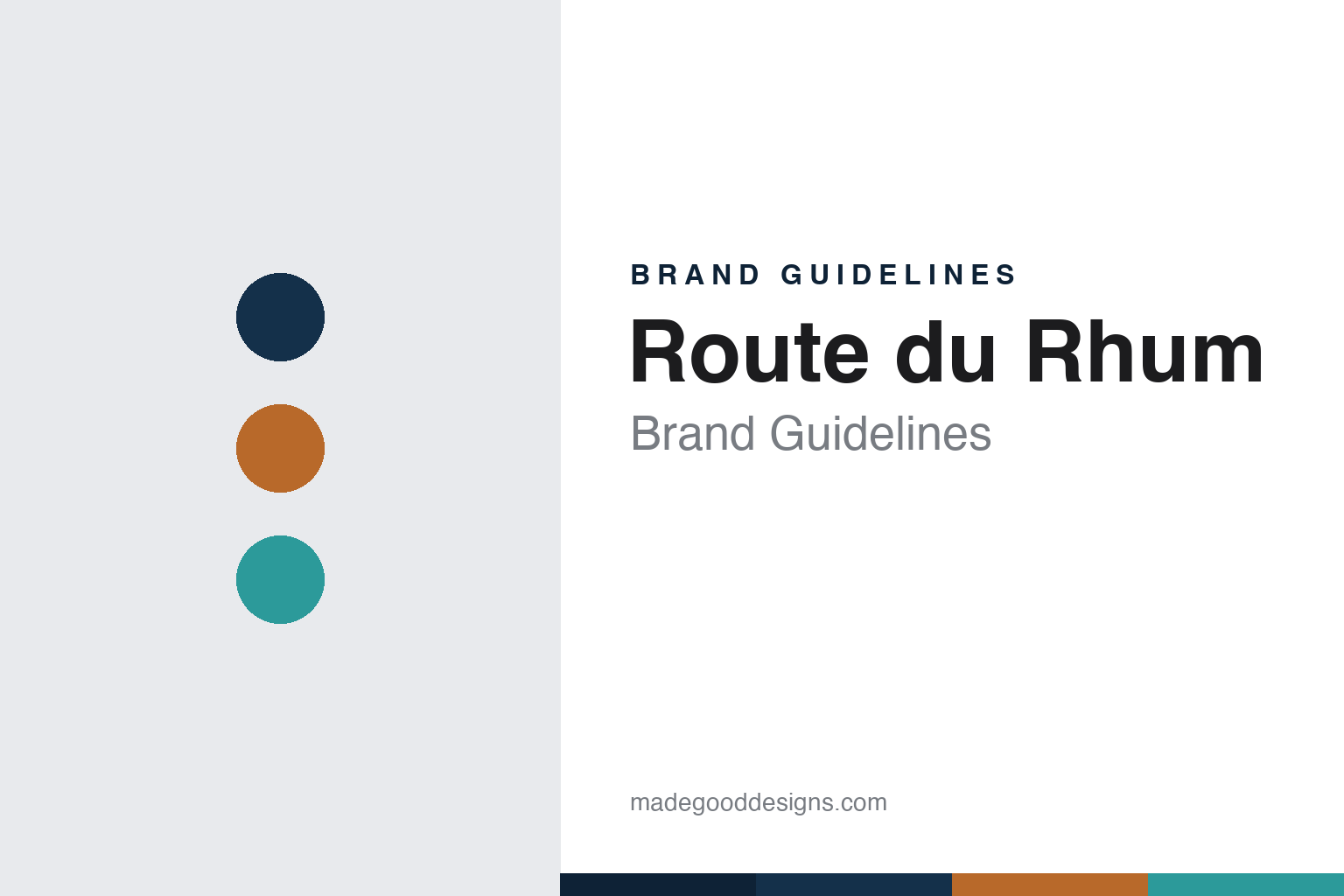
Two constants: an Atlantic navy, rum amber and lagoon turquoise palette and a condensed race sans register. Abstract homage — not a Route du Rhum mark; no logo, poster or race graphic is reproduced.
A rum road
A race named after its first backers.
The Route du Rhum is a single-handed sailing race across the Atlantic from Saint-Malo, in Brittany, to Pointe-à-Pitre, in Guadeloupe. It is held every four years, between late October and early November, and its first edition was sailed in 1978. French Wikipedia credits its creation to Michel Etevenon, a former impresario who had worked at the Olympia music hall in Paris, and a plaque at the Pointe du Grouin, near Cancale, marks his role.
The name came from the people who first backed it. French Wikipedia, citing France Bleu in 2014 and Voiles et Voiliers in 2018, traces the idea to a lunch in Paris in the spring of 1975 between Bernard Hass, then general secretary of the French Caribbean rum and sugar producers’ association, who was looking for a way to promote rum, and Florent de Kersauson, who suggested an autumn sailing race to the Antilles. Producers in Guadeloupe joined the project from 1976. The rum makers leaned towards Bordeaux, a historic port for sugar and rum, as the start; Kersauson argued for Saint-Malo, and Saint-Malo won.
The race also answered a change in the rules elsewhere. In December 1976, after British organisers had capped the length of boats in their transatlantic races, Etevenon announced in L’Équipe a French race with no size limit, French Wikipedia says. On 14 March 1978, according to the same article, which cites Libération, he and six partners from sugar and distilling businesses formed a company, Promovoile, to run a solo transatlantic race every four years under the name Route du Rhum. Promovoile organised the race from its first edition, and Florent de Kersauson served as its general secretary.
That first race was open to any boat: monohulls and multihulls raced together, with no classes and no size restrictions. English Wikipedia names the Canadian sailor Mike Birch, on Olympus Photo, as the winner. Classes by boat length arrived for the second and third editions, and from 1990 the race separated monohulls from multihulls, French Wikipedia says.
Colour
One course, one organiser, several names.
The course has stayed the same since 1978, the German sailing magazine YACHT wrote in September 2026, putting the distance from Saint-Malo to Pointe-à-Pitre at 3,542 nautical miles; French Wikipedia gives 3,510 miles on the shortest theoretical route. The route runs from east to west, past the Azores and into the Caribbean.
Both ends of the course are shaped for an audience. The start line lies just west of the Pointe du Grouin, at Cancale, and boats must leave a mark off Cap Fréhel to starboard so that spectators on shore can follow the opening hours, French Wikipedia says. At the far end, sailors must round Guadeloupe by the north and west, through the channel of Les Saintes, before finishing off Pointe-à-Pitre.
The organiser has changed with the business around it. French Wikipedia says the race has been organised since 2006 by the French company now called OC Sport Pen Duick. Pen Duick, a race-organising company named after Éric Tabarly’s boats, was owned by Groupe Télégramme, the Breton press group that publishes Le Télégramme; in 2014 the group became majority shareholder of the events company OC Sport, and Pen Duick became its French offshore-racing arm, according to French Wikipedia’s article on OC Sport. The same group of companies runs other sailing races and road-running events.
Sponsors have entered the name too. The 2006 and 2010 editions were sponsored by La Banque Postale and ran as La Route du Rhum-La Banque Postale, French Wikipedia says, citing Le Télégramme in December 2005. Since the 2014 edition the Guadeloupe region has been the main partner, and the race has carried the full name Route du Rhum-Destination Guadeloupe, the same article says, citing France 3 in December 2013. The organisers use that full name on their own website today.
Typography
Races, regattas and their names.
Offshore races and regattas are run by organisers rather than manufacturers, so their identities live on posters, start lines, race villages, maps and broadcasts more than on products. Some organisers are clubs, some are private companies and some are semi-public bodies tied to a host town or region. A design guide for any of them starts with a plain question: who runs the event, and who owns the name.
Race names carry a lot of history. Many events have changed their names as title sponsors came and went, and an organiser’s pages on history and past editions usually list each edition under the name it raced under at the time. A wordmark often has to sit beside a sponsor’s name, a host town and a year, and partner logos are usually set in tiers below it, from title partner down to official suppliers.
Boat classes shape the look as well. Sources name classes such as IMOCA, Class40, the Mini 6.50 and the F50 one-design catamaran, and each event sets out which classes it admits. Sails, hulls and wings carry team names and partner marks, and course maps and tracking graphics let viewers follow a long race day by day.
The rest of the identity sits on land: the race village where boats are moored before the start, the signage on pontoons, the official merchandise and the trophy, which some organisers unveil publicly. The guides in this group describe what their sources show about those elements, name organisers, clubs and companies plainly, and treat editions and dates as the main facts.
Aa
A condensed sans for a race named after a road and a drink. (Specimen set in Barlow Condensed, a sans STAND-IN; NOT the Route du Rhum logo.)
Route du Rhum
The 13th edition, in 2026.
The 13th edition started on 1 November 2026. The organisers announced the date in October 2025, with a start time of 1.02pm and six classes on a single start line: Ultim, IMOCA, Ocean Fifty, Class40, Vintage Multi and Vintage Mono. They described a race village of nearly 70,000 square metres along the Saint-Malo quays, free to enter and open from 20 October, with a new area called “Terre de Départ” given over to the Brittany region, and a parade of boats through the town’s locks in the days before the start.
YACHT counted 118 boats entered across the six classes in September 2026: eight Ultims, 23 IMOCAs, 11 Ocean Fifties and 49 Class40s, more than any other class, along with 13 vintage monohulls and 14 vintage multihulls. The magazine described the entry list as a snapshot of French and international offshore sailing at the time.
Tom Laperche was first to finish, on the Ultim trimaran SVR-Lazartigue, Yachting World reported on 8 November 2026, with a time of 6 days, 13 hours, 27 minutes and 40 seconds, which the magazine called a new record for the course.
The identity rests on a few fixed parts. The name joins a Breton port to Caribbean rum country in three words, and the suffix names the region that backs the race. The start at the Pointe du Grouin, the mark off Cap Fréhel and the finish at Pointe-à-Pitre stay the same from one edition to the next, as does the four-year rhythm, so each race is numbered as an edition rather than renamed.
For a design guide, Route du Rhum shows how a sailing race can carry its origin in its name and keep one course as its constant. Compare Vendée Globe, another French solo ocean race, and Transat Jacques Vabre, another race across the Atlantic. For this guide we use a deep Atlantic navy, a warm rum amber, a lagoon turquoise and a granite grey with a condensed sans, an unofficial interpretation; no product or logo is reproduced.
Explore & save
Keep Route du Rhum’s identity on hand — save it to a board in the Made Good inspiration library.
Route du Rhum identity set
Pin the Atlantic navy, rum amber and lagoon turquoise palette and the condensed race sans register to your own board.
Source & notes
Frequently Asked Questions
What font can I use to match the Route du Rhum look?
This guide describes Route du Rhum’s type as “A condensed sans for a race named after a road and a drink”. Its type specimen is set in Barlow Condensed from Google Fonts as a stand-in; Barlow Condensed is not Route du Rhum’s own lettering.
What colours are in the Route du Rhum palette?
This guide’s Route du Rhum palette is Atlantic navy #14304A, Rum amber #B8692A, Lagoon turquoise #2C9A9A, Granite grey #6E6E68 and Paper #F7F4EE. The tones are the guide’s own unofficial interpretation, not official Route du Rhum hex codes.
When was Route du Rhum founded?
Route du Rhum was founded in 1978, in Saint-Malo to Pointe-à-Pitre.
Who founded Route du Rhum?
Route du Rhum was founded by Michel Etevenon in 1978.