The Ghan Brand Guidelines
The Adelaide–Darwin train named after a nickname.
Aa
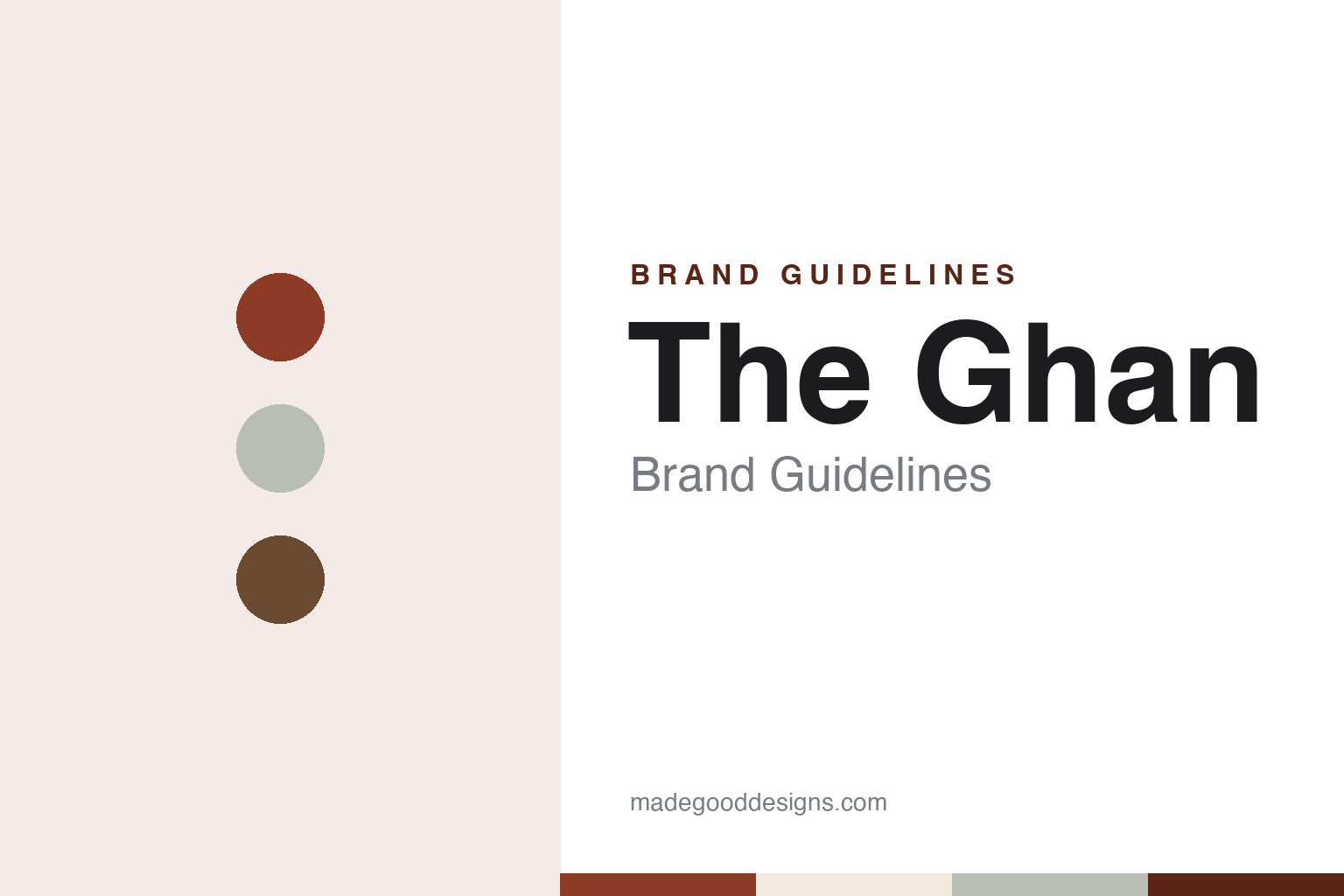
Two constants: a red earth, ghost gum and walnut palette and a deco geometric sans register. Abstract homage — not a Ghan or Journey Beyond asset; no logo, livery or carriage is reproduced.
Adelaide, 1929
A narrow-gauge train to Alice Springs, then a line to the Top End.
The Ghan is a long-distance passenger train that runs across Australia between Adelaide on the south coast and Darwin on the north coast, by way of Alice Springs. English Wikipedia gives the route as 2,979 kilometres and the scheduled journey, including extended stops for off-train tours, as 53 hours 15 minutes. The train stops at Adelaide, Alice Springs, Katherine and Darwin.
Its history is older than the full route. The first service left Adelaide on 4 August 1929, when the line from Adelaide reached only as far as Alice Springs, SBS News reported in August 2019 in a piece from the AAP news agency. The operator’s own history page says the train carried more than 100 passengers and supplies to the town of Stuart, later renamed Alice Springs, and arrived two days later. That first train ran on the Central Australia Railway, a narrow-gauge line whose construction had begun at Port Augusta in 1878; until the extension to Alice Springs was finished in 1929, the last leg of the trip was made by camel, English Wikipedia says.
The service ran fortnightly at first, weekly from the 1930s and twice weekly from 1956 to 1975. English Wikipedia says the service was greatly expanded during the Second World War, which put pressure on water supplies along the line, and that de-mineralisation towers were built so bore water could be used. In October 1980 a new standard-gauge line from Tarcoola to Alice Springs opened about 160 kilometres west of the old one; the last narrow-gauge service left Alice Springs on 26 November 1980, and the first Ghan on the new line left Adelaide on 11 December 1980.
The northern section came later. Work on the line from Alice Springs to Darwin began in July 2001, and the first passenger train reached Darwin on 3 February 2004, English Wikipedia says; the operator dates the departure of that inaugural transcontinental journey to 1 February 2004. SBS News noted that the Darwin line was considered at the time the second-biggest civil engineering project in Australia’s history, after the Snowy Mountains hydro-electric scheme.
Colour
From a crew nickname to a privately run train.
The name is a shortening. English Wikipedia says “The Ghan” comes from an earlier nickname, The Afghan Express, which is reputed to have been given by a train crew in 1923; the cameleers who worked the routes into the interior from the late nineteenth century were generically called “Afghans.” The same article records a contrary view that the nickname began as a mocking joke among crews in the 1890s and says that modern marketing completed the turnaround. The operator presents the name as a tribute to the cameleers who opened a permanent trail into the Red Centre. A heritage tourist train on the Pichi Richi Railway still uses the name The Afghan Express on part of the original route, the operator says.
Ownership has changed several times. The train was run by government railways until the break-up of Australian National; in 1997 The Ghan, the Indian Pacific and The Overland were sold to Great Southern Rail, a consortium that included Serco, which became sole owner in October 1999, English Wikipedia says. Serco sold the business to the Sydney investment fund Allegro Funds in March 2015, and in September 2016 Allegro sold a 70 per cent stake to Quadrant Private Equity. In 2019 Great Southern Rail was rebranded Journey Beyond Rail Expeditions, later shortened to Journey Beyond, which is based in Adelaide. In January 2022 the business was sold to the Hornblower Group, owned by the New York private equity firm Crestview Partners; after Hornblower filed for bankruptcy in February 2024, Journey Beyond was separated from the group and came under the sole ownership of Crestview Partners, English Wikipedia says.
Each train has on average 28 stainless steel carriages, built by Comeng at Granville in the late 1960s and early 1970s for the Indian Pacific, plus a motorail wagon, for an average length of 774 metres. Two Pacific National NR class locomotives haul it, with locomotive crews from Pacific National and on-board staff employed by Journey Beyond. In July 2016 economy seating was withdrawn, which English Wikipedia says left The Ghan classed as an exclusively luxury train. The operator dates its first four-day Ghan Expedition departure from Darwin, with visits to Uluṟu and Coober Pedy, to 23 May 2015.
Typography
How luxury and sleeper trains present themselves.
Luxury, sleeper and scenic trains sell a journey rather than a seat, and their identities are built to match. A train’s name is often its strongest asset: some revive the names of older services, others are named after a route, a region or a landscape. Operators publish these names with crests, monograms and lettering that echo railway signwriting, and many give a train its own livery, so that the colour of the carriages becomes part of the brand. The Venice Simplon-Orient-Express, for example, runs in a blue-and-gold livery, National Geographic Traveller reported in 2018.
Inside, the identity moves into materials. Carriage interiors carry marquetry, glass, upholstery and fittings, and on trains that use restored rolling stock the pages on history and individual carriages, with their build years and builders, become a large part of what the operator publishes. Newer interiors are often credited to named designers, studios and craft workshops.
The printed and digital pieces around a journey do much of the remaining work. Menus, cabin cards, tickets, luggage labels and welcome letters repeat the same names and lettering; route maps and timetables show where a train runs, how many nights a journey takes and which stations it stops at; and dress codes, music and dining arrangements are described as part of the experience.
Behind the names sit owners and operators that change over time: state railways, regional railway companies, private operators and international hotel groups. This guide states those owners and operators plainly, with dates, and attributes descriptions of carriages, suites and routes to the operator or to a named, dated source. It does not cover fares, and it makes no record claims.
Aa
A geometric sans with deco leanings, after the carriage interiors. (Specimen set in Josefin Sans, a sans STAND-IN; NOT The Ghan logo.)
The Ghan
Interiors drawn from the landscape outside.
Much of the documented design work on the train is inside. Wallpaper* reported in June 2024 that the studio Woods Bagot, which had already redesigned The Ghan’s Platinum carriages in 2019, the train’s 90th anniversary year, was commissioned by Journey Beyond to rework the Gold Premium carriages, including the cabins, lounge and restaurant. The magazine described rich reds and burgundy set against walnut timber and polished brass, and said the existing joinery, furniture and materials were reused, with the construction carried out on site at Churchill Yards in Adelaide.
The details are local. According to Wallpaper*, original brass handles and fittings were kept; original seats were reupholstered in fabric from the Melbourne company Willie Weston using “Terra,” a dot design by Kathleen Korda of Durrmu Arts; the pressed-metal ceilings were recreated by an Adelaide manufacturer; and the lounge wall lights were hand-blown at JamFactory in Adelaide. Woods Bagot told the magazine the colours respond to the landscapes of the Arrernte artist Albert Namatjira, and custom carpets by Modieus carry a ghost gum motif.
The train has also been filmed at length. English Wikipedia lists an episode of the BBC’s Great Railway Journeys of the World in 1980, presented by Michael Frayn, and a 2018 SBS slow-television programme of the whole Adelaide–Darwin journey, filmed in 2017, shown in a three-hour version and a 17-hour version. For its 90th year in August 2019, SBS News reported, a commemorative train of 35 carriages left Adelaide with a stop at Pimba for an open-air concert.
For a design guide, The Ghan shows how a train can carry a contested old nickname, a long timeline and a rebuilt interior in one identity, with the outback itself as the colour source. Compare Indian Pacific, its sister train under the same operator, and Caledonian Sleeper, the overnight train between London and Scotland. For this guide we use a red earth, a ghost gum silver and walnut with a geometric sans, an unofficial interpretation; no product or logo is reproduced.
Explore & save
Keep The Ghan’s identity on hand — save it to a board in the Made Good inspiration library.
The Ghan identity set
Pin The Ghan red earth, ghost gum and walnut palette and the deco geometric sans register to your own board.
Source & notes
Frequently Asked Questions
What font can I use to match the The Ghan look?
This guide describes The Ghan’s type as “A geometric sans with deco leanings, after the carriage interiors”. Its type specimen is set in Josefin Sans from Google Fonts as a stand-in; Josefin Sans is not The Ghan’s own lettering.
What colours are in the The Ghan palette?
This guide’s The Ghan palette is Red earth #8E3B26, Burnt sienna ink #5A2417, Ghost gum silver #B8BDB5, Walnut #6B4A32 and Spinifex sand #F1E9DE. The tones are the guide’s own unofficial interpretation, not official The Ghan hex codes.