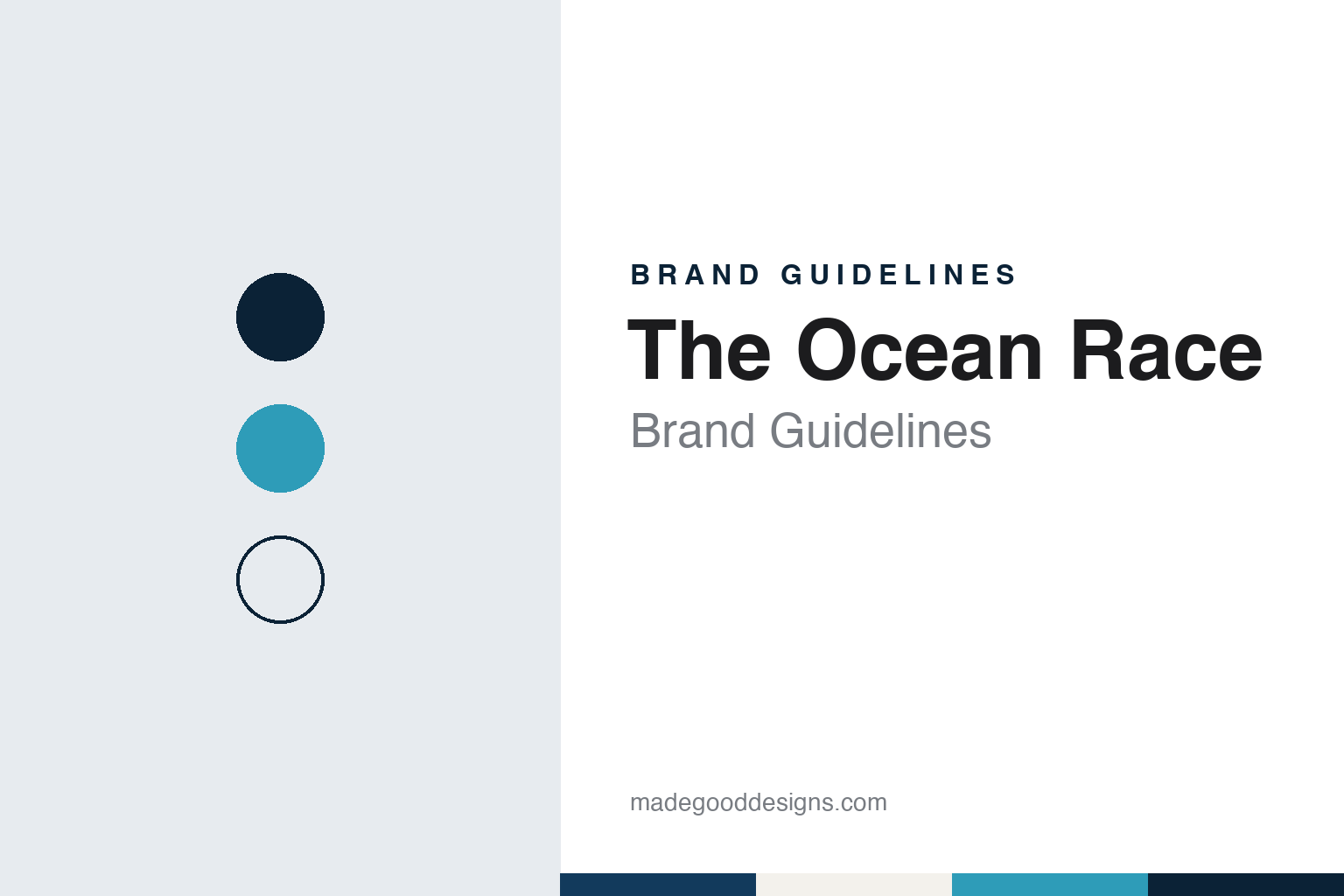
The Ocean Race Brand Guidelines
The crewed round-the-world race that outgrew two sponsor names.
Aa
Two constants: a deep ocean, sailcloth and open-water palette and a wind-shaped sans register. Abstract homage — not a The Ocean Race asset; no symbol, logo or trophy is reproduced.
Whitbread
A brewer’s regatta around the globe.
The Ocean Race began as the Whitbread Round the World Race. English Wikipedia says that in 1972 the British brewing company Whitbread agreed, with a British sailing association, to sponsor a regatta around the globe, and that the first race started from Portsmouth on 8 September 1973 with seventeen yachts and 167 crew. It was won by the Mexican amateur sailor Ramón Carlín in Sayula II, a Swan 65. The same source says the original course followed the route of the square-rigged ships that carried cargo around the world in the 19th century, and that the race has been held every three or four years since 1973.
The early fleets were mixed. English Wikipedia describes a very wide range of boat types in the first races, from large “maxi” yachts to much smaller boats, and says that concerns about cost after the 1989–90 race led to the Whitbread 60, a single design. It was used for all the smaller boats in 1993–94 and for every boat in 1997–98, and the race then stayed with one class for seven editions, moving on to the Volvo Open 70 and then the Volvo Ocean 65, or VO65.
The sponsor’s name changed with the owner. From 2001, English Wikipedia says, Volvo and Volvo Cars took over the race and it became the Volvo Ocean Race, with stopover ports added in Germany, France and Sweden. Since the 2008–09 race each boat has also carried a dedicated media crew member, the On Board Reporter, who does not sail the boat but sends pictures and video back to race headquarters by satellite. Alicante, in Spain, was the start port in 2008, 2011 and 2014, and the 2017–18 race started there in October and was scheduled to finish in The Hague on 30 June 2018, Yachting World reported.
Colour
New owners, then a new name.
Volvo’s time as owner ended in 2018. On 31 May 2018, Yachting World reported that the next edition would be under new ownership: a Spanish company led by Richard Brisius, Johan Salén and Jan Litborn, taking over from Volvo Group and Volvo Cars after twenty years. The magazine spelled the company “Atlantic Ocean Racing Spain”; Trade Only Today, in March 2019, gave it as Atlant Ocean Racing Spain. Brisius and Salén had sailed in the 1989–90 race and later managed teams, including EF Language in 1997–98 and Ericsson 4 in 2008–09, and they were president and co-president of the 2017–18 race. Volvo Cars stayed on as a sponsor of the next edition, both reports said. English Wikipedia names the owner since 2018 as The Ocean Race 1973 SLU, a successor company to Atlant Ocean Racing.
The new name came next. On 19 February 2019, Scuttlebutt Sailing News reported that the race would be known as The Ocean Race, with its information moving to theoceanrace.com. On 21 March 2019, in Alicante, the organisers revealed the new brand identity and confirmed two team entries, Scuttlebutt reported, quoting managing director Johan Salén and executive director Richard Mason. That report also said the next race would be open to two classes: the foiling IMOCA 60 and the one-design VO65.
The next round-the-world race had first been set for 2021–22 and was moved back by a year. The 14th edition started from Alicante on 15 January 2023, with legs via Cabo Verde, Cape Town, Itajaí in Brazil, Newport in Rhode Island, Aarhus, a fly-by at Kiel and The Hague, ending with a grand finale in Genova and a final in-port race on 1 July 2023, according to Scuttlebutt on 29 June 2023. Only the IMOCAs raced the whole way round; the VO65s sailed The Ocean Race VO65 Sprint on legs one, six and seven. An In-Port Series was raced at seven stopover cities; those races did not count towards the overall points but were used to break ties.
The organisers also run a shorter race. English Wikipedia says The Ocean Race Europe was first sailed in May 2021, from Lorient in France to Genoa with stops in Cascais and Alicante, for IMOCA 60s and VO65s racing side by side with separate results, and that a second edition started on 10 August 2025.
Typography
Design and documentation.
Offshore races and regattas are run by organisers rather than manufacturers, so their identities live on posters, start lines, race villages, maps and broadcasts more than on products. Some organisers are clubs, some are private companies and some are semi-public bodies tied to a host town or region. A design guide for any of them starts with a plain question: who runs the event, and who owns the name.
Race names carry a lot of history. Many events have changed their names as title sponsors came and went, and an organiser’s pages on history and past editions usually list each edition under the name it raced under at the time. A wordmark often has to sit beside a sponsor’s name, a host town and a year, and partner logos are usually set in tiers below it, from title partner down to official suppliers.
Boat classes shape the look as well. Sources name classes such as IMOCA, Class40, the Mini 6.50 and the F50 one-design catamaran, and each event sets out which classes it admits. Sails, hulls and wings carry team names and partner marks, and course maps and tracking graphics let viewers follow a long race day by day.
The rest of the identity sits on land: the race village where boats are moored before the start, the signage on pontoons, the official merchandise and the trophy, which some organisers unveil publicly. The guides in this group describe what their sources show about those elements, name organisers, clubs and companies plainly, and treat editions and dates as the main facts.
Aa
A wind-shaped sans — an identity built around sails and a boat-like A. (Specimen set in Sora, a sans STAND-IN; NOT The Ocean Race logo or its typeface.)
The Ocean Race
Wind-filled sails and a boat-shaped A.
The 2019 identity was made with the design studio Mucho, which describes the project in a case study on its own website. Mucho says the brand needed to do more than remove the name of the previous sponsor, Volvo, and that the new identity was meant to stress technology and sustainability. It describes a symbol resembling wind-filled sails, a typeface by the foundry TypeMates with a distinctive “A” drawn like a boat seen from above, and a visual language of shapes, colours and wind-inspired patterns. Mucho also says it set up a flexible system of sub-brands, so that related events and programmes could sit under the main name, and wrote detailed guidelines with the race’s own design team. Those are the studio’s descriptions of its work.
The name itself is the main design change. For most of its history the race carried a company’s name: Whitbread for its first editions and Volvo from 2001. Scuttlebutt’s March 2019 report dated the editions as the Whitbread Round the World Race from 1973 to 1997 and the Volvo Ocean Race from 2001 to 2018. Dropping a sponsor from the title left a plain descriptive name, The Ocean Race. The sub-brand system shows in event names such as The Ocean Race Europe and The Ocean Race VO65 Sprint, which add a place or a boat class to the same three words.
The race also produces a large amount of imagery. The On Board Reporter role, in place since 2008–09, means each boat sends its own pictures and video from the middle of the ocean, and the in-port races let local fans watch the teams on a short inshore course, Scuttlebutt wrote in 2023. Its March 2019 report said the route for the next race, with up to nine stopover ports, was to follow a selection process for host cities, and its 2023 report set the legs out as a numbered schedule of ports and distances.
For a design guide, The Ocean Race shows how an event can move from a sponsor’s name to its own name while keeping a run of editions that goes back to 1973. Compare Vendée Globe, the solo round-the-world race whose IMOCA class now also sails in The Ocean Race, and America’s Cup, another crewed sailing event with a long history. For this guide we use a deep ocean blue, sailcloth white, an open-water blue and a coral accent with a sans, an unofficial interpretation; no product or logo is reproduced.
Explore & save
Keep The Ocean Race’s identity on hand — save it to a board in the Made Good inspiration library.
The Ocean Race identity set
Pin The Ocean Race deep ocean, sailcloth and open-water palette and the wind-shaped sans register to your own board.
Source & notes
Frequently Asked Questions
What font can I use to match the The Ocean Race look?
This guide describes The Ocean Race’s type as “A wind-shaped sans — an identity built around sails and a boat-like A”. Its type specimen is set in Sora from Google Fonts as a stand-in; Sora is not The Ocean Race’s own lettering.
What colours are in the The Ocean Race palette?
This guide’s The Ocean Race palette is Deep ocean #123A5C, Night watch #0B2236, Sailcloth #F3F1EC, Open water #2E9CB8 and Signal coral #E2725B. The tones are the guide’s own unofficial interpretation, not official The Ocean Race hex codes.