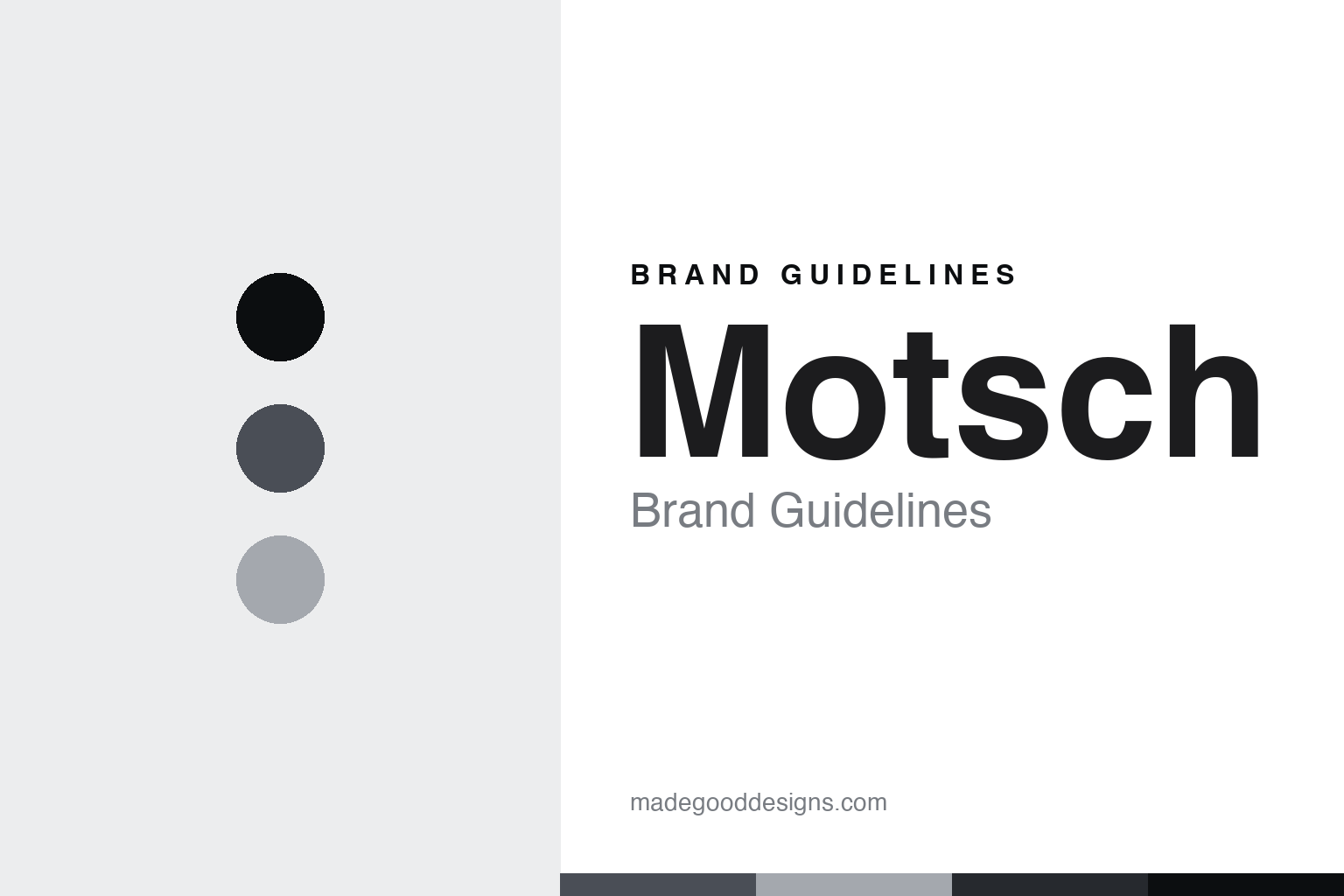
Motsch Brand Guidelines
The last hatter of Paris.
Aa
Two constants: a graphite palette and a Paris-sans register. Abstract homage — not a Motsch hat, the Hermès marks, or the George V shopfront.
The last hatter of Paris
Motsch is the historic Paris hatter founded in 1887, bought by Hermès in the early 1990s to save it, its name and heritage shopfront preserved within Hermès.
Motsch is a lesson in how a name is saved by being absorbed. Founded in Paris in 1887, Motsch was a traditional hatter — men’s felt hats, Panamas, bespoke headwear — and, by the 2000s, was described as the last true hat shop in Paris. Its answer to how a hat house survives is unusual: be bought by a luxury house that wants to keep the craft alive. A Paris hatter preserved inside a bigger name.
Its identity is the last Paris hatter, saved. Motsch’s traditional Paris hatmaking, and its heritage George V shopfront, are what the name is known for. A hatter, preserved. A name kept alive by absorption.
(Honest notes, so the story stays precise, because Motsch no longer trades on its own. Motsch was founded in 1887 by Ernest Motsch, at the corner shop on avenue George V in Paris — the premises date to 1870, but the hatmaking business to 1887, and we keep those apart. By the early 1990s the founding family wanted to sell, and Hermès acquired the house — the deal around 1991, the Motsch trademark registered by Hermès in 1992 (not 1997) — committing to preserve the hatmaking. Today there is no independent Motsch house, boutique or product line we can confirm: the historic, heritage-listed George V shopfront survives, its gilded name preserved, but the address is now a general Hermès flagship. So we describe Motsch honestly as a historic Paris hatter, saved and absorbed — its name and shopfront kept within Hermès, its hatmaking effectively part of that house — and we write in the past and heritage register, using the present tense only for Hermès, and never imply Motsch trades independently. Its name is now an Hermès-owned trademark; we describe it but reproduce no Hermès marks or the shopfront lettering. There is no official brand hex; these tones are an unofficial interpretation. This is design commentary and does not promote any product.)
Colour
Motsch lives in a graphite palette. Click a swatch to copy the hex.
Motsch’s identity is refined, Parisian and quiet — a graphite, an ink, a grey, a slate, and a paper. The palette leans graphite and grey: the register of a preserved Paris hatter and a discreet, absorbed name. It signals restraint over display. The honest caveat: with no published brand hex, these values are an original, unofficial interpretation, not first-party colours.
The lesson is a graphite palette signals a preserved, Parisian identity. Motsch’s world is a refined, discreet, French object. For designers, it is a reminder that a graphite and a soft grey can carry a name built on preservation — the near-black of a formal hat and the calm of a quiet survival. Because these tones can fail as small text, keep type dark and let the colour live in the accents, palette and band. The takeaways: honour the heritage; keep the shopfront; describe the absorption honestly; and treat any single hex as unofficial.
Typography
The register is a Paris sans — refined, quiet, discreet.
Motsch’s identity carries a refined, quiet, discreet spirit — a preserved heritage name, not a live brand. A Paris sans captures the mood: even, restrained and understated, the register of a saved Paris hatter. Set in a graphite palette, the Paris sans feels refined and quiet — exactly the personality Motsch carries. It is discreet rather than loud, mirroring a formal hat. (Motsch’s real shopfront lettering and the Hermès marks are things we describe but do not reproduce, and the exact typeface is not ours to use.) Because it is not ours to use, the honest description is “a Paris-sans spirit,” shown here in a stand-in. The type behaves like the name: refined, quiet and discreet.
Aa
A Paris-sans spirit — refined and quiet. (Specimen set in Libre Franklin, a Paris-sans STAND-IN; NOT the Motsch shopfront lettering or Hermès marks.)
The hat houses that lasted
Motsch stands for the name that lasted by being absorbed.
Motsch is a lesson in how a heritage name can last by being absorbed into a bigger house. A graphite palette, a Paris sans and a preserved shopfront make one thing — the last hatter of Paris, saved — the whole identity: refined, Parisian and quiet. The absorption is the differentiator, and the preservation is the meaning. The point is an 1887 hatter that would likely have vanished, kept alive because a luxury house bought it and preserved its name and heritage shopfront.
Put to work, the identity is preservation, honestly told, as design. A heritage name in this spirit would be candid that it no longer trades on its own — a founding in 1887, an acquisition by Hermès in the early 1990s, a shopfront preserved within a flagship. A brand learning from it would see that being absorbed can be a form of survival — that a name and a craft kept inside a bigger house beats a name lost entirely — and that being precise, founded 1887, bought by Hermès around 1991, now preserved rather than independent, keeps the story honest. A brand learning from it would also treat the owner with care: describing the preservation without borrowing the owner’s marks or the famous shopfront is exactly the restraint an honest account requires. The lesson Motsch teaches is that a name can last by being saved: the absorption gives it survival, and the honest framing keeps it credible. The preserved shopfront is the personality, and the hatter’s heritage is the proof.
For designers and brand-builders, Motsch holds the absorbed pole in this round of the hat houses that lasted, from France: be honest about survival by absorption. The lessons: honour the heritage; separate the premises date from the founding; state the acquisition precisely; write in the heritage register; and never reproduce the owner’s marks or the shopfront. It is also a reminder to stay precise: Motsch is the historic Paris hatter founded in 1887, bought by Hermès in the early 1990s to save it, its name and heritage shopfront preserved within Hermès — with the palette here an unofficial interpretation. Motsch shows how absorption can be survival — proof that a name kept by a bigger house can still be the difference.
Explore & save
Keep Motsch’s identity on hand — save it to a board in the Made Good inspiration library.
Motsch identity set
Pin the graphite palette and the Paris-sans register to your own board.