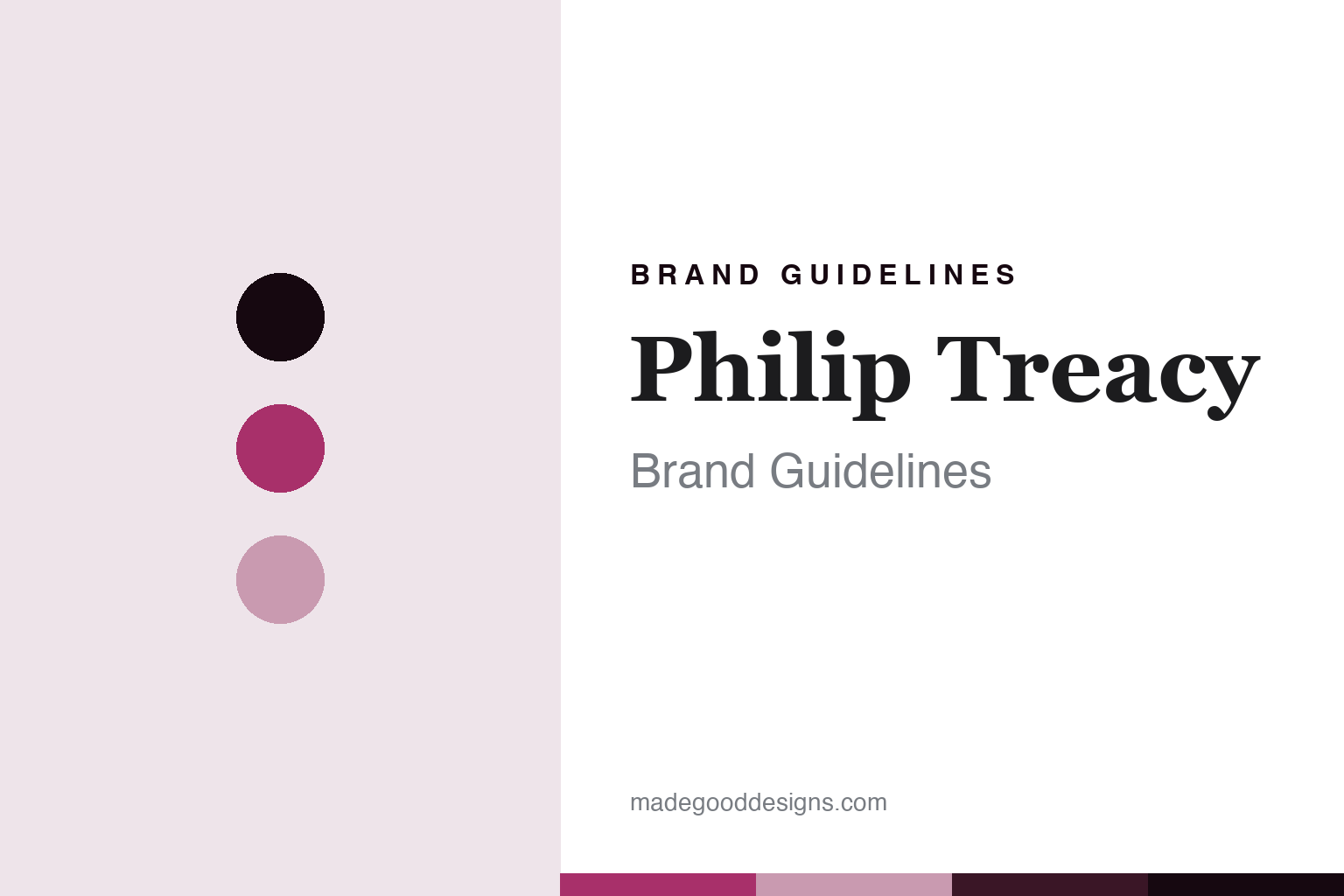
Philip Treacy Brand Guidelines
The sculptural hat.
Aa
Two constants: a magenta palette and a couture-serif register. Abstract homage — not a Philip Treacy hat or headpiece.
The couture milliner
Philip Treacy is the Irish-born, London-based milliner regarded as the leading couture hat designer of his generation, known for sculptural headpieces.
Philip Treacy is a lesson in how a milliner’s name can become the art of the hat. An Irish-born, London-based designer, Treacy is widely regarded as the leading couture milliner of his generation — his sculptural, sometimes surreal headpieces treat the hat as wearable sculpture. His answer to how a hat becomes a name is imagination and craft: design a hat as an art object, and let the name stand for the form. A milliner whose hats belong as much to the gallery as the head.
Its identity is the couture milliner. Treacy’s sculptural hats and headpieces, and his standing among the great living milliners, are the work the name is known for. A hat, made as art. A name that is a maker.
(Honest notes, so the story stays precise, and a living maker is treated with care. Philip Treacy was born in 1967 in Ahascragh, County Galway, in Ireland, and built his career in London, taking an MA at the Royal College of Art in 1990; so he is Irish-born and London-based. His early champion was the late Isabella Blow, whose patronage from around 1989 was career-defining. He has designed hats for, or in collaboration with, couture houses — including for Karl Lagerfeld at Chanel from 1991, and with Alexander McQueen, Givenchy and Valentino — which we present as reported collaborations, not employment. He is strongly associated with occasion millinery, from Royal Ascot to the 2011 royal wedding of William and Catherine, for which he is reported to have made dozens of guests’ hats, including a much-discussed headpiece for Princess Beatrice (Camilla, then Duchess of Cornwall, was a guest, not the bride). He was appointed OBE in 2007. His hats are, as reported, made in his London atelier; we present that as reported rather than an absolute made-in-Britain claim. As this is a living maker, we keep strictly to public professional facts, and because his sculptural designs are highly recognisable and protectable, we reproduce no specific hat or headpiece — only an abstract homage. His name and marks are his IP, and there is no official brand hex; these tones are an unofficial interpretation. This is design commentary and does not promote any product.)
Colour
Philip Treacy lives in a magenta palette. Click a swatch to copy the hex.
Philip Treacy’s identity is bold, sculptural and couture — a magenta, an ink, a rose, a plum, and a paper. The palette leans magenta and rose: the register of dramatic, art-led millinery. It signals imagination over convention. The honest caveat: with no published brand hex, these values are an original, unofficial interpretation, not first-party colours.
The lesson is a magenta palette signals a couture, sculptural identity. Treacy’s world is a bold, art-led, couture object. For designers, it is a reminder that a rich magenta and a soft rose can carry a name built on drama and form — the boldness of a headpiece and the calm of an atelier. Because these tones can fail as small text, keep type dark and let the colour live in the accents, palette and band. The takeaways: treat the hat as art; sign the work; keep to public facts; and treat any single hex as unofficial.
Typography
The register is a couture serif — refined, dramatic, elegant.
Treacy’s identity carries a refined, dramatic, elegant spirit — a couture milliner, not a hat factory. A couture serif captures the mood: fine, considered and theatrical, the register of art-led millinery. Set in a magenta palette, the couture serif feels refined and dramatic — exactly the personality Treacy carries. It is couture rather than commercial, mirroring a sculptural headpiece. (Treacy’s real designs and marks are things we describe but do not reproduce, and the exact typeface is not ours to use.) Because it is not ours to use, the honest description is “a couture-serif spirit,” shown here in a stand-in. The type behaves like the atelier: refined, dramatic and elegant.
Aa
A couture-serif spirit — refined and dramatic. (Specimen set in Cormorant Garamond, a couture-serif STAND-IN; NOT the Philip Treacy wordmark or any design.)
The milliners
Philip Treacy stands for the hat as art.
Philip Treacy is a lesson in how a milliner’s name and imagination can be the identity. A magenta palette, a couture serif and a sculptural headpiece make one thing — the hat as wearable art — the whole identity: bold, sculptural and couture. The imagination is the differentiator, and the maker’s hand is the meaning. The point is a designer whose name is on the hat because the vision is his, who turned occasion millinery into an art form watched by the world.
Put to work, the identity is the maker as the brand. A milliner in this spirit would treat each hat as an art object, build a real body of work, and let a champion and the runway carry the name — while being described only in public professional facts. A brand learning from it would see that a maker’s imagination is a durable identity — that a sculptural headpiece has a story a mass hat cannot tell — and that being precise, Irish-born and London-based, a leading living milliner by critical consensus rather than an absolute superlative, keeps the account honest. A brand learning from it would also respect the work: reproducing none of the recognisable designs, and treating a living maker with care, is exactly what an honest homage requires. The lesson Treacy teaches is that a maker can be the identity: the imagination gives it art, and the restraint keeps it honest. The vision is the personality, and the headpiece is the proof.
For designers and brand-builders, Philip Treacy opens this round of the milliners, from London: treat the hat as art, and let the maker be the name. The lessons: design with imagination; build a body of work; attribute collaborations honestly; keep to public facts; and never reproduce a signature design. It is also a reminder to stay precise: Philip Treacy is the Irish-born, London-based milliner regarded as the leading couture hat designer of his generation, known for sculptural headpieces — with the palette here an unofficial interpretation. Treacy made the hat an art form — proof that a maker’s imagination can be the difference.
Explore & save
Keep Philip Treacy’s identity on hand — save it to a board in the Made Good inspiration library.
Philip Treacy identity set
Pin the magenta palette and the couture-serif register to your own board.