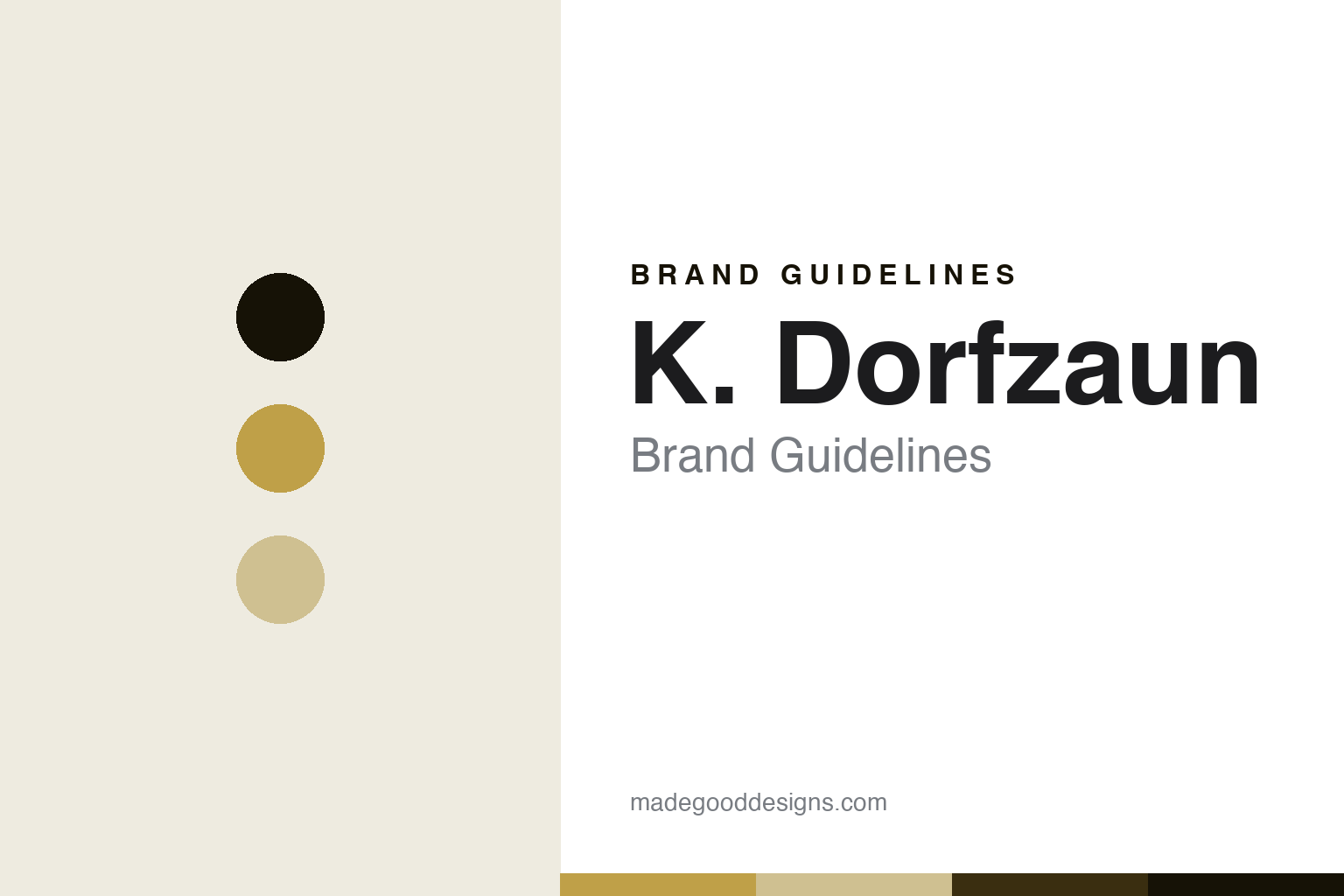
K. Dorfzaun Brand Guidelines
The Panama exporter.
Aa
Two constants: a straw-gold palette and a Cuenca-sans register. Abstract homage — not a K. Dorfzaun hat or any toquilla weave motif.
The Cuenca Panama house
K. Dorfzaun is the Cuenca Panama-hat exporter built by a refugee family, working with Ecuadorian weavers of toquilla straw since 1939.
K. Dorfzaun is a lesson in how an exporter can be the bridge for a craft. From Cuenca, in the Ecuadorian highlands, Dorfzaun makes and exports genuine Panama hats — toquilla-straw hats hand-woven by Ecuadorian artisans, finished and shipped to the world. Its answer to how a hat reaches the world is a bridge: work with weaving communities, finish the hats in Cuenca, and export them globally. A Cuenca house carrying an Ecuadorian craft abroad.
Its identity is the Cuenca Panama exporter. Dorfzaun’s toquilla-straw Panama hats, woven by Ecuadorian artisans and finished in Cuenca, are the work it is known for. A hat, woven in Ecuador. A family that made a home, and a craft, its life.
(Honest notes, so the story stays precise, and the craft is credited to its people. K. Dorfzaun — Exportadora K. Dorfzaun — is based in Cuenca and is primarily an exporter and finisher of toquilla-straw Panama hats, working with weaving communities rather than a single workshop; the weaving is done by hand by Ecuadorian artisans, while blocking and finishing are done at Dorfzaun’s Cuenca facility. On its history: the Dorfzaun family, German-Jewish refugees who fled Nazi Germany, began exporting hats from Cuenca in 1939; the firm bearing the name, founded by Kurt Dorfzaun (the “K.”), dates to 1950, with the third generation, Alberto Dorfzaun, from 1999 — so we say the family export business began in 1939 and the named firm in 1950, rather than flatly “founded 1939.” It is one of Cuenca’s established, long-standing Panama exporters; we do not claim it is the largest. The crucial, honest point is cultural: the “Panama hat” is Ecuadorian, misnamed for its shipping route through Panama; the weaving of toquilla straw was inscribed on UNESCO’s list of Intangible Cultural Heritage in 2012, honouring Ecuadorian weavers as a national tradition, not any one company — so we present Dorfzaun as a custodian and exporter within that tradition, distinguish Cuenca from the finest Montecristi weaving, and reproduce no weaving motifs. Its name and marks are its IP, described but never reproduced, and there is no official brand hex; these tones are an unofficial interpretation. This is design commentary and does not promote any product.)
Colour
K. Dorfzaun lives in a straw-gold palette. Click a swatch to copy the hex.
K. Dorfzaun’s identity is warm, Ecuadorian and natural — a straw gold, an ink, a cream, an umber, and a paper. The palette leans straw gold and cream: the register of woven toquilla straw and a Cuenca house. It signals craft and origin over fashion. The honest caveat: with no published brand hex, these values are an original, unofficial interpretation, not first-party colours — an abstract nod to straw, not a reproduction of any weave.
The lesson is a straw-gold palette signals an Ecuadorian, toquilla identity. Dorfzaun’s world is a warm, straw, Ecuadorian object. For designers, it is a reminder that a golden straw and a soft cream can carry a brand built on a woven material and a place — the gold of toquilla and the neutral of a finished hat — while keeping the weave itself out of an abstract homage. Because these tones can fail as small text, keep type dark and let the colour live in the accents, palette and band. The takeaways: credit the weavers; finish the hats; name the origin honestly; and treat any single hex as unofficial.
Typography
The register is a Cuenca sans — warm, plain, grounded.
K. Dorfzaun’s identity carries a warm, plain, grounded spirit — an exporter of a craft, not a fashion label. A Cuenca sans captures the mood: even, honest and unadorned, the register of a woven hat. Set in a straw-gold palette, the Cuenca sans feels warm and grounded — exactly the personality Dorfzaun carries. It is craft-rooted rather than glossy, mirroring toquilla straw. (Dorfzaun’s real labels and the toquilla weave are things we describe but do not reproduce, and the exact typeface is not ours to use.) Because it is not ours to use, the honest description is “a Cuenca-sans spirit,” shown here in a stand-in. The type behaves like the house: warm, plain and grounded.
Aa
A Cuenca-sans spirit — warm and grounded. (Specimen set in Mulish, a Cuenca-sans STAND-IN; NOT the K. Dorfzaun wordmark or any weave.)
The hat houses that lasted
K. Dorfzaun stands for the exporter that carried a craft.
K. Dorfzaun is a lesson in how an exporter lasts by carrying a craft to the world. A straw-gold palette, a Cuenca sans and a toquilla hat make one thing — a genuine Ecuadorian Panama, exported — the whole identity: warm, Ecuadorian and natural. The bridge to the world is the differentiator, and the Ecuadorian weaving is the meaning. The point is a Cuenca house, built by a refugee family, that has carried a hand-woven Ecuadorian craft to the world for over eighty years.
Put to work, the identity is a craft, honestly credited, as design. An exporter in this spirit would credit the weavers, finish the hats with care, and name the origin precisely — an Ecuadorian craft, a family that began in 1939, a named firm from 1950. A brand learning from it would see that being an honest bridge for a craft is a durable identity — that a genuine Ecuadorian Panama carries a story a factory hat cannot — and that being precise, a family export business from 1939, the K. Dorfzaun firm from 1950, one of Cuenca’s established exporters, keeps the story honest. A brand learning from it would above all get the culture right: the Panama is Ecuadorian, its weaving a UNESCO-honoured national tradition of Ecuadorian artisans, and an exporter is a custodian within it, never its owner. The lesson Dorfzaun teaches is that carrying a craft can hold an identity: the weaving gives it authenticity, and the honest credit keeps it right. The straw is the personality, and the woven hat is the proof.
For designers and brand-builders, K. Dorfzaun holds the export pole in this round of the hat houses that lasted, from Ecuador: carry the craft, and credit its people. The lessons: credit the weavers; finish with care; name the founding precisely; get the cultural origin right; and never reproduce a weave. It is also a reminder to stay precise: K. Dorfzaun is the Cuenca Panama-hat exporter built by a refugee family, working with Ecuadorian weavers of toquilla straw since 1939 — with the palette here an unofficial interpretation. Dorfzaun made carrying the craft the identity — proof that an honest bridge for a craft can be the difference.
Explore & save
Keep K. Dorfzaun’s identity on hand — save it to a board in the Made Good inspiration library.
K. Dorfzaun identity set
Pin the straw-gold palette and the Cuenca-sans register to your own board.