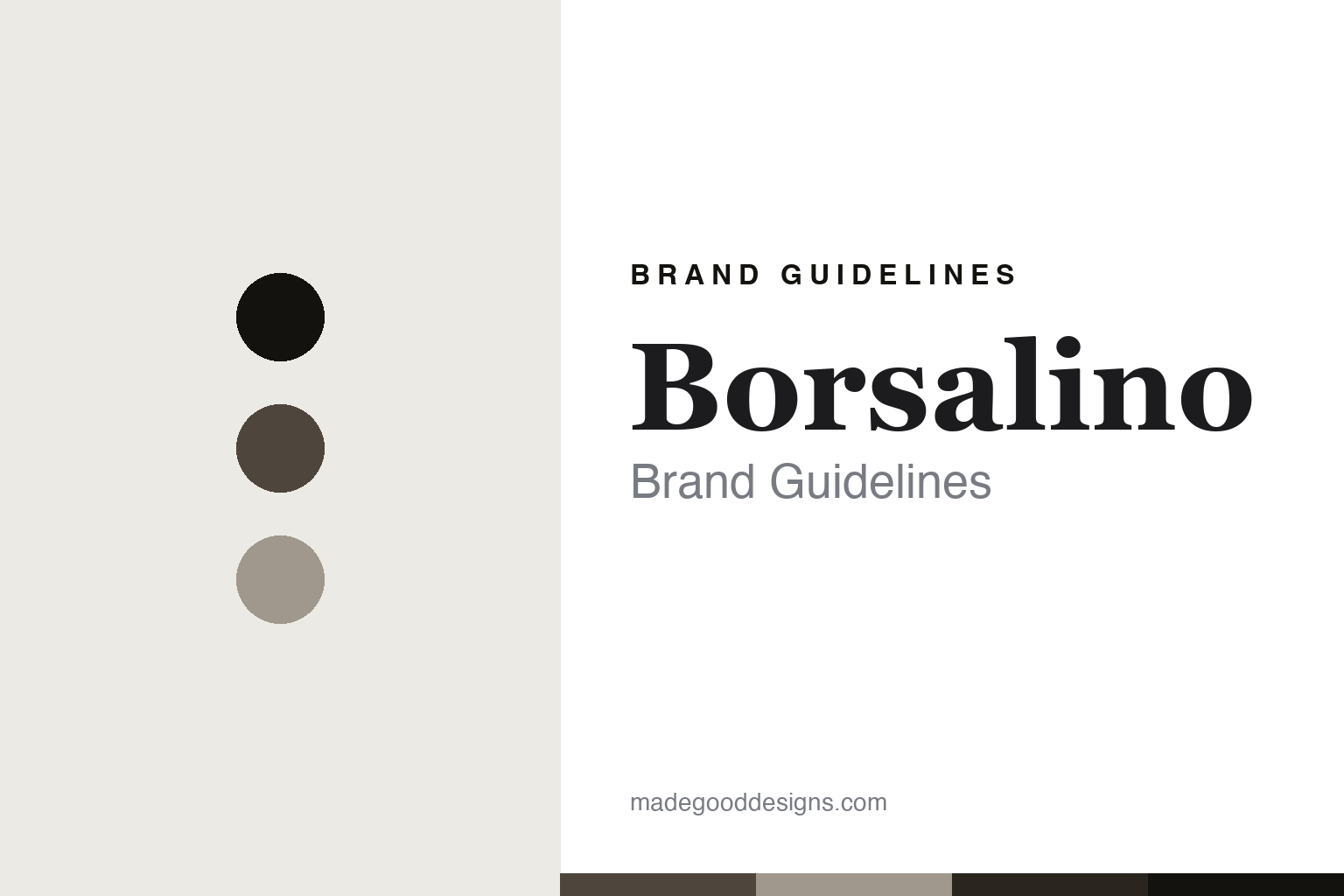
Borsalino Brand Guidelines
The felt fedora.
Aa
Two constants: a felt-brown palette and a cinema-serif register. Abstract homage — not a Borsalino hat, label or hatband.
The felt fedora
Borsalino is the Italian felt-fedora house from Alessandria since 1857, a symbol of 20th-century elegance, revived under Haeres Equita.
Borsalino is a lesson in how a hat is made a symbol. From Alessandria, in Piedmont, it has made felt hats since 1857 — and the soft felt fedora it perfected became so identified with the house that Italians call any such hat “un borsalino.” Its answer to how a hat is made is patient craft: turn rabbit-fur felt into a hat through dozens of hand steps over weeks. A hat that became the word for the thing itself.
Its identity is the felt-fedora house. Borsalino’s fur-felt fedora, and its place in 20th-century elegance and cinema, are the work it is known for. A hat, made a legend. A house whose name became a common noun.
(Honest notes, so the story stays precise. Borsalino makes its hats in the Alessandria area of Piedmont — production sits at Spinetta Marengo, on the outskirts of the city — genuine Italian manufacture; a felt hat takes over fifty manual steps and around seven weeks, and fine straw far longer. It was founded on the fourth of April, 1857, by Giuseppe Borsalino (his brother Lazzaro is sometimes co-credited). One honest point on the modern house: it went through hard times — the company was declared bankrupt in December 2017, and was bought at a court auction in July 2018 by Haeres Equita, the private-equity vehicle led by Philippe Camperio, so we describe the current house as the revived Borsalino under Haeres Equita rather than an unbroken firm. The 1970 film Borsalino is named after the hat, not made by the company. Its name, script logo, sweatband and box are its IP, described but never reproduced, and there is no official brand hex — these tones are an unofficial interpretation. This is design commentary and does not promote any product.)
Colour
Borsalino lives in a felt-brown palette. Click a swatch to copy the hex.
Borsalino’s identity is elegant, classic and Italian — a felt brown, an ink, a stone, an umber, and a paper. The palette leans felt brown and stone: the register of fur-felt and a cinematic elegance. It signals craft and heritage over flash. The honest caveat: with no published brand hex, these values are an original, unofficial interpretation, not first-party colours — an abstract nod to felt, not a sampled hat.
The lesson is a felt-brown palette signals a fedora, made-in-Piedmont identity. Borsalino’s world is a hand-crafted, felt, Italian object. For designers, it is a reminder that a soft felt brown and a warm stone can carry a brand built on a single hat — the brown of fur-felt and the neutral of a hatbox. Because these tones can fail as small text, keep type dark and let the colour live in the accents, palette and band. The takeaways: perfect one hat; craft it by hand; be honest about the revival; and treat any single hex as unofficial.
Typography
The register is a cinema serif — elegant, classical, timeless.
Borsalino’s identity carries an elegant, classical, timeless spirit — a house of the silver screen, not a fast brand. A cinema serif captures the mood: refined, storied and graceful, the register of a hat tied to 20th-century glamour. Set in a felt-brown palette, the cinema serif feels elegant and classical — exactly the personality Borsalino carries. It is timeless rather than trendy, mirroring a hand-made fedora. (Borsalino’s real labels and marks are things we describe but do not reproduce, and the exact typeface is not ours to use.) Because it is not ours to use, the honest description is “a cinema-serif spirit,” shown here in a stand-in. The type behaves like the house: elegant, classical and timeless.
Aa
A cinema-serif spirit — elegant and classical. (Specimen set in Playfair Display, a cinema-serif STAND-IN; NOT the Borsalino wordmark or any label.)
The hat houses
Borsalino stands for the felt fedora, honestly revived.
Borsalino is a lesson in how a hat becomes the whole identity. A felt-brown palette, a cinema serif and a fur-felt fedora make one thing — a hat so definitive it became a word — the whole house: elegant, classic and Italian. The felt craft is the differentiator, and the fedora is the meaning. The point is a house that perfected one hat over more than a century, and whose name entered the language as a synonym for it.
Put to work, the identity is a single perfected object as design. A hat house in this spirit would master one signature hat, craft it by hand in its home region, and be honest about its recent history — a bankruptcy and a revival, not an unbroken dynasty. A brand learning from it would see that owning one definitive object is a durable identity — that a hat that became a common noun is a rare kind of brand power — and that being precise, founded 1857, made in the Alessandria area, revived under Haeres Equita since 2018, keeps the heritage honest rather than mythologised. A brand learning from it would also let the craft itself, seven weeks and fifty steps for a felt hat, carry the story, since the labour is the luxury. A brand learning from it would also see that a name entering the language is both a gift and a trap: when a trademark becomes an everyday word, the house must keep defending the mark even as it enjoys the fame, and the honest move is to treat the common word and the protected label as two different things rather than letting the genericised term erode the brand. The lesson Borsalino teaches is that a single perfected hat can hold an identity: the felt craft gives it substance, and the fedora gives it fame. The hat is the personality, and the felt is the proof.
For designers and brand-builders, Borsalino opens this new vein of the hat houses, from Italy: perfect one object, and tell the revival honestly. The lessons: master a signature hat; craft it at home; disclose the bankruptcy and revival; and never reproduce a protected label. It is also a reminder to stay precise: Borsalino is the Italian felt-fedora house from Alessandria since 1857, revived under Haeres Equita — with the palette here an unofficial interpretation. Borsalino made the fedora the identity — proof that one perfected hat, honestly told, can be the difference.
Explore & save
Keep Borsalino’s identity on hand — save it to a board in the Made Good inspiration library.
Borsalino identity set
Pin the felt-brown palette and the cinema-serif register to your own board.