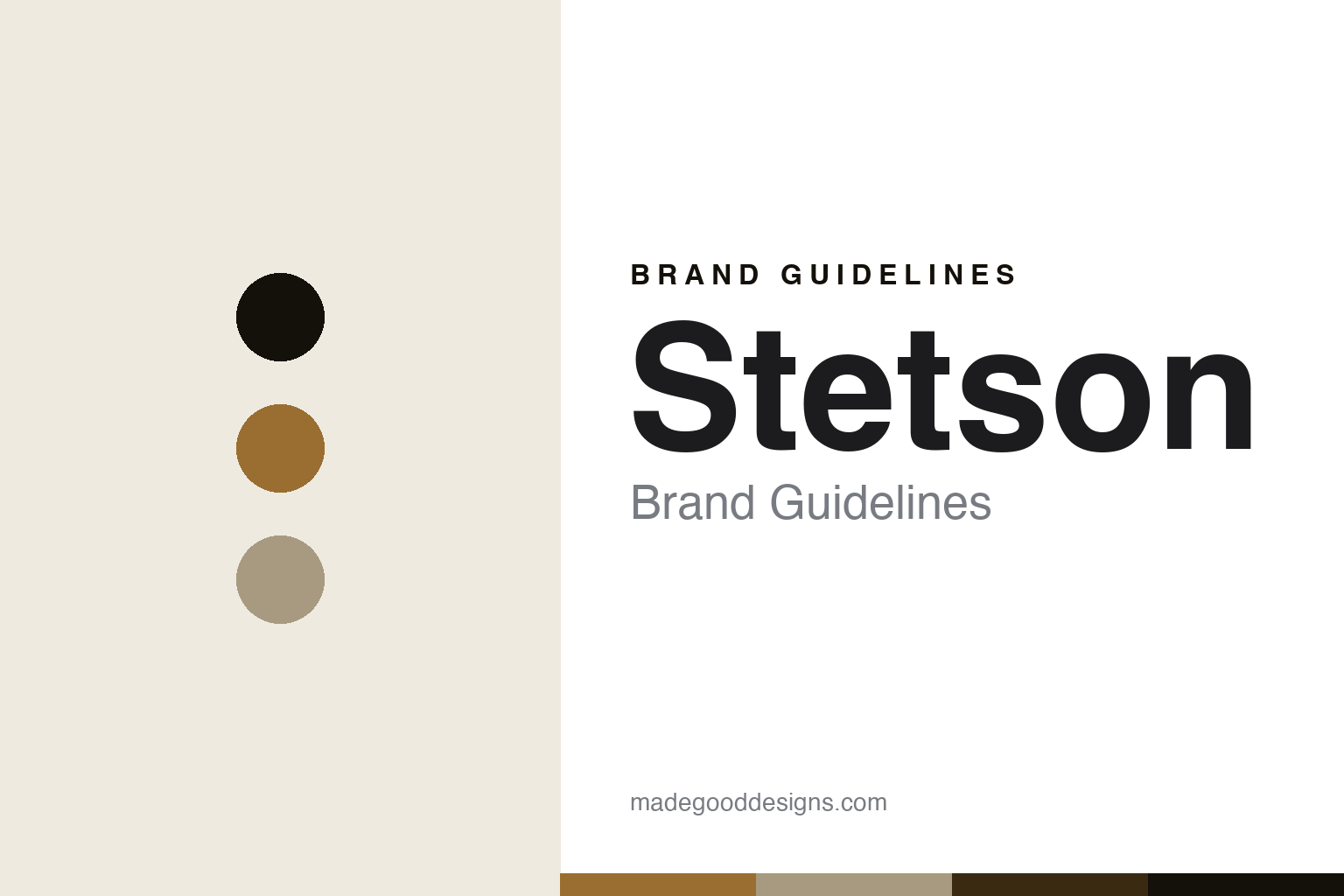
Stetson Brand Guidelines
The cowboy hat.
Aa
Two constants: a buckskin-ochre palette and a Western-sans register. Abstract homage — not a Stetson hat, label or hatband.
The cowboy hat
Stetson is the American hat name behind the “Boss of the Plains” cowboy hat since 1865, today a licensing brand with hats made in Texas.
Stetson is a lesson in how a hat becomes a national symbol. In 1865, John B. Stetson made the “Boss of the Plains” — the wide-brimmed felt hat that became the archetype of the American cowboy hat and a symbol of the West. His name became a byword for the cowboy hat itself. Its answer to how a hat is made a symbol is American: build a rugged, practical felt hat for the frontier, and let it come to stand for a whole nation’s idea of itself. A hat that means “the West.”
Its identity is the American cowboy hat. Stetson’s Boss of the Plains and its Western felt hats are the work it is known for. A hat, made a legend of the frontier. A name that means cowboy.
(Honest notes, so the story stays precise, because the modern reality differs from the myth. Stetson was founded in 1865 by John B. Stetson (born in Orange, New Jersey, the son of a hatter) in Philadelphia, where the company became the world’s largest hatmaker. But — the key honest point — Stetson no longer makes its own hats: production ceased in 1968 and the Philadelphia factory closed in 1971, and Stetson has since operated as a licensing brand. Its US Western and felt hats are made under license in Garland, Texas, by the hat maker there (alongside names like Resistol), and the Stetson name is separately licensed across cologne, apparel, boots, eyewear and even bourbon; a distinct Stetson Europe operates in Germany. So we never say the hats are still “made by the John B. Stetson Company.” The Boss of the Plains is the widely credited progenitor of the cowboy hat, not the sole inventor of all cowboy hats. Its name, script logo and trade dress are its IP, described but never reproduced, and there is no official brand hex — these tones are an unofficial interpretation. This is design commentary and does not promote any product.)
Colour
Stetson lives in a buckskin-ochre palette. Click a swatch to copy the hex.
Stetson’s identity is rugged, American and iconic — a buckskin ochre, an ink, a sand, a bronze, and a paper. The palette leans buckskin and sand: the register of a Western felt hat and a frontier landscape. It signals the American West over European refinement. The honest caveat: with no published brand hex, these values are an original, unofficial interpretation, not first-party colours — an abstract nod to buckskin felt, not a sampled hat.
The lesson is a buckskin palette signals a cowboy-hat, Western identity. Stetson’s world is a rugged, felt, American object. For designers, it is a reminder that a warm buckskin ochre and a soft sand can carry a brand built on the West — the tan of a Western felt and the neutral of dry plains. Because these tones can fail as small text, keep type dark and let the colour live in the accents, palette and band. The takeaways: own the symbol; be honest about licensing; credit the archetype; and treat any single hex as unofficial.
Typography
The register is a Western sans — bold, plain, rugged.
Stetson’s identity carries a bold, plain, rugged spirit — a symbol of the West, not a fine-milliner’s house. A Western sans captures the mood: strong, direct and unadorned, the register of a frontier hat. Set in a buckskin palette, the Western sans feels bold and rugged — exactly the personality Stetson carries. It is plain-spoken rather than ornate, mirroring a practical felt cowboy hat. (Stetson’s real labels and marks are things we describe but do not reproduce, and the exact typeface is not ours to use.) Because it is not ours to use, the honest description is “a Western-sans spirit,” shown here in a stand-in. The type behaves like the name: bold, plain and rugged.
Aa
A Western-sans spirit — bold and rugged. (Specimen set in Space Grotesk, a Western-sans STAND-IN; NOT the Stetson wordmark or any label.)
The hat houses
Stetson stands for the cowboy hat, honestly licensed.
Stetson is a lesson in how a hat name can outgrow its factory. A buckskin palette, a Western sans and a felt cowboy hat make one thing — the archetypal hat of the American West — the whole name: rugged, American and iconic. The Boss of the Plains is the differentiator, and the frontier symbolism is the meaning. The point is a name so powerful it became the word for the cowboy hat — even as the company stopped making hats and became a licensor.
Put to work, the identity is a symbol, honestly managed, as design. A hat name in this spirit would steward a genuine icon, and be candid about the modern reality — a licensing brand, not a maker; hats made in Texas under license; the name lent to cologne and bourbon. A brand learning from it would see that a powerful symbol is a durable identity — that a name meaning “the West” is worth stewarding carefully — and that being precise, founded 1865, production ended 1968 and the Philadelphia factory closed 1971, now a licensing brand with hats made in Garland, Texas, keeps the story honest rather than trading on a factory that no longer exists. A brand learning from it would also credit the icon accurately: the Boss of the Plains is the progenitor of the cowboy hat, not the only cowboy hat ever made. The lesson Stetson teaches is that a symbol can hold an identity: the icon gives it power, and the honesty about licensing keeps it credible. The symbol is the personality, and the cowboy hat is the proof.
For designers and brand-builders, Stetson holds the American-icon pole in this round of the hat houses, from the United States: steward a symbol, and be honest about licensing. The lessons: own the icon; disclose the licensing model; say where the hats are actually made; credit the archetype precisely; and never reproduce a protected label. It is also a reminder to stay precise: Stetson is the American hat name behind the Boss of the Plains since 1865, today a licensing brand with hats made in Texas — with the palette here an unofficial interpretation. Stetson made the cowboy hat the identity — proof that a symbol, honestly managed, can be the difference.
Explore & save
Keep Stetson’s identity on hand — save it to a board in the Made Good inspiration library.
Stetson identity set
Pin the buckskin palette and the Western-sans register to your own board.

