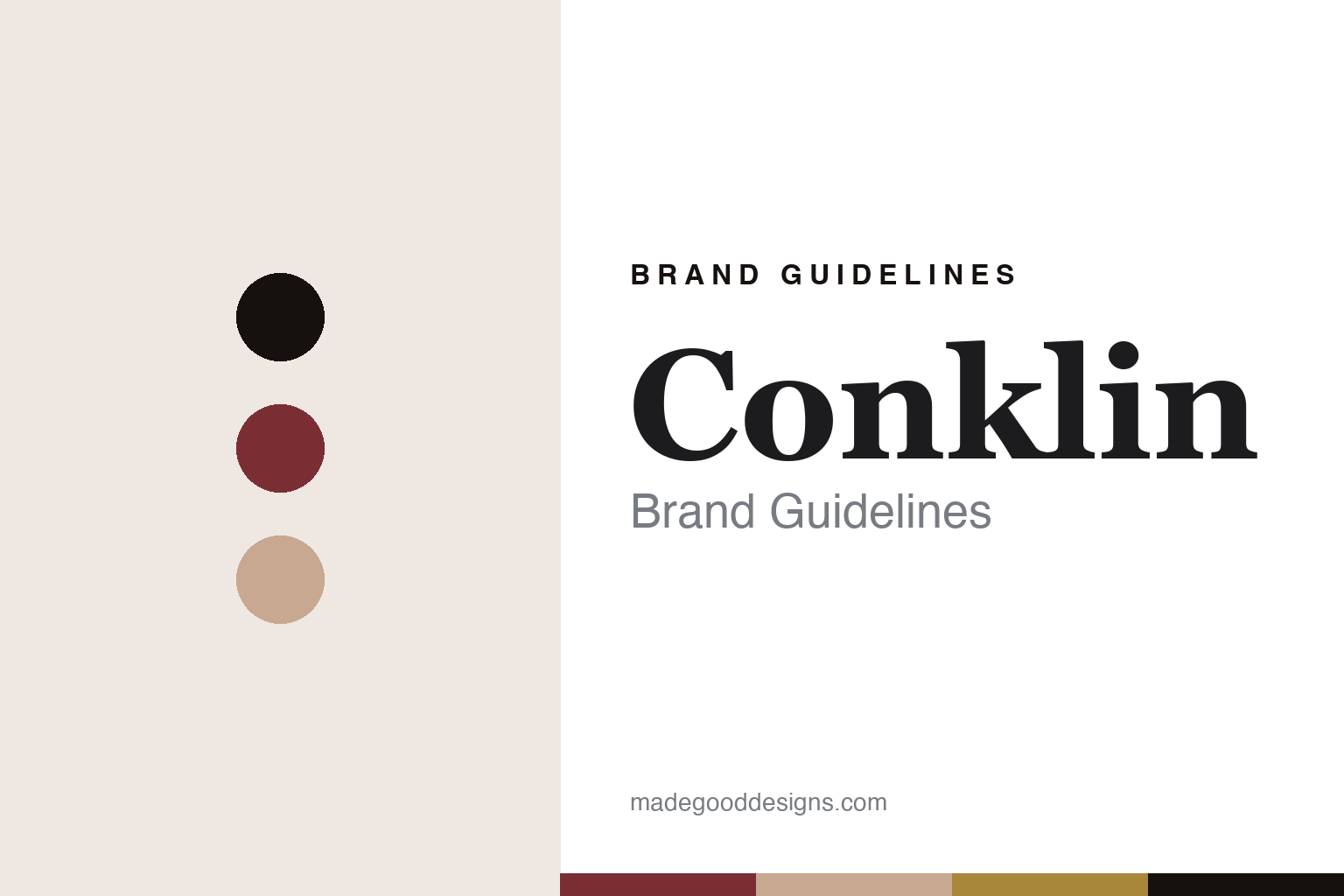
Conklin Brand Guidelines
The revived crescent.
Aa
Two constants: a heritage-burgundy palette and a heritage serif register. Abstract homage — not a Conklin pen or wordmark.
The revived crescent
Conklin is an 1898 American pen name — the crescent filler, Mark Twain’s pen — revived and now made abroad.
Conklin is a lesson in a revived heritage name as the identity. An 1898 American pen name — inventor of the crescent-filler and once endorsed by Mark Twain — it went silent for decades, then was brought back as a heritage revival, its old story on modern pens. A name, given a second life.
Its identity is the revived crescent. Conklin’s heritage — the crescent filler and the Mark Twain endorsement — carried on new pens is the work it is known for. A history, made a signature. A name older than most of its rivals, revived.
(Honest notes, so the story stays precise. Conklin was founded in 1898 in Toledo, Ohio, by Roy Conklin, whose crescent-filler was among the first practical self-filling pens, and Mark Twain became its spokesperson in 1903; production went silent around 1955. It is not the original company: the name was revived and is owned today by the Yafa Pen Company of California, which also owns Monteverde. On where it is made we are precise: it is an American heritage name, owned and designed in California, but its modern pens are manufactured abroad, in Asia — so we describe it that way, never as “made in the USA.” Its designs and the Mark Twain and crescent-filler names are its owner’s IP, described but never reproduced, and there is no official brand hex — these tones are an unofficial interpretation. This is design commentary and does not promote any product.)
Colour
Conklin lives in a heritage-burgundy palette. Click a swatch to copy the hex.
Conklin’s identity is heritage, warm and American — a heritage burgundy, an ink, a blush, a gold, and a cream. The palette leans heritage burgundy and gold: the register of a turn-of-the-century American pen name. It signals history and warmth over novelty. The honest caveat: with no published brand hex, these values are an original, unofficial interpretation, not first-party colours.
The lesson is a heritage-burgundy palette signals a heritage, American identity. Conklin’s world is a revived, heritage, storied object. For designers, it is a reminder that a deep burgundy and a warm gold can carry a brand built on a revived name — the burgundy of a vintage pen and the gold of an old trim. Because these tones can fail as small text, keep type dark and let the colour live in the accents, palette and band. The takeaways: revive the name; honour the history; be honest where it is made; and treat any single hex as unofficial.
Typography
The register is a heritage serif — classical, warm, storied.
Conklin’s identity carries a classical, warm, storied spirit — a heritage object, not a modern one. A heritage serif captures the mood: high-contrast, warm and old, the register of a name from 1898. Set in a heritage-burgundy palette, the heritage serif feels classical and storied — exactly the personality Conklin carries. It is warm rather than new, mirroring a revived vintage pen. (Conklin’s real designs and wordmark are things we describe but do not reproduce, and the exact typeface is not ours to use.) Because it is not ours to use, the honest description is “a heritage-serif spirit,” shown here in a stand-in. The type behaves like the maker: classical, warm and storied.
Aa
A heritage-serif spirit — classical and storied. (Specimen set in Playfair Display, a heritage-serif STAND-IN; NOT the Conklin wordmark or any pen design.)
A revived heritage name as identity
Conklin stands for the revived crescent.
Conklin is a lesson in making a revived heritage name the identity. A heritage-burgundy palette, a heritage serif and its crescent-filler story make an old American name the whole maker — heritage, warm and storied. The name is the differentiator. The differentiator is a genuine history — an 1898 pioneer of the self-filling pen, endorsed by Mark Twain, brought back to life after decades of silence.
Put to work, the identity is a revived name as design. A maker building in this spirit would treat a dormant name as an asset worth reviving, carry its real history forward, and be honest that it is a revival rather than the original firm, so the customer buys into a genuine story rather than a costume. It would let the crescent filler and the Twain endorsement anchor the brand. It would never dress overseas-made pens as American-made. The lesson Conklin teaches is that a revived name can build a brand: the history gives it weight, and the honesty keeps it credible. The name is the personality, and the story is the proof.
For designers and brand-builders, Conklin offers a clear takeaway: revive a name honestly, and own where it is made. The lessons: carry the history; honour the invention; be honest about ownership and origin; and never overclaim a country. It is also a reminder to stay precise: Conklin is an American pen name founded in 1898 in Toledo, revived and owned by Yafa, designed in California but made abroad — with the palette here an unofficial interpretation. Conklin made the revived crescent the maker — proof that a revived name, told honestly, can be the difference.
Explore & save
Keep Conklin’s identity on hand — save it to a board in the Made Good inspiration library.
Conklin identity set
Pin the heritage-burgundy palette and the heritage-serif register to your own board.