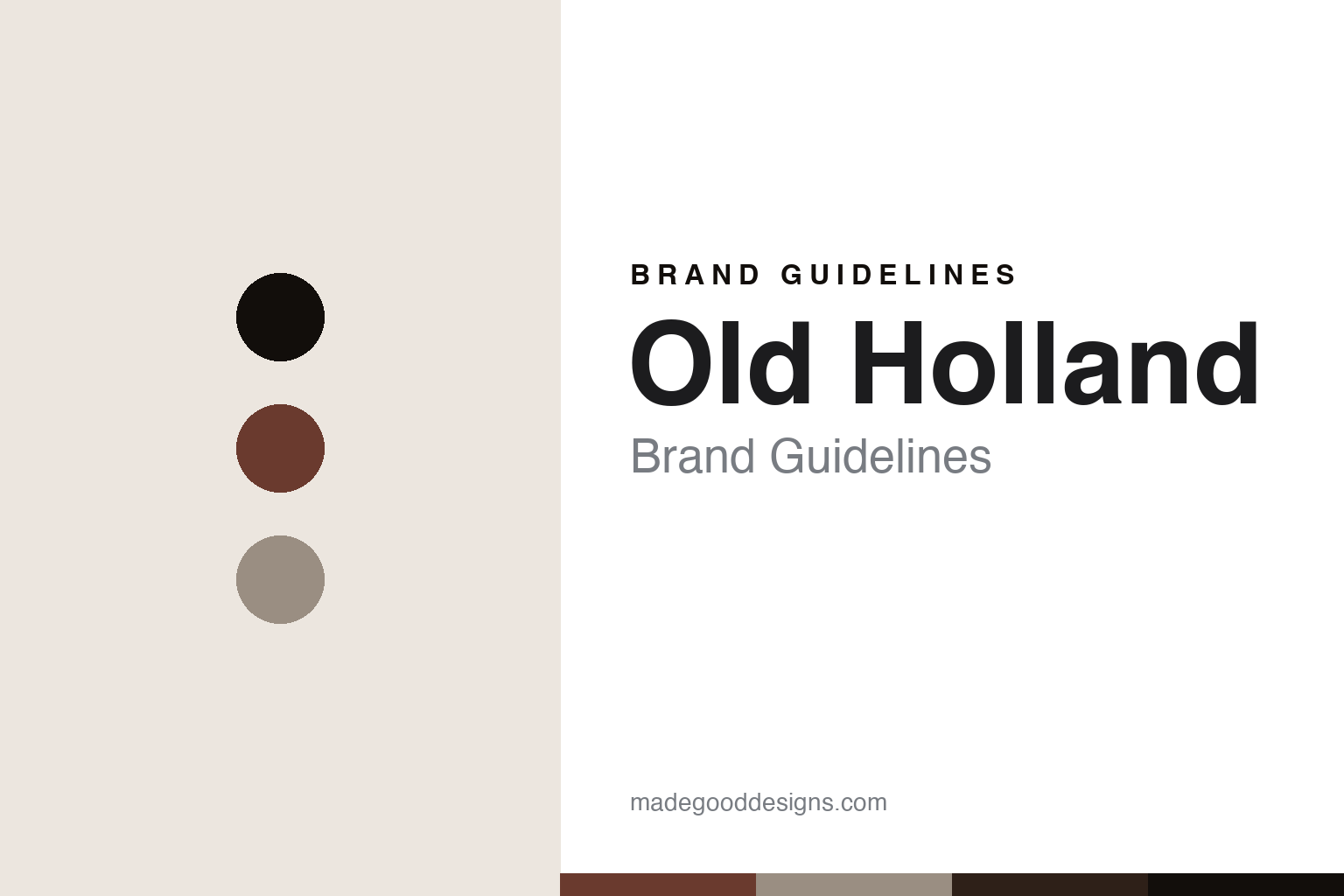
Old Holland Brand Guidelines
The paint of the Old Masters.
Aa
Two constants: a madder-brown palette and a masters-sans register. Abstract homage — not an Old Holland colour, label or wordmark.
The paint of the Old Masters
Old Holland is the Dutch maker of high-pigment classic oils, tracing a colour-making tradition to 1664 and revived by the de Beer family.
Old Holland is a lesson in how a colour is made the way the Old Masters had it. From Driebergen, in the Netherlands, it makes classic oil colours loaded with the maximum pigment the oil will hold, ground with cold-pressed linseed oil — colours meant to match the depth of the Dutch Masters’ palette. Its answer to how a colour is made is uncompromising: pack in the pigment, grind it well, and let the colour do the work. A paint made for saturation, not economy.
Its identity is the high-pigment classic oil. Old Holland’s maximum pigment load, its Dutch making and its Old-Masters lineage are the work it is known for. A tradition, carried forward. A house that makes the paint of the Masters.
(Honest notes, so the story stays precise, because the heritage claim needs care. Old Holland makes its colours in Driebergen, in the Netherlands — genuine Dutch manufacture — and markets a colour-making tradition “since 1664,” which it traces to painters of the Guild of Saint Luke in The Hague who made their own paint. That 1664 is a heritage lineage, not an unbroken company: the thread runs through later owners and was revived by Theo de Beer in 1982, with his son Edward leading since 2000 — so we describe it as a modern family firm carrying a tradition traced to 1664, not a continuously operating 17th-century business. It is often called “the oldest paint maker in the world,” but the company itself does not make that claim, so we do not assert it. It is family-owned and independent, known for a very high pigment concentration in its classic oils. Its logo, labels and colour names are its IP, described but never reproduced, and there is no official brand hex — these tones are an unofficial interpretation. This is design commentary and does not promote any product.)
Colour
Old Holland lives in a madder-brown palette. Click a swatch to copy the hex.
Old Holland’s identity is Dutch, classical and saturated — a madder brown, an ink, a linen, an umber, and a paper. The palette leans madder brown and linen: the register of a deep, pigment-heavy oil and a Dutch Masters palette. It signals depth and tradition over brightness for its own sake. The honest caveat: with no published brand hex, these values are an original, unofficial interpretation, not first-party colours.
The lesson is a madder-brown palette signals a high-pigment, Old-Masters identity. Old Holland’s world is a saturated, cold-pressed-linseed, Dutch-made object. For designers, it is a reminder that a deep madder and a soft linen can carry a brand built on saturation — the brown of an aged master’s canvas and the linen of the ground. Because these tones can fail as small text, keep type dark and let the colour live in the accents, palette and band. The takeaways: load the pigment; grind it well; date the tradition honestly; and treat any single hex as unofficial.
Typography
The register is a masters sans — even, classical, grounded.
Old Holland’s identity carries an even, classical, grounded spirit — a traditional colour house, not a trend. A masters sans captures the mood: calm, sober and rooted, the register of an Old-Masters palette. Set in a madder-brown palette, the masters sans feels even and classical — exactly the personality the house carries. It is grounded rather than showy, mirroring a deep, pigment-heavy oil. (Old Holland’s real labels and marks are things we describe but do not reproduce, and the exact typeface is not ours to use.) Because it is not ours to use, the honest description is “a masters-sans spirit,” shown here in a stand-in. The type behaves like the house: even, classical and grounded.
Aa
A masters-sans spirit — even and classical. (Specimen set in Libre Franklin, a masters-sans STAND-IN; NOT the Old Holland wordmark or any label.)
How a colour is made
Old Holland stands for a tradition carried, honestly dated.
Old Holland is a lesson in how a colour is made to a Masters’ standard, and a heritage dated honestly. A madder-brown palette, a masters sans and a high-pigment oil make one thing — a saturated classic colour ground the old way — the whole house: Dutch, classical and saturated. The maximum pigment load is the differentiator, and the honestly-told tradition is the meaning. The point is a colour made without compromise on pigment, in the Netherlands, by a family carrying a colour-making tradition it traces to 1664.
Put to work, the identity is heritage carried honestly as design. A colour house in this spirit would load its pigment to the maximum, keep the making at home, and be candid that a “since 1664” tradition is a lineage revived, not an unbroken firm. It would decline a superlative it cannot prove. A brand learning from it would see that a deep heritage is a durable identity — that “the paint of the Old Masters” is a powerful, evocative claim — but only if dated truthfully: a tradition traced to 1664, a family revival in 1982, and no unearned “oldest in the world.” A brand learning from it would also let the product itself, the sheer pigment load, back the heritage rather than rely on the date alone. The lesson Old Holland teaches is that a high-pigment craft plus an honest heritage can hold an identity: the pigment gives it substance, and the tradition, dated truthfully, gives it depth. The craft is the personality, and the saturated colour is the proof.
For designers and brand-builders, Old Holland holds the heritage pole in this round about how a colour is made: load the pigment, and date the tradition honestly. The lessons: maximise the pigment; make it at home; call a lineage a lineage; and never reproduce a protected label or claim an unproven superlative. It is also a reminder to stay precise: Old Holland is a Dutch maker of high-pigment classic oils in Driebergen, carrying a colour-making tradition traced to 1664 and revived by the de Beer family in 1982 — with the palette here an unofficial interpretation. Old Holland made saturation the identity — proof that pigment, and an honestly dated heritage, can be the difference.
Explore & save
Keep Old Holland’s identity on hand — save it to a board in the Made Good inspiration library.
Old Holland identity set
Pin the madder-brown palette and the masters-sans register to your own board.